Roughly 321,409 new websites are added to the internet every day. That works out to about 13,392 an hour, 223 a minute, and four every second.
The figures come from the web statistics service Sitefi, and the growth rate is about 23 per cent lower than in earlier periods.
The total, and the number underneath it
As of September, there were 1,474,005,351 websites worldwide, up from 1,337,528,194 in September 2025.
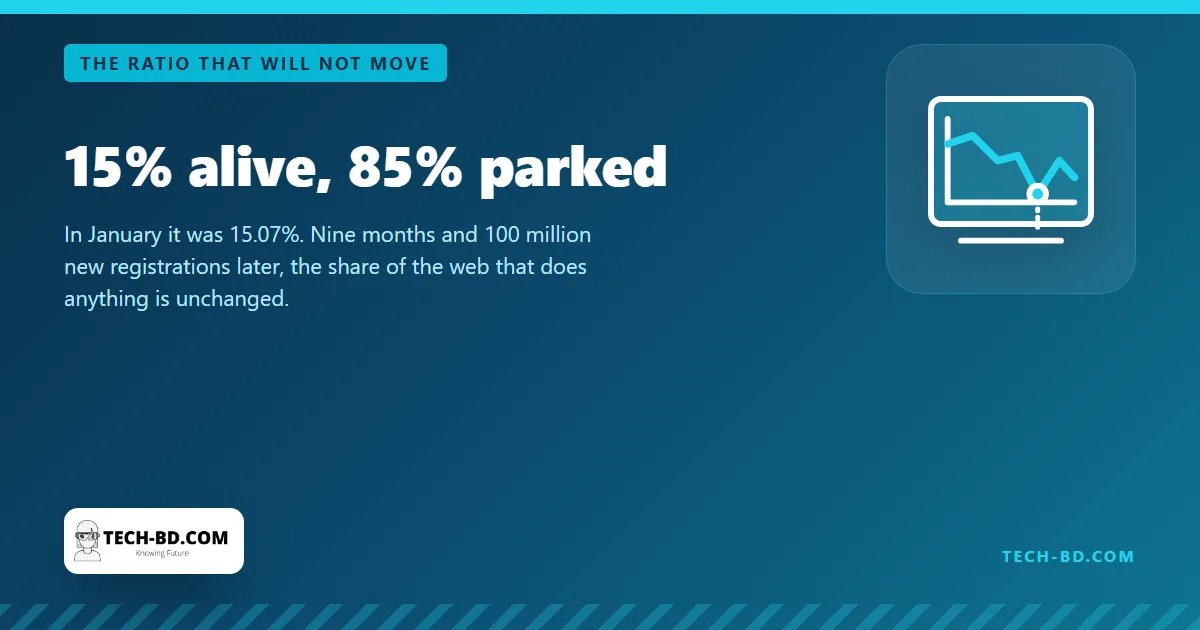
But only 217,569,803 of them were active — about 15 per cent. The other 1,252,865,548, roughly 85 per cent, are inactive: mostly parked domains and similar holdings. That is about 5.8 dead sites for every live one.
The ratio is remarkably stable. In January 2026 the total was 1,376,952,390, of which 207,532,573 were active — 15.07 per cent. Nine months and nearly a hundred million new registrations later, the share of the web that actually does anything has not moved.
What "parked" actually means
A parked domain is a name somebody registered and never built on. Some are held for a project that never happened. Many are held by speculators waiting to resell. Some exist only to catch typing mistakes made by people aiming for a different site.
This is worth understanding because of how often the 1.47 billion figure is quoted as a measure of the web's size. It is really a measure of how many names have been bought. The web people actually use is the 217 million.
Where it all sits, and in what language
By server location, the United States hosts 33.2 per cent of websites and Germany is second with 16.1 per cent. Half the web, by that measure, sits in two countries.
By language, English accounts for 49.5 per cent of websites, followed by Spanish (6 per cent), German (5.9), Japanese (4.9) and French (4.6).
And here is the figure worth stopping on: more than 7,000 languages exist, but fewer than 200 have any digital presence at all.
Why that last number matters here
Bangla is one of the most widely spoken languages on earth and does not appear in that top-five list anywhere. Being among the 200 with a presence is not the same as being well served by it.
It is the same shortage that shows up every time an AI voice feature or a translation tool launches in English first: the training data follows the web, and the web is overwhelmingly English. Every Bangla site that gets built is a small correction to that imbalance — which is a better reason to publish in Bangla than search traffic alone.
Two more numbers for scale
About 6 billion people — around 74 per cent of the world — were online in 2025, up from 5.8 billion in 2024.
The web first passed 1 billion sites in September 2014, then fell back below that mark for about eighteen months before crossing it again in March 2016. That dip is a useful reminder that domains expire as well as appear.
And one platform still carries an extraordinary share of what is actually published: WordPress powers 39.4 per cent of websites.