Forget water. An Ohio company says it has found a way to fight fires with sound waves — extinguishing a blaze without drenching the home or business it is saving.
Sonic Fire Tech has developed a system it says can put out fires using low-frequency sound, without drawing on strained municipal water supplies and without causing water damage.
The problem it is aimed at
Each year there are around 330,000 home fires in the United States, resulting in about 2,600 civilian deaths. The number of home fires has roughly halved since 1980 — but firefighters today face a different mix of them.
Modern homes see more grease fires, because far more people cook with oil than in the past. And lithium-ion batteries are now everywhere: the US Department of Commerce says they have caused more than 200,000 fires since 2011.
Those two categories matter here because they are the ones water handles worst. Water on a grease fire can spread it violently. A lithium-ion cell in thermal runaway generates its own heat and oxygen and can reignite long after it appears out.
Why sound can move a flame at all
The underlying idea is not new, and it is worth stating plainly because "sound puts out fire" sounds like a trick.
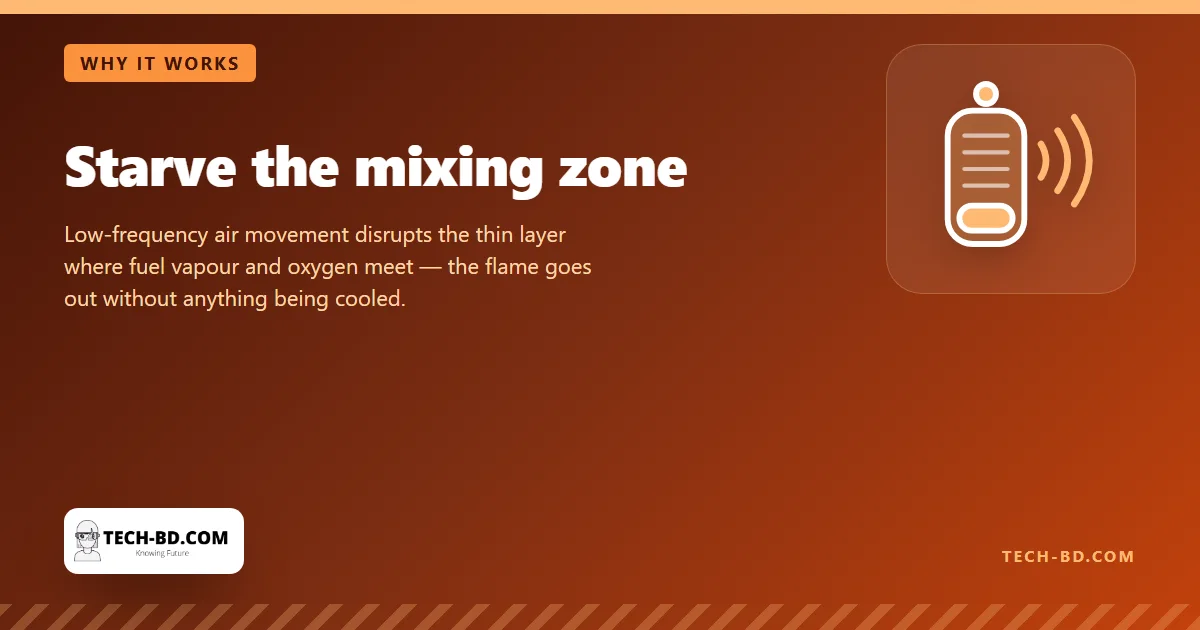
A flame needs a steady supply of oxygen arriving at the fuel. Sound is a pressure wave — air moving back and forth. At low frequencies the air displacement per cycle is large, and pushing air rapidly across the base of a flame disrupts the thin boundary layer where fuel vapour and oxygen actually mix. Starve that mixing zone and the flame goes out, without anything being cooled or soaked.
The hard part has never been the physics. It is doing it at the scale of a room rather than a laboratory bench, and keeping the fire out once the sound stops.
The caveat worth keeping
That last point is the one to watch as this technology is marketed. Disrupting a flame is not the same as removing the heat that created it. If the fuel and the surrounding material are still above ignition temperature, there is nothing to stop re-ignition once the pressure wave is gone — which is precisely why water, for all its mess, has never been fully replaced: it carries heat away.
A sound-based system is therefore most convincing as a fast first response in a confined space, or as a layer alongside conventional suppression, rather than as a replacement for a fire engine.
What it would mean here
For Bangladesh the appeal is specific. Dense urban housing means a fire in one flat damages several, and much of that damage is water from fighting it. Kitchen oil fires are common. Lithium-ion packs are multiplying fast in e-bikes, rickshaws, power banks and the battery backups that carry households through load-shedding — and those are stored indoors, often in stairwells.
A suppression method that does not ruin everything it touches, and that targets exactly the fires that are growing, is worth following. It is early, the company's claims are its own, and the re-ignition question is unanswered. But the direction is the right one.