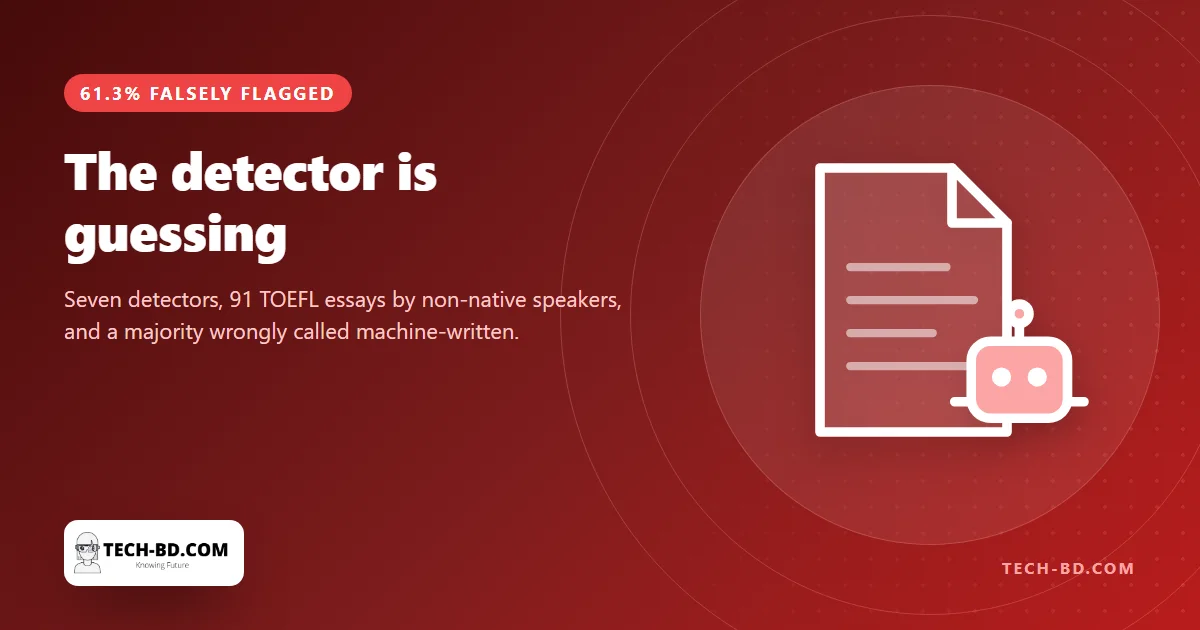
A university student in Dhaka — called Nusrat, a pseudonym — submitted an English assignment she had written by hand. Her teacher told her a detector had flagged it as AI-written. She had not used AI.
The research suggests this was not bad luck. It is what these tools do to people who learned English as a second language.
What the studies found
Stanford researchers tested seven popular detectors on 91 TOEFL essays written by non-native English speakers. On average, 61.3% were flagged as AI-written.
A separate test across 14 detectors found that none reached 80% accuracy.
Take those together. A tool that is wrong about the majority of a group is not a flawed tool being misapplied — it is a tool that produces the opposite of the right answer more often than not for that group.
Why it happens
Detectors guess whether text was machine-written by looking at writing style. Simple vocabulary and clean, regular sentences read as machine-like to them.
That is also a fair description of careful second-language English. People who learned English formally tend to write in shorter, more regular sentences, use a narrower and safer vocabulary, and make fewer of the idiomatic swerves a first-language writer makes without noticing.
The detector is not detecting AI. It is detecting a narrow band of stylistic variation, and penalising anyone who writes outside it. Students in Bangladesh, India, Nigeria and the Philippines are on the wrong side of that line by default.
Institutions have started saying so
A 2026 advisory from Mount Royal University in Canada warned that detectors can wrongly flag innocent students. A small study in the Philippines advised teachers not to treat a detector score as the only evidence.
Both stop short of banning the tools, and both land in the same place: a score is an input, not a finding.
If you are accused
The tutorial's advice is practical and worth following before you need it:
- Keep your drafts and writing history. Version history in Google Docs or Word, or dated drafts in a folder, is the strongest evidence there is — it shows the work being built.
- Explain how you wrote it. Walk the teacher through your sources, your notes and the order you worked in.
- Ask for human judgement, not just the score. Request that someone read the work against your earlier work.
What teachers should take from this
If you teach, the number to remember is that no detector tested reached 80% accuracy, and that the errors are not spread evenly — they fall hardest on the students with the least standing to argue back.
Using a score as evidence of misconduct, in a country where almost every student writes English as a second language, means accusing a predictable group of people of something most of them did not do.
One more reason the scores drift
There is a second problem beneath the accuracy figures: detectors are tuned against the models they were built to catch, and those models change every few months. A tool calibrated on last year's output is measuring a moving target, and nobody recalibrates a detector in a university's licence the way a model gets updated. So a score is not only uncertain — its uncertainty grows quietly over time, while the number it prints stays just as confident as it was on the day it was installed.