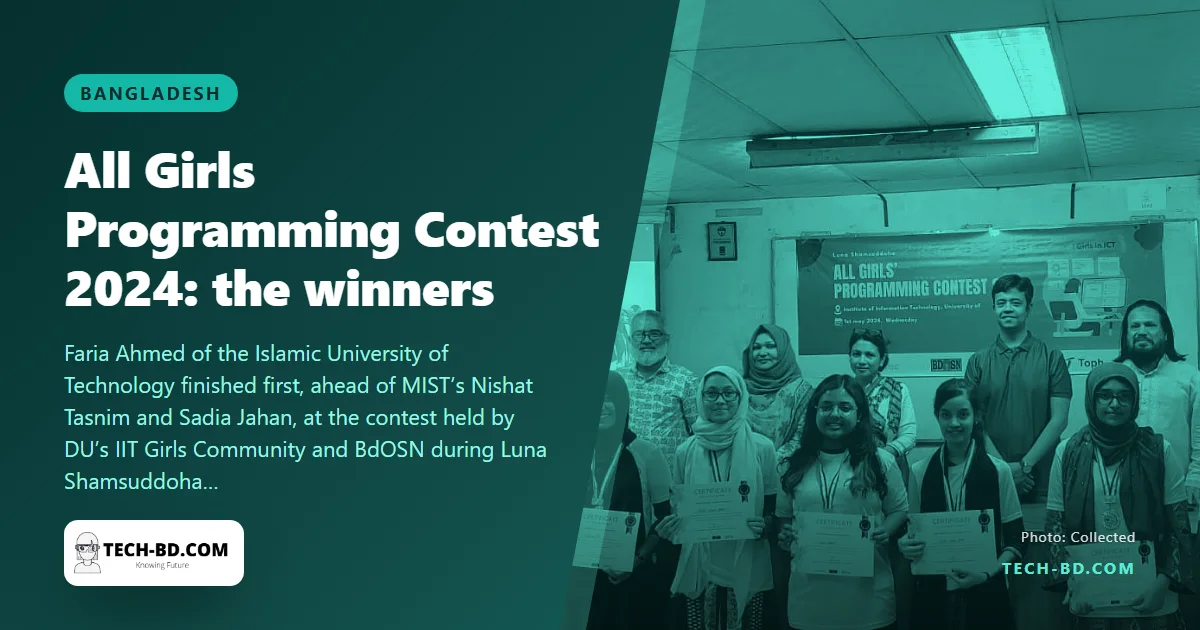
The All Girls Programming Contest, held on Wednesday at Dhaka University’s Institute of Information Technology, was won by Faria Ahmed of the Islamic University of Technology. Nishat Tasnim and Sadia Jahan, both of the Military Institute of Science and Technology, took second and third. At the school and college level the winner was S M Sabikun Mim of Jalalabad Cantonment Public School and College in Sylhet. The three top finishers received cash prizes; every winner received a certificate.
The top ten
Fourth to tenth were Umme Habiba (BUET), Atia Maisha (East West University), Taufika Bhuiyan (Jahangirnagar University), Mahrin Afroz and Nabiha Tahsin (both BUET), Lamia Rahman Khan (Jagannath University) and Meherin Nisha (North South University) — seven universities in the top ten, public and private, which is itself a sign of how far competitive programming has spread beyond BUET.
Who ran it, and why
The contest was organised by the IIT Girls Community of Dhaka University together with the Bangladesh Open Source Network (BdOSN), as part of Luna Shamsuddoha ICT Week. Luna Shamsuddoha, who died in 2021, founded Dohatec New Media in 1992, built the government’s e-procurement system and was the first woman to chair a state-owned bank in Bangladesh; BdOSN marks her memory each year with a week of events for women in technology. Professor Lafifa Jamal of DU’s robotics and mechatronics department said the contest exists to give women a place to show their coding skill and to compete against other coders; BdOSN general secretary Munir Hasan said it honours Shamsuddoha’s work for the country’s ICT sector.
Why a women-only contest
Because the open ones are not, in practice, open. Women are roughly a fifth of computer-science students in Bangladesh and a far smaller fraction of contest participants; at the national ICPC preliminaries a women’s team is rare enough to be photographed. The all-girls format works like a training ground — the same problems, the same judge, the same clock, without the crowd that persuades many first-year women that this is not for them. Its graduates turn up, a year or two later, in the mixed contests, which is the point.