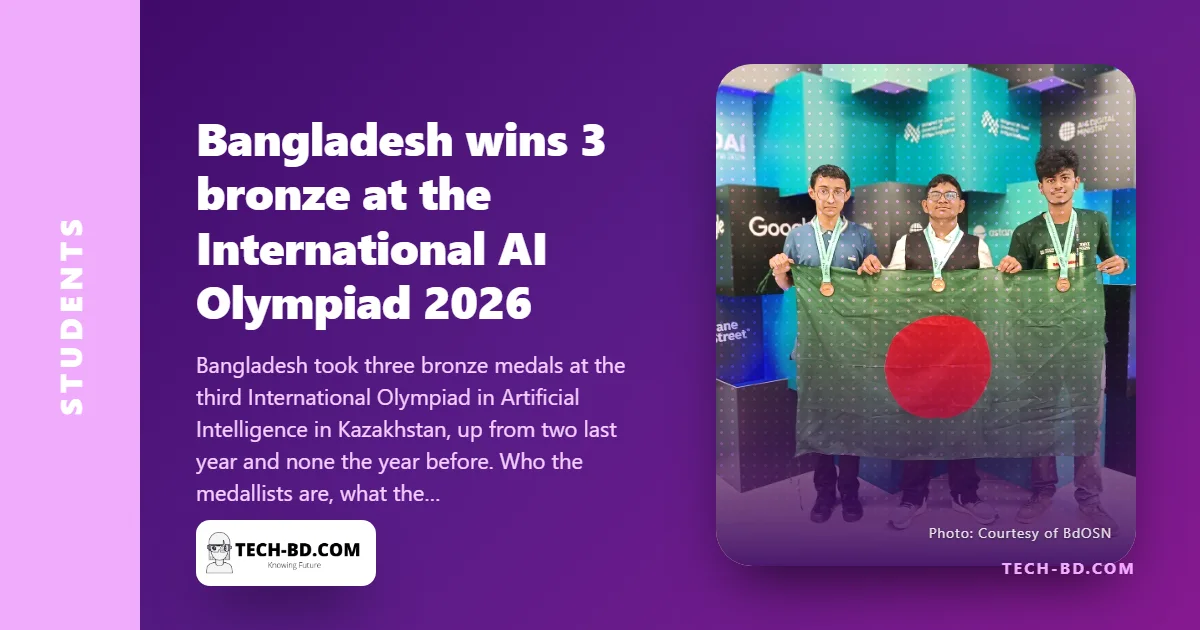
The International Olympiad in Artificial Intelligence is three years old, and Bangladesh's results trace a line through all three: no medals in Bulgaria in 2024, two bronzes in China in 2025, and three bronzes at IOAI 2026 in Astana. In a field of 437 competitors from 107 countries, that is a team improving on purpose.
The medallists
- Labib Shahriar, Class 10, Homna Adarsha High School, Cumilla
- Md Saiduzzaman, Class 11, Moulvibazar Government College
- Mobtasim Chowdhury, Class 11, Notre Dame College, Dhaka
The fourth team member was Ananya Zarif Akand, Class 11, Munnu International School and College, Manikganj. The team was led by Professor B M Mainul Hossain of the University of Dhaka's Institute of Information Technology and coached by Mohammad Azam Khan of Daffodil International University. Two of the four come from outside Dhaka, and one is still in Class 10.
What a six-hour machine-learning round actually involves
This is not a quiz about AI. Competitors sat two individual rounds, each six hours with three problems: given a dataset and a task, build and train a model that performs well on data they never see, writing real code under time pressure.
That format is fundamentally different from the older olympiads, and the difference is worth drawing out.
In a mathematics or informatics olympiad there is a correct answer. A proof is right or it is not; a program passes the test cases or it does not. The skill being measured is insight — seeing the trick that makes a hard problem tractable.
In a machine-learning round there is no correct answer, only a score, and you cannot see it while you work. You are optimising against held-out data, which means the thing you can measure during the contest is not the thing you are graded on. Every hour spent improving your visible score may be an hour spent fitting noise that will not survive the real test.
So the skills rewarded are different, and duller, and far closer to the job: cleaning data that arrives messy, choosing an approach proportionate to the time available, running disciplined experiments rather than guessing, keeping a baseline you can fall back to, and — the one that separates competitors most — knowing when to stop tuning. A student who builds something reasonable in two hours and spends four validating it reliably beats one who builds something ambitious at hour five.
That is unusually close to how the work is actually done, which makes this olympiad a better predictor of professional capability than most.
How a student gets there
The route runs through the Bangladesh AI Olympiad, organised by the Bangladesh Open Source Network. Activities began in April, regional rounds were held in May — in person in Dhaka, Chattogram and Rangpur, and online for Rajshahi, Khulna and elsewhere — and the national round took place on 16 May at Bangladesh University of Business and Technology, followed by training camps for the selected squad.
The structure deliberately mirrors the maths and informatics olympiads that produced Bangladesh's earlier international medals, and the online regional rounds are doing visible work: two of the four team members are from outside the capital, which is not what a Dhaka-only selection process produces.
The barrier this olympiad has that the others do not
Here is the structural point, and it decides how far this programme can go.
A mathematics olympiad needs paper. An informatics olympiad needs a computer that can run a compiler, which is to say almost any computer. Machine learning needs hardware that can train models, and a student practising seriously needs to run hundreds of experiments — which on a low-end laptop means waiting hours for each one, and in practice means not practising.
That is a capital requirement the older olympiads never had, and it falls hardest on exactly the students the regional rounds are designed to find. Free cloud notebooks close part of the gap and come with usage limits, queueing and a reliable internet connection as a prerequisite. A school computer lab with one capable machine closes more of it, and almost no school has one.
So the thing that would most improve the next three years is not better coaching. It is access to compute for the squad between selection and competition — which is cheap by the standards of any sponsor, unglamorous, and the actual constraint.
What the trend says
Professor Hossain was pleased but explicit that there is room to improve, and Saiduzzaman put the motivation plainly: a medal exists to inspire the students who come after.
The trend supports both readings. Zero, two, three is not yet a silver. It is the signature of a programme that knows what it is doing two years in, running against countries that have been building this pipeline for longer and with more equipment — and the gap that remains is more a question of practice hours on real hardware than of talent.