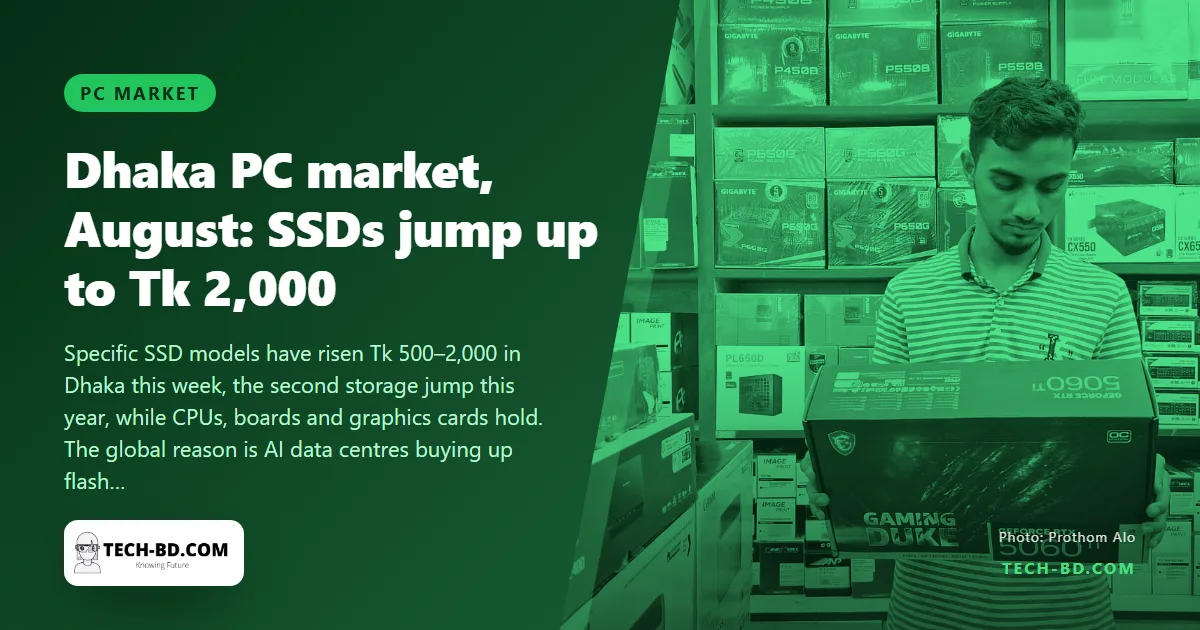
Anyone who read January's price report will feel a sense of repetition. This week, specific SSD models are Tk 500 to Tk 2,000 dearer in Dhaka's computer markets depending on brand and capacity — a sharper move than the Tk 500–1,000 rise seven months ago. Sellers again describe everything else as roughly stable.
The prices that have not moved
| Part | Model | Price (Tk) |
|---|---|---|
| CPU | Intel Core Ultra 9 285K | 72,000 |
| CPU | Intel Core i9, 14th gen | 56,000 |
| CPU | Intel Core Ultra 7 265K | 36,000 |
| CPU | Intel Core i7, 14th gen | 50,000 |
| CPU | Intel Core i5-14600KF | 38,000 |
| CPU | AMD Ryzen 9 7950X | 47,500 |
| CPU | AMD Ryzen 7 5700G | 23,500 |
| CPU | AMD Ryzen 5 5600G | 19,000 |
| Board | Asus Prime H610M (DDR4) | 10,600 |
| Board | Gigabyte B760M Gaming X (DDR4) | 20,000 |
| RAM | Corsair Vengeance LPX 16 GB DDR4-3200 | 13,000 |
| RAM | G.Skill Trident Z5 Neo RGB 32 GB DDR5-6000 | 64,000 |
Two quiet shifts in that table: the budget AMD chips have crept up since July — the Ryzen 5 5600G from Tk 16,000 to Tk 19,000 and the 5700G from Tk 19,000 to Tk 23,500 — eroding the value advantage they held over Intel's mid-range.
The divergence worth noticing
Readers following these columns through the year will have seen memory fall while storage rose. That is not noise, and it is the most informative thing in the data.
Memory and flash are made by overlapping companies on comparable equipment, so the instinct is that they should move together. They did not this year, and the reason is that they serve different buyers whose demand arrived at different times. The useful habit is to stop treating "chip prices" as one thing: flash and memory are separate markets that happen to share some factories, and knowing which one a component sits in tells you more than any general statement about the industry.
Why flash specifically keeps rising
The local explanation sellers give — import batches landing at higher cost — is accurate and downstream. Three things are happening above it.
Enterprise demand is taking the capacity. The NAND flash inside every consumer SSD is also what fills the storage tiers of large data centres, and the operators building them buy enterprise drives in volumes that commit factory output months ahead. They also pay more per unit and buy on contracts rather than at retail, which makes them the customer a manufacturer serves first. Consumer drives get what is left, at whatever price that implies.
Production discipline. Flash manufacturers spent a long stretch selling below cost during an oversupply, and the industry's response was to cut output rather than keep filling warehouses. Supply discipline works — it is what ended the glut — and it works in both directions: capacity taken offline does not come back the moment prices recover, because restarting it is expensive and nobody wants to cause the next crash.
Older generations are being retired. Flash improves by stacking more layers in a chip, and manufacturers steadily shift production to the newest, densest generations because they are cheaper per gigabyte to make. That is good for high-capacity drives and bad for the cheap small ones, which are built on the older processes being wound down. It is the same end-of-life effect that raises the price of an ageing memory standard — the part stops improving, supply shrinks, and the price goes up rather than down.
None of these reverses quickly, which is why 2026 has produced two rises and no meaningful fall.
What would signal a turn
Worth knowing what to watch, since "prices will come down eventually" is true and useless.
The turn in a flash cycle comes when manufacturers restart idled capacity or bring a new plant online, and both are announced well in advance because they are enormous capital decisions. The lagging indicator is a glut of high-capacity drives: when 2 TB and 4 TB consumer models start discounting hard, supply has outrun the enterprise buyers and the rest of the market follows within months.
Local prices will trail either move by weeks, for the ordinary reason — a shop is selling inventory bought at an earlier cost, so a global fall has to wait for that stock to clear.
How to buy around it
- Buy the capacity you need now, not the capacity you might need. A 512 GB or 1 TB boot drive plus a spinning disk for bulk files is still the cheapest working combination, and 2 TB hard drives remain around Tk 10,000.
- Look at the budget drives. Models like the Team MP33 have risen less than the premium NVMe lines, because the price pressure is concentrated where enterprise demand overlaps with consumer parts. For a boot drive the difference is far smaller than the price gap suggests.
- Do not skip the SSD to save money. A PC that boots from a hard disk in 2026 is miserable to use. Cut the graphics card, cut the case, cut the RGB — the SSD is the part you feel every time you turn the machine on.
- If you need a large drive, decide rather than wait. On the supply picture above, waiting for a fall is a bet against a market that is still tightening. Buying now at a known price is the defensible choice; buying in six months at an unknown one is a forecast.