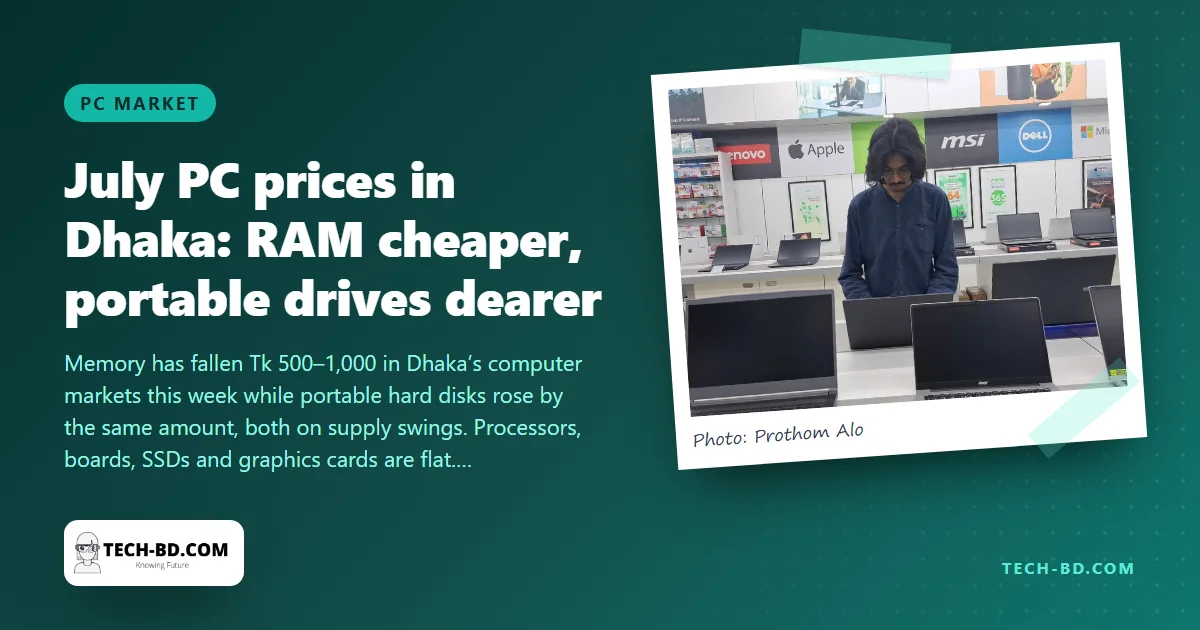
Six months after storage prices jumped, the Dhaka computer market has swung the other way on a different part. This week RAM is Tk 500 to Tk 1,000 cheaper depending on brand and model, while portable hard drives are Tk 500 to Tk 1,000 dearer on specific models. Sellers attribute both to supply — memory shipments have loosened, portable drives have tightened. Everything else is steady: processors, motherboards, internal SSDs, graphics cards and monitors are where they were last week.
Reference prices this week
| Part | Model | Price (Tk) | vs January |
|---|---|---|---|
| CPU | Intel Core Ultra 9 285K | 72,000 | flat |
| CPU | Intel Core i7, 14th gen | 48,000 | +2,500 |
| CPU | Intel Core i5-14600KF | 38,000 | +6,000 |
| CPU | Intel Core i3, 13th gen | 16,500 | flat |
| CPU | AMD Ryzen 9 7950X | 47,500 | new listing |
| CPU | AMD Ryzen 7 5700G | 19,000 | flat |
| CPU | AMD Ryzen 5 5600G | 16,000 | flat |
| Board | Asus Prime H610M (DDR4) | 10,600 | flat |
| Board | Gigabyte B760M Gaming X (DDR4) | 20,000 | flat |
| RAM | Corsair Vengeance LPX 16 GB DDR4-3200 | 13,000 | +700 (Jan), down this week |
| RAM | Corsair Vengeance RGB 16 GB DDR5-5200 | 27,500 | down this week |
| RAM | G.Skill Trident Z RGB 8 GB DDR4-3200 | 7,500 | −1,100 |
Why memory, specifically, behaves like this
Readers of these columns will have noticed that RAM moves far more than anything else on the list, in both directions. That is not a quirk of the Dhaka market. It is the nature of the product, and knowing why makes the price in any given month easier to read.
Memory chips are a commodity: a 16 GB module from one maker is functionally interchangeable with another's, so there is nothing to compete on but price. Almost all of the world's supply comes from a very small number of manufacturers, and new production capacity means a fabrication plant costing billions and taking years to build.
So supply is fixed in the short term and demand is not. That mismatch produces a cycle that repeats: shortage drives prices up, high prices persuade everyone to build capacity, the capacity arrives together two years later, oversupply crashes the price below cost, investment stops, and the shortage returns. The industry has run this loop for decades, and a buyer's position in the cycle matters more than any brand choice.
There is a newer pressure on top of it. AI accelerators use a specialised, high-margin kind of memory, built on the same advanced production lines as ordinary DRAM. When a manufacturer can sell that capacity at several times the margin, conventional memory gets whatever is left over — which is why consumer RAM prices have been unusually jumpy, and why a quiet month in AI hardware procurement shows up as a Tk 1,000 drop in a Dhaka shop some months later.
The DDR4 trap
One warning that matters more than this week's movement, because it runs the other way from what people expect.
DDR4 is the older standard, and the instinct is that older means cheaper over time. For most of a technology's life that holds. At the end of its life it reverses: as manufacturers wind down DDR4 lines to free capacity for DDR5, supply falls while a large installed base still needs it — and prices rise, sometimes sharply, for a part that is no longer improving.
So a DDR4 build bought today is sound, and a DDR4 build you intend to upgrade in three years may find that the 16 GB stick you planned to add costs more than it does now. If you are buying a DDR4 machine and know you will eventually want 32 GB, the cheaper decision is usually to buy both sticks at once rather than to leave a slot empty for later.
Why Dhaka prices lag the world
Local prices do not track global movements immediately, and the reason is inventory. A shop is selling stock it imported weeks or months ago, paid for at the dollar rate of that day, with duty and VAT already applied to that landed cost.
The consequences run both ways and are worth holding on to. A global price fall takes weeks to appear here, because old stock has to clear first. A global rise also arrives late — but arrives suddenly, when existing stock runs out and the next shipment is priced at the new rate. That is why Dhaka prices tend to sit flat and then step, rather than drifting, and why "it was Tk 32,000 in January" can become Tk 38,000 without any single week showing a dramatic move.
What to do this week
The quiet story is the Core i5-14600KF at Tk 38,000, up from Tk 32,000 in January, and the 14th-generation i7 at Tk 48,000, up Tk 2,500. Neither moved this week; the rise happened across the spring. AMD's equivalents held, which shifts the value calculation — the Ryzen 7 5700G at Tk 19,000 is now the obvious pick for a capable office or student machine, and the Ryzen 5 5600G at Tk 16,000 remains the cheapest route to a working PC with no graphics card.
Take the RAM dip. Memory is the component people most often regret skimping on, and the one where a dip is worth acting on rather than waiting out. On 8 GB, this is the week to move to 16. Building new on DDR4, 16 GB at Tk 9,600–13,000 is comfortable and 32 GB is finally reasonable for editors and developers. DDR5 kits are down too, but the platform cost — a DDR5 board — keeps that a choice for new high-end builds rather than upgrades.
Wait on portable drives if you can. A Tk 500–1,000 rise on specific models is the kind of supply blip that usually reverses within a month or two. If the drive is for backup rather than an urgent need, an internal drive or a cloud plan bridges the gap — and storage remains the part where a thousand-taka swing matters least over the life of a machine.