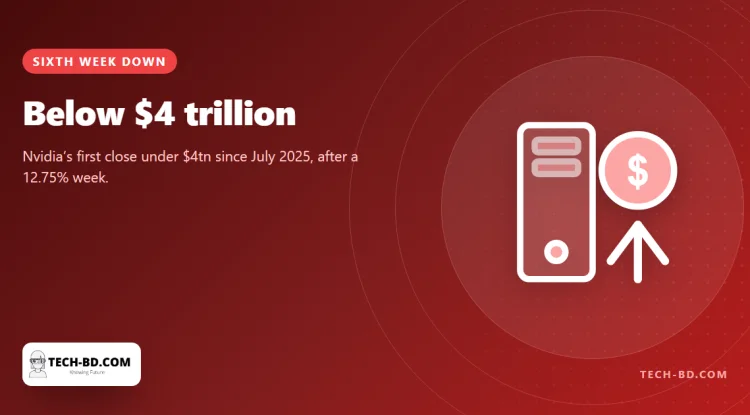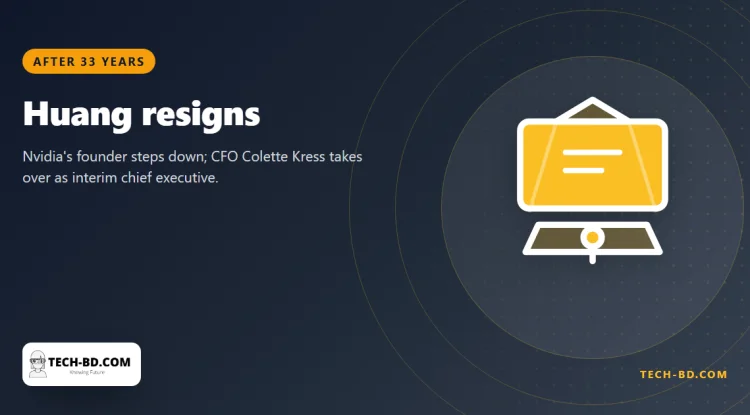
Jensen Huang's return as Nvidia's chief executive moved more than the company's share price in New York. The shock travelled, and it was felt hardest in Asia — because the saga exposed how much of the region is now riding on one firm.
What the week looked like
Tech-heavy stock indexes in Japan, South Korea and Taiwan went on a rollercoaster. Markets soared after a near-trillion-dollar surge in Nvidia's share price, then slumped as concerns about political and regulatory scrutiny hit investor confidence.
That is a lot of movement for a governance story about one American company, and the size of the swing is the point.
Why the region is this exposed
Nvidia is a "symbolic bellwether" of the AI trade that is fast becoming key to places like South Korea, Taiwan, Singapore and Malaysia, says Dylan Loh, an international studies lecturer at Nanyang Technological University.
The exposure is not one thing. It runs from chip manufacturing, through data centres, to inbound foreign investment. AI has become a strategic priority for these economies in the way heavy industry or electronics once was — and that makes them increasingly dependent on Nvidia's fortunes.
Two things compound it. In Nvidia, the AI industry has both the unrivalled power of cutting-edge chips and the financial clout that turned the company into what the BBC calls "the bank of AI". And in Huang it has a high-profile evangelist. That combination put the firm at the heart of the AI ecosystem in more ways than one, which is exactly why a crisis at the top of it propagates so far.
What this looks like from Bangladesh
Bangladesh is not in the list of exposed economies, and the distinction is worth drawing precisely rather than dismissing.
Taiwan and South Korea are exposed because they make the hardware: a slowdown in orders is a slowdown in factories and in export earnings. Singapore and Malaysia are exposed because they host the data centres: the investment is physical, sited and already committed. Bangladesh has neither. What it has is a services export sector — freelancers, outsourcing firms, development shops — that buys AI capacity rather than selling it.
That is a different position, and in a week like this one it is a safer one. The cost shows up elsewhere: as the price of the tools, and as the availability of the chips that will eventually sit behind any local AI infrastructure.
The thing to watch
It is also worth being clear about what this week did not show. Nothing in the underlying demand for chips changed between Monday and Friday. No factory closed, no data centre was cancelled, no order was withdrawn. What moved was sentiment about one executive, and it moved four national stock indexes with it. A market that reprices entire economies on a governance story is telling you that the valuations were resting on confidence rather than on contracts.
Not the share price. Watch whether the governments that made AI a strategic priority start hedging — second suppliers, domestic chip programmes, rules about where data centres may be built and who may own them. A single-company dependency is comfortable while the company is doing well, and this week was a demonstration of what it costs when that stops being true for a fortnight.