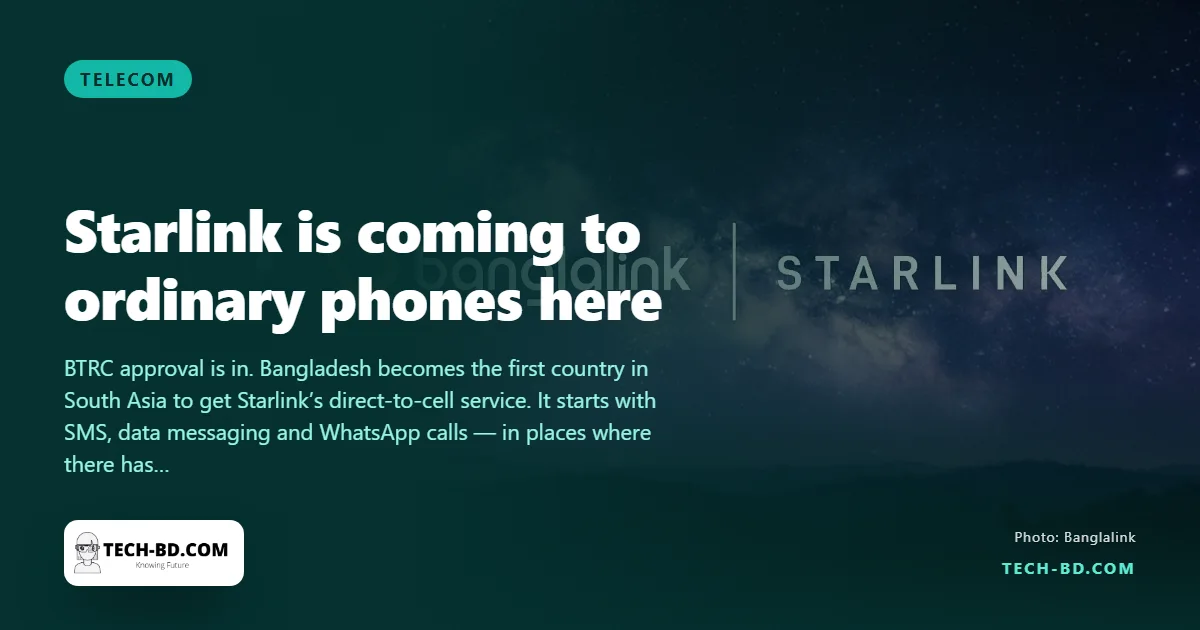
Banglalink is launching Starlink's direct-to-cell service commercially in Bangladesh, and says it already has approval from the Bangladesh Telecommunication Regulatory Commission. On the company's announcement, Bangladesh becomes the first country in South Asia to get it.
What it actually is
The point of direct-to-cell is that there is nothing to buy. A Banglalink connection and a 4G-capable handset is the whole requirement. No special phone, no satellite dish, no extra equipment, nothing to install. Inside a D2C coverage area, the phone in your pocket talks to a satellite.
It starts limited. The first services are SMS, data messaging and WhatsApp calls — not full voice, not broadband. The technology works by joining Starlink's satellites to Banglalink's existing mobile network, so the phone behaves as though it has found a very distant tower.
Where it matters
Not in Dhaka. The entire value of this sits in the places the network has never reached: the sea, remote islands, the coast and the hill areas. Banglalink singles out fishermen and people working offshore as the clearest beneficiaries, along with people living in remote areas and travellers.
The second case is disasters. During cyclones and floods, when mobile towers or other network infrastructure are damaged — or when the power simply goes, including during load-shedding — D2C keeps a channel open to reach family or call for help. For a country with the coastline Bangladesh has, that is not a marketing line.
Banglalink chief executive Yohan Bosse framed it as a people story rather than a technology one: the point, he said, is that a fisherman out at sea, a family in a remote area or someone caught in a disaster should not have to worry about communication. Bangladesh, he said, can now reach out from more places and from further away.
What to keep expectations honest about
Three things are worth knowing before anyone plans around it. Direct-to-cell is narrow-band — messaging, not video calls and not a broadband replacement. Coverage is a defined D2C area, not the whole country the moment it switches on. And the satellite needs a view of the sky, so this works outdoors and on the water far better than it works indoors.
Pricing has not been announced, and that is the number that will decide whether this becomes genuinely useful for a fishing crew or stays a premium extra.
The deeper significance is resilience. Bangladesh's connectivity has a single point of failure that the country has felt before — when the terrestrial network goes down, everything goes with it, as it did during the 2024 shutdown, when mobile internet came back slowly and unevenly for days afterwards. A channel that does not depend on local towers or local power is a different kind of infrastructure, and having it in the hands of ordinary handsets rather than specialist equipment is what makes it count.
What to watch next
Two numbers will decide whether this is infrastructure or a press release. The first is price, and specifically whether it is charged per message or folded into an existing pack — a fishing crew budgets in hundreds of taka, not thousands, and a per-message rate set for travellers prices out the people the service was announced for. The second is the published map of the D2C area. Until Banglalink states which stretches of coast and which hill districts fall inside it, "first in South Asia" describes an approval rather than a service anyone can plan around.