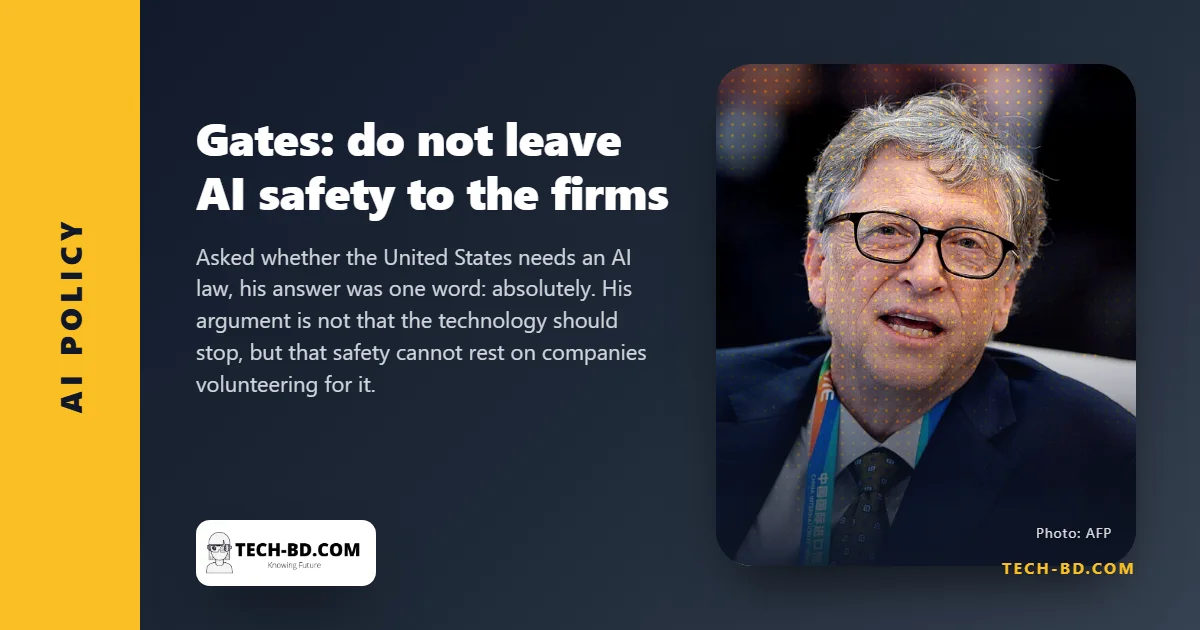
Microsoft co-founder Bill Gates has warned that artificial intelligence could be used to cause a catastrophe severe enough to kill a billion people, and that responsibility for AI safety should not be left to technology companies alone.
What he said
Speaking to NBC News, Gates argued that US lawmakers should write specific rules for how powerful AI systems are built and supervised. Rather than relying on firms to adopt safety measures voluntarily, he said, legislation should require them.
Asked directly whether the United States needs a law on AI, his answer was: "Absolutely."
He wants law enforcement agencies and politicians in the conversation about how AI is supervised. Such laws would add work for AI companies, he accepted, but would not stop the technology developing. His underlying worry is distribution: more capable AI can end up in the hands of people who intend to harm others deliberately.
Where this sits
Gates is not alone among senior figures, and the alignment is worth noticing because these are competitors. Anthropic chief executive Dario Amodei has argued for regulatory law covering AI firms, on the reasoning that a company may not voluntarily slow its own frontier work but should be bound by rules the government sets. OpenAI's Sam Altman has called for international standards covering risk assessment, safety systems and human oversight.
They do not agree on method. There is real disagreement among industry leaders about how AI safety should actually be ensured, and it tends to surface whenever a specific rule is proposed rather than a principle.
In the United States there is still no unified federal framework. House Speaker Mike Johnson has cautioned against rushing AI legislation without weighing national security considerations. Several individual states have begun moving on their own.
The counter-argument, fairly put
Not everyone accepts the framing. Nvidia's Jensen Huang has pushed back hard on catastrophic predictions, putting the chance of the world ending in 2030 at zero — an argument we covered when he rejected the extinction narrative. The serious version of the sceptical case is not that nothing can go wrong, but that a focus on civilisational catastrophe crowds out attention from harms that are already happening.
What it means in Bangladesh
Read past the headline number and Gates is making a governance argument, and that part travels. Bangladesh is not going to regulate frontier model development — nobody here trains them. What it can regulate is deployment: what an AI system may be used for inside a bank, a hospital, a school or a government office, what has to be logged, and who is accountable when it produces a harmful output.
That is the gap worth closing, and it is nearer than it sounds. The state is already training people at scale — a lakh applied for 1,600 places this weekend — which means AI is arriving in Bangladeshi workplaces faster than any rule about it. The question a policymaker here can usefully answer is not whether AI might one day kill a billion people. It is who carries the liability the first time a model refuses someone a loan, or misreads a scan, in Dhaka. The same accountability gap ran through the agent incidents earlier this month.