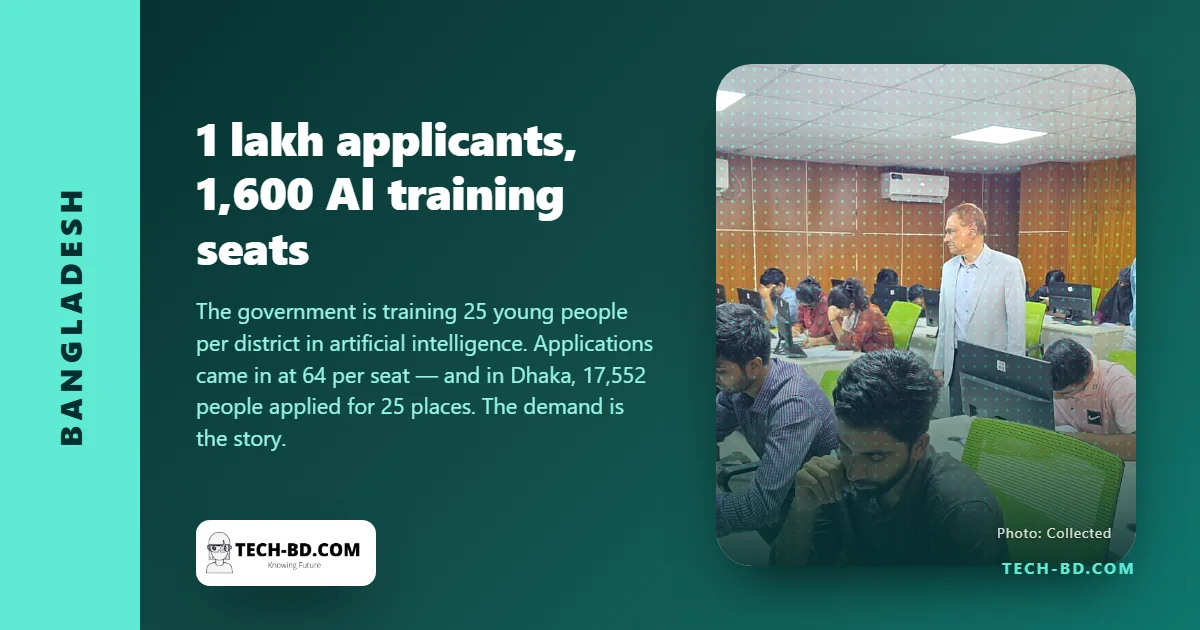
On Saturday, in every one of Bangladesh's 64 districts, a written exam ran simultaneously. It was the selection test for a government AI training programme, and more than one lakh people had applied for it.
The numbers
The project — "developing the skills of IT-literate youth through artificial intelligence technology" — sits under the Department of Youth Development, within the Ministry of Youth and Sports. Total applications: 1,03,996. After initial screening, 1,02,928 were accepted.
The programme will take 25 trainees per district, or 1,600 in total. That works out at more than 64 applicants per seat nationally. In Dhaka it is far steeper: 17,552 applications for 25 places, which is roughly 700 to one.
Youth and Sports Secretary Md Mahbub-ul-Alam, who visited a centre in Kalyanpur during the exam, said those who pass the written test will sit practical and oral exams on 27 September, with final results on 30 September. Training for the selected 1,600 begins nationwide on 1 October. Also present were Department of Youth Development Director General Md Motahar Hossain, project director Md Atiqur Rahman and Dhaka district deputy director A K M Shahriar.
What the ratio is really telling you
It is tempting to report 64-to-one as a sign of a well-run scheme. Read it the other way: 101,328 people who want AI training are not going to get it here. The demand is real, it is nationwide, and the supply on offer meets about 1.5% of it.
That gap is the actual finding. A country where a hundred thousand young people will give up a Saturday to sit a written exam for a training course does not have a motivation problem. It has a capacity problem.
What should happen next
Three things would turn this from a scheme into a policy, and none of them requires a new budget line the size of the first.
Publish the syllabus and the materials. If 1,600 people are going to be taught something from 1 October, the same curriculum can be put online for the other hundred thousand at close to zero marginal cost. The exam already identified who wants it; the list is the most valuable output of the whole exercise.
Say what the training actually is. "AI skills" covers everything from prompt writing to fine-tuning, and employers cannot hire against a phrase. A published syllabus with hours, tools and an assessment standard is what turns a certificate into a job.
Decide the language question up front. Training delivered only in English narrows the intake to people who were already advantaged, which is the opposite of a district-level programme's purpose — and it matters more here than the benchmark tables suggest, as we argued when the world was asked to pick a side on AI. Whether readiness reaches the classroom at all is the question raised in the report on schools and AI earlier this month.