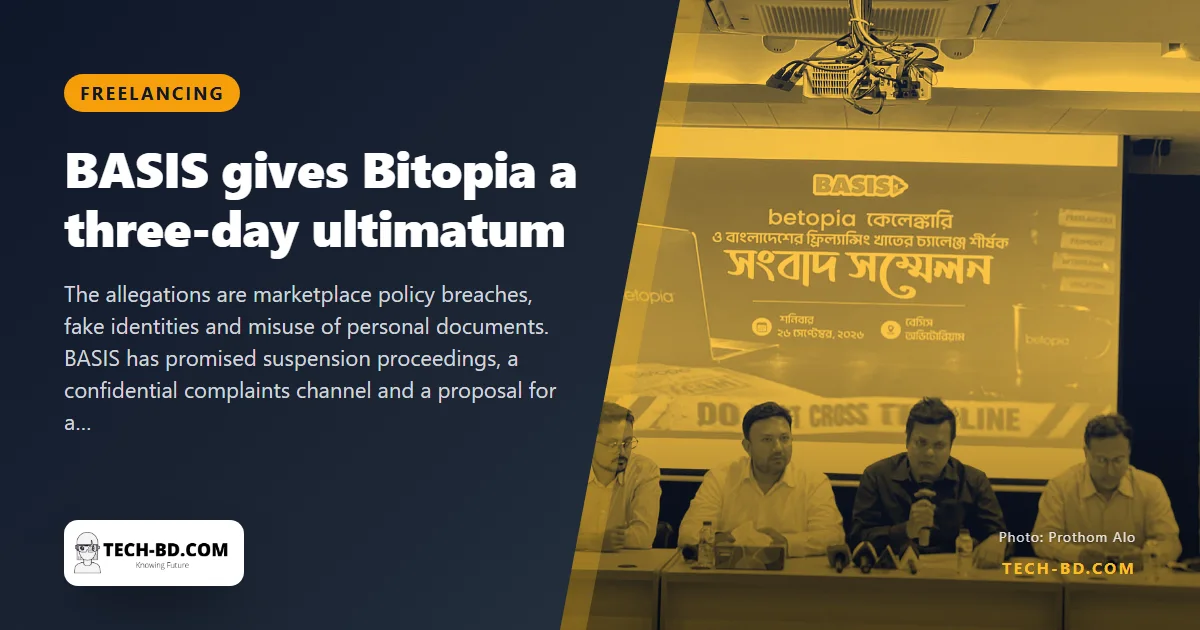
At an emergency press conference on Saturday, the Bangladesh Association of Software and Information Services (BASIS) set out its position on allegations against the technology firm Bitopia — and gave it three days to respond.
The allegations are unproven. BASIS was explicit that it will not bury wrongdoing, and equally that it will not declare anyone guilty before an investigation.
What is alleged
The conference, titled "The Bitopia scandal and the challenges of Bangladesh's freelancing sector", listed what has come to the association's attention: breaches of international marketplace policy, misuse of NID and passport documents, artificial orders and reviews, and the use of fake identities and accounts. Bitopia Group is a BASIS member under the name BD Calling.
Reports in the press have described allegations on the international platform Fiverr of accounts being run improperly, fabricated reviews, and disruption of other professional freelancers' work.
Sakib Mahmud, who described himself as affected by Bitopia's conduct, told the conference the complaints are not new and that he has faced pressure for speaking about them, saying he holds and has published evidence of fake IDs — including, he said, accounts belonging to people who no longer work there.
The four steps BASIS announced
- Organisational action. After verifying preliminary facts under its constitution and code of conduct, BASIS will issue a show-cause notice and consider suspending membership, alongside final legal and organisational measures.
- Full cooperation with government investigations — the ICT Division, the Commerce Ministry, Bangladesh Bank, BFIU, the NBR, the Cyber Crime Unit and law enforcement, with documents and institutional records provided.
- A confidential complaints channel for freelancers and former employees whose NID, passport or marketplace accounts were controlled without consent, with identities protected.
- A national framework. BASIS will propose a "National Freelancing and Marketplace Governance Framework" covering the use of personal data under agency operations, who owns a digital identity after employment ends, and the limits on an agency running accounts.
The written statement was read by Mohammad Juwel of the BASIS support committee, chairman of Trust-IT (BD). BACCO, the contact centre and outsourcing association, separately expressed deep concern and called for a neutral investigation, warning that one firm's conduct should not damage a sector built over years.
What it means in Bangladesh
Whatever the investigation finds, the structural problem is already visible and it belongs to the whole industry. Bangladesh's freelancing economy runs on agencies operating marketplace accounts that are, on paper, held by individuals — because Fiverr and Upwork verify a person, not a company. That mismatch is where every one of these allegations lives.
The practical question for any freelancer reading this is ownership. If your NID or passport was used to open an account somebody else operates, you carry the risk: a ban follows the verified identity, not the agency. Before joining an agency, get in writing who holds the account, who holds the payout method, and what happens to both when you leave. If you have already left and an account in your name is still running, document it and take it to the new BASIS channel while it is open.
The fourth proposal is the one that matters beyond this case, and it is the same gap we found in the supplier dispute behind the Foodpanda case: business-to-business relationships in Bangladeshi tech are governed by almost nothing, so they end up in the press or in court. On the question of what an allegation does and does not establish, our explainer on how a complaint moves through the courts applies here too.