Update, October 2026 — The warning given from this stage — adopt AI or lose the business — can now be checked against the industry it was aimed at. The result is not what either side of the argument expected: in the world's largest outsourcing market, AI adoption rose and employment rose with it. What the numbers show, and what they hide, follows the original article.
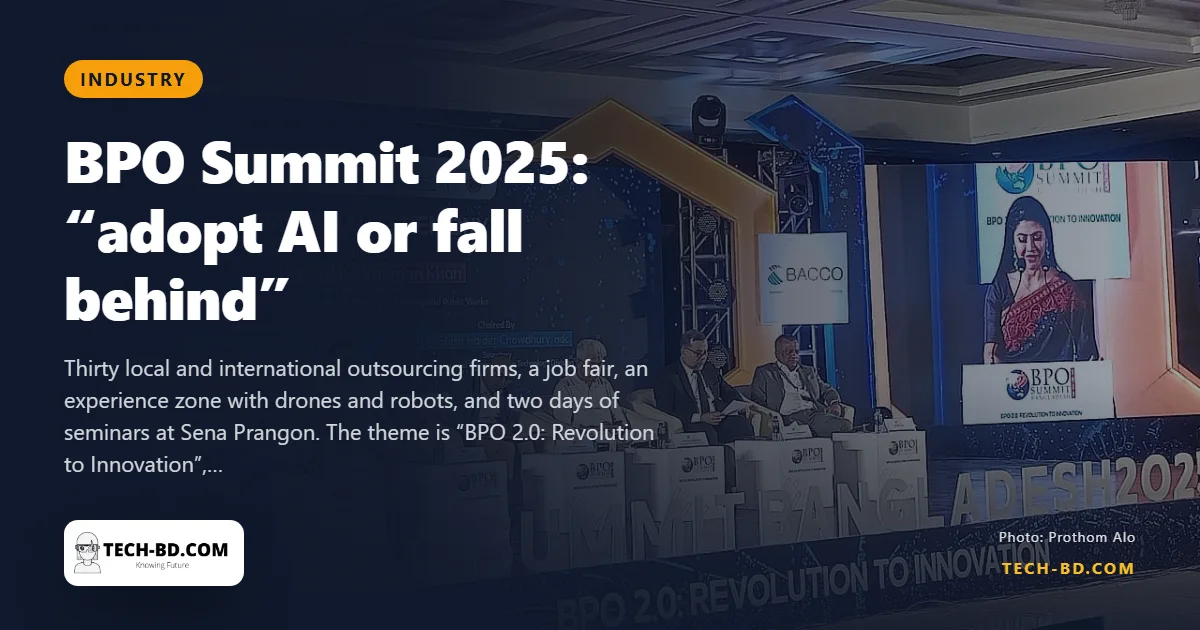
The country’s business process outsourcing industry gathered on Saturday at Sena Prangon in Dhaka for BPO Summit Bangladesh 2025, a two-day event organised by the Bangladesh Association of Contact Center and Outsourcing (BACCO) with the ICT Division and the Business Promotion Council. Industries adviser Adilur Rahman Khan opened it. The theme, “BPO 2.0: Revolution to Innovation”, is a polite way of naming the thing everyone in the hall was thinking about.
The AI question, put directly
Faiz Ahmad Taiyeb, the chief adviser’s special assistant on ICT and telecoms, did not soften it. The technology sector had changed fundamentally since Covid, he said, and “the new reality is artificial intelligence. If BPO and other technology firms do not adopt AI, they will face new challenges.” It was a warning rather than a threat: an industry that sells human voices answering telephones is exactly the industry that AI agents are built to replace, and Bangladesh’s pitch of low-cost, English-capable staff is worth less each year that the machines get cheaper. His answer was skilled human resources and effective policy — the industry has to move up the value chain to the work that still needs people.
What the government promised
Adilur Rahman Khan framed BPO as part of a shift away from an economy built on agriculture and garments toward technology-based industry, and pointed to smart-city planning and IT park construction as the state’s contribution. BACCO president Tanvir Ibrahim said local firms were building capacity and creating jobs at the same time, and that the pace of technological change was itself creating openings. ICT Division director general Md Abu Sayeed and BACCO general secretary Faisal Alim also spoke; ICT secretary Shish Haider Chowdhury chaired.
On the floor
Thirty domestic and international IT and BPO companies exhibited, alongside seminars and workshops with foreign buyers and analysts. An experience zone showed augmented and virtual reality, drones, a submarine model and robots, mostly built by students. The most practical corner was the job fair, where companies collected CVs from young applicants in person — a reminder that, whatever the seminars say about AI, the industry still hires people, and that a summit in Dhaka is one of the few places a graduate from outside the capital can hand a résumé to ten firms in an afternoon. BTRC was strategic partner; the Bangladesh ICT Journalist Forum and Technology Media Guild Bangladesh supported the event. It runs through Sunday.
What actually happened to the jobs
The clearest evidence comes from the Philippines, the largest contact-centre market in the world and the one Bangladesh's industry is measured against. Through 2025, as AI adoption accelerated across the sector, Philippine contact-centre and business-process employment rose by more than 60,000 to about 1.68 million, up from roughly 1.62 million the year before, with industry projections pointing at further growth into 2026.
That is worth sitting with, because it contradicts the simplest version of the story told from conference stages in both directions. The industry did not collapse. It also did not stand still.
What the aggregate hides
A headcount that grows while the technology that replaces headcount is adopted means the composition changed underneath, and that is where the real finding is.
The work that automated is the work everyone said would: scripted, single-outcome, high-volume contacts. Order tracking, appointment booking, balance enquiries, password resets. Published industry figures put automated handling of routine enquiries at up to 87 per cent, resolved in seconds against the minutes a human conversation takes. That is a genuine replacement of a task, not an augmentation of it.
What grew was everything the automated path hands over: the exception, the angry customer, the case where the system has already failed once, the regulated conversation that cannot be left to a model, and the new category of work the models themselves created — annotation, evaluation, prompt and workflow design, quality review of machine output. Industry research anticipates on the order of 100,000 new roles in algorithm training and data curation in the Philippine sector alone over five years.
So the rise in total employment is real and it is not reassurance. It describes a sector replacing its entry level with its middle, which is a harder transition than a shrinking one, because the jobs that disappeared were the ones people started in.
The displacement figures, and how to read them
Against the growth sit the projections, and both can be true. Analysts put up to 30 per cent of roles in major outsourcing hubs as automatable by 2030, with estimates of 2 to 3 million workers across India and the Philippines facing disruption and around a million outsourcing jobs directly affected.
These are not predictions that employment falls by 30 per cent. They are estimates of how much of the current task mix a machine can do, which is a different quantity: a role can be 30 per cent automatable and still exist, with a different day in it. The honest reading is that the risk is concentrated by seniority rather than spread evenly — and that an industry whose pitch is low cost per seat is competing against something whose cost per interaction falls every year, which is a race that cannot be won on price.
What this makes of the advice given on stage
"Move up the value chain" was the answer offered at the summit, and the evidence supports it as a destination while saying nothing about the route, which was the question in the room.
Moving up is not the same as training existing staff harder. The work that survives needs judgement, domain knowledge, written communication and comfort supervising a system rather than following a script — a different hiring profile, not a longer induction. And it needs fewer people per unit of revenue, so the same policy that protects the industry's margins reduces its headcount growth. Those two facts are usually stated separately and are the same fact.
The second thing the advice skips is who absorbs the entry-level problem. The value of a BPO industry to a country with many graduates and few formal jobs has always been that it hires at the bottom in volume and trains on the job. If the bottom automates, the sector's social function — a first formal job for someone from outside the capital, with a wage and a reference — weakens even as its revenue holds. That is a question for policy rather than for any individual firm, and it was not what the stage was discussing.
What is worth watching, rather than predicting
Three measurable things will tell you more than any forecast: whether entry-level hiring volume holds or falls while total headcount grows; whether revenue per employee rises, which is what moving up the value chain actually looks like in a number; and whether contracts shift from per-seat to per-outcome pricing, since a client paying for resolutions rather than hours has stopped buying labour and started buying a result. The third is the one that would change the industry's shape permanently, and it is the least reported.