
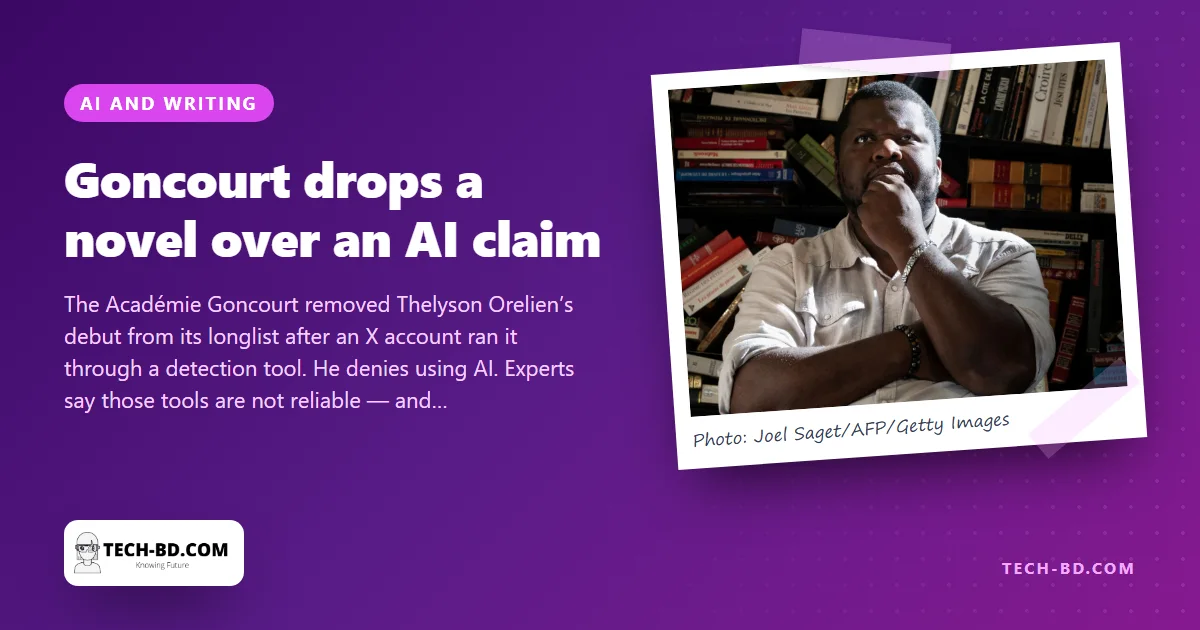
The organisers of France's most prestigious literary prize said on Friday they had removed a bestselling novel from the Goncourt longlist after its author was accused of writing it with artificial intelligence.
What happened
The book is "C'était Ça ou Mourir" ("It Was Either That or Die"), the debut novel of Haitian-Canadian author Thelyson Orelien. It tells the story of a Haitian migrant travelling north through Latin America to Canada, had already won several other awards, and was due to be translated into multiple languages.
The accusation came this week from a little-known X account, "Balance ton Claude" — ownership of which was later claimed by essayist Samuel Fitoussi, who said he ran it with others. The account said passages put through the AI detection tool Pangram indicated the novel was written almost entirely by AI.
Orelien denies using AI. Reports of plagiarism in earlier work followed: La Presse said a 2012 short story took passages from a book by French author Louis Pauwels, and that a 2013 opinion piece copied from The Philippine Star. Orelien has not responded to those claims.
The Académie Goncourt said it had noted both sets of accusations and removed the novel to preserve the integrity of the prize and of the Académie. It said it hoped the decision showed it was fully against the creation of texts generated with AI assistance, and that it would say nothing further before 6 October, when the shortlist is announced. Orelien's French and Canadian publishers had initially given him their full support.
The uncomfortable part
A major prize acted on a claim produced by an AI detection tool and published by an anonymous account. CNN notes what specialists have said for two years: the reliability of AI detection tools is questionable. They produce false positives, and they produce them unevenly — writing by people who learned English or French as a second language, or who write in a plain declarative style, is flagged more often.
The plagiarism reports are a separate matter with separate evidence, and they are checkable in a way a detector score is not. That distinction got lost in a single week.
What it means in Bangladesh
This will arrive here through universities and publishers rather than prizes. Bangladeshi students writing in English are precisely the group detection tools misjudge most, and the consequence lands on an individual who has no way to prove a negative — you cannot demonstrate that you did not use a tool.
Institutions adopting these tools should write down three rules before the first accusation, not after. A detector score is an indicator, never a finding, and cannot on its own support a penalty. The accused must see the actual output and be allowed to answer. And there must be a second, human route to establish authorship — drafts, version history, an oral defence of the argument — which is the only method that actually works and, conveniently, the one that has always worked.
We wrote this week about York students' concerns over what happens to the coursework they submit. This is the other half of that bargain: a tool that judges the student, on evidence the student cannot inspect.