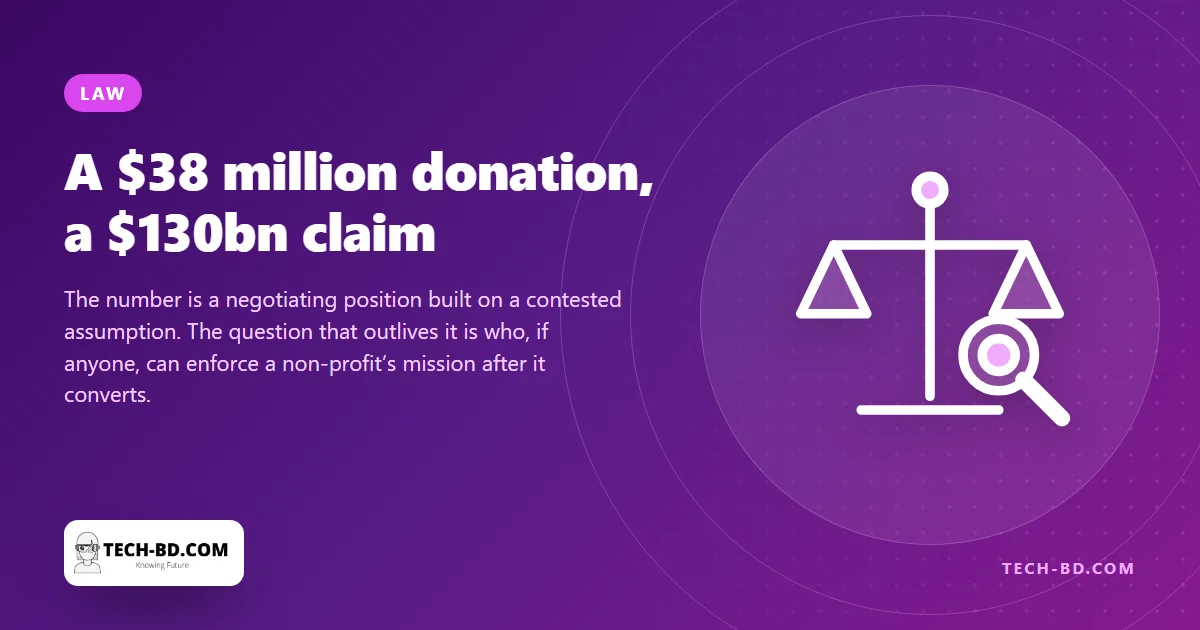
The fight between Elon Musk and the company he helped start now has a price tag. In a court filing, Musk demanded $130.4 billion in damages from OpenAI and its biggest backer, Microsoft, according to Bloomberg. His argument in one sentence: he gave money to a charity, the charity became one of the most valuable companies on earth, and he was cheated out of his share.
How $38 million becomes $130 billion
Musk co-founded OpenAI in 2015 as a non-profit research lab and left in 2018, citing disagreements about its commercial direction. Along the way he donated about $38 million. The filing relies on an economist whose calculation treats that donation the way a venture investor would treat seed money. Musk's lawyer makes the analogy explicit: an early investor in a start-up can earn many multiples of what they put in. With OpenAI valued at roughly $500 billion, Musk claims a significant share is rightfully his.
Everything turns on what that calculation assumes, because the assumption is the case. Treating a donation as seed equity requires a counterfactual in which the money would have bought a stake — and whether a donor to a non-profit was entitled to anything resembling equity is precisely what is in dispute. The damages model does not prove the claim; it prices it, on the condition that the claim succeeds.
Large headline numbers in US civil litigation also serve a function beyond arithmetic. They establish the scale of the settlement conversation and shift the defendant's calculation of what a loss would cost. Reading $130 billion as a prediction of an outcome is the wrong reading; reading it as an opening position is closer.
Why the jury ruling was the real news
The demand landed a day after a federal judge in Oakland rejected OpenAI and Microsoft's final attempt to avoid a jury trial. That means twelve ordinary citizens, not a judge alone, will weigh whether a non-profit's pivot to a capped-profit structure — and its deep partnership with Microsoft — amounted to fraud against an early donor.
The procedural step matters more than the number. Companies spend heavily to avoid juries for reasons that have little to do with the merits: a judge decides on doctrine, while a jury decides on a story, and "he gave money to a charity and they turned it into the most valuable company in the world" is a story that needs no technical background to follow. The defence is more complicated to tell than the claim, which is a structural disadvantage that exists regardless of who is right.
The question underneath
Strip away the personalities and the case reaches something genuinely unsettled, which is why it will be read far beyond this dispute.
A non-profit is bound to its stated mission. The difficulty is who may enforce that. In US law the party that oversees a charity's adherence to its purpose is generally the state — the attorney general — rather than a donor, precisely so that charities are not governed by whoever gave them money. A donor who could sue over a change of direction would effectively hold a veto bought with a gift.
So Musk's claim runs into a doctrine built to exclude it, and the arguments will be about whether there was something more than a donation here: representations made, conditions attached, an agreement that the lab would remain non-commercial. That is a factual question about 2015 and 2016, which is exactly the kind of thing a jury decides.
The wider significance is that the structure in dispute is now common. Several research organisations founded as non-profits have moved toward commercial forms as the cost of training models outran what donations and grants could cover — a genuine financial pressure rather than a pretext. What nobody has settled is what obligations survive that transition, and to whom. Early employees who joined a mission, researchers who published openly on the understanding that the work would stay open, and funders who gave rather than invested all have an interest in the answer, and almost none of them have a clear legal route to assert it.
What each side says
OpenAI and Microsoft deny the allegations. OpenAI called the lawsuit baseless and part of an ongoing campaign of harassment, said it is ready to present its evidence in court, and characterised the latest demand as escalation. Earlier the company had written to investors and banking partners warning them to expect "deliberately exaggerated and attention-grabbing claims".
Musk now runs the rival lab xAI, which gives him an obvious commercial interest in the outcome and is the first thing any opposing counsel will raise. It does not dispose of the legal question, and treating it as though it does is as lazy as treating the $130 billion as a forecast.
Whatever the jury decides about the number, the reasoning in that Oakland courtroom about what a mission-driven organisation owes the people who funded it will be read very closely by organisations that are not parties to this case.