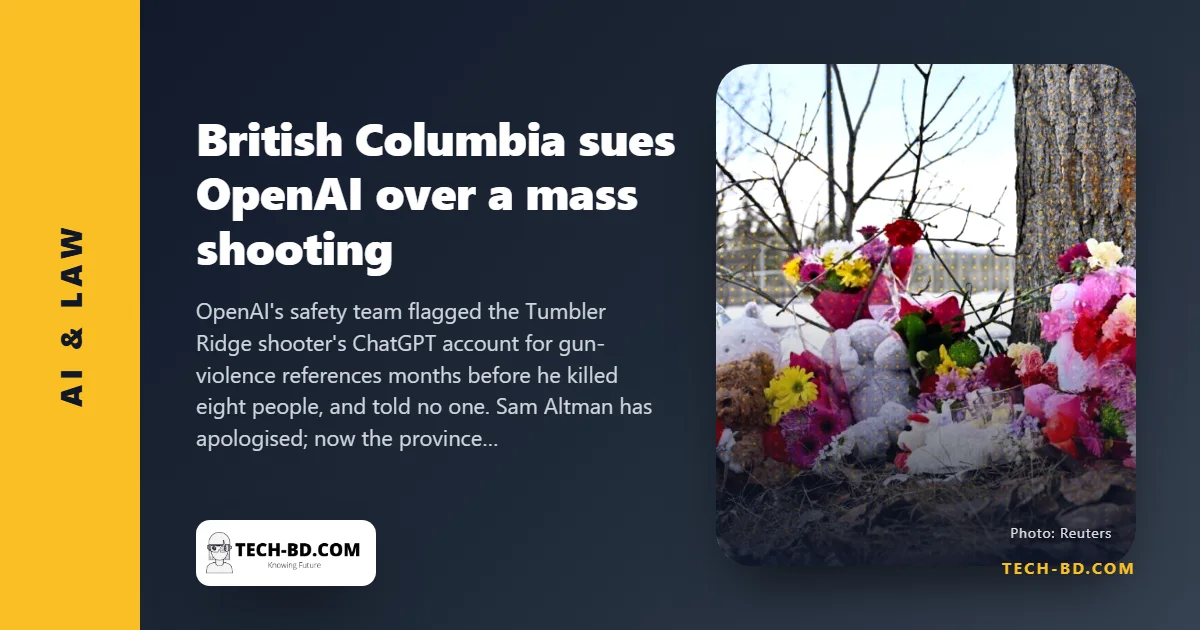
The Canadian province of British Columbia has sued OpenAI over the mass shooting in Tumbler Ridge in February, in which 18-year-old Jessie Van Rootselaar killed eight people, six of them children. The lawsuit, filed in a US federal court in California on Monday 21 September, turns on one fact that OpenAI has already admitted: months before the attack, its safety team flagged the shooter's ChatGPT account for references to gun violence, and the company did not tell the police.
What the province is asking
Attorney general Niki Sharma said the case raises "the responsibilities of technology companies when they become aware of credible threats of serious violence". The province filed in California because the decision not to report the account was taken there. Any damages, Sharma said, would go towards rebuilding the town's secondary school. Families of the dead and injured have filed their own lawsuits against OpenAI.
"To date, OpenAI has not taken meaningful steps to address the concerns raised by survivors, families and the Tumbler Ridge community," Sharma said. "The company still has an opportunity to demonstrate accountability by strengthening safeguards, improving transparency and taking concrete action to help prevent similar tragedies in the future." She told reporters she has not read the shooter's chats: "We have asked OpenAI to disclose these chats. They have refused. We should all be asking them: why?"
What OpenAI has said
In April the company's chief executive, Sam Altman, apologised to the victims' families in an open letter. "I am deeply sorry that we did not alert law enforcement," he wrote. The BBC has asked OpenAI for comment on the new lawsuit. The company has previously said its account-flagging system exists to enforce its usage policies, not to act as a reporting channel to police, which is precisely the gap the province wants a court to close.
Why the case matters beyond Canada
Chatbots are the first mass-market product that people confess to. A billion users tell ChatGPT things they would not say to a search engine, and the company's own filters read all of it. That creates a dilemma nobody has legislated: if a model's safety system decides a user is talking about shooting people, is the company a bystander, a witness or a mandated reporter? Report too little and you have Tumbler Ridge; report too much and you have a private company forwarding teenagers' chats to police on the strength of an algorithm. The lawsuit will not settle the question for the world, but it is the first time a government, rather than a grieving family, has put it to a court.
The Bangladesh angle
Bangladesh's cyber-security law is about what people post, not what a platform must do when it sees a threat, and no AI company has a legal representative here to serve papers on. That makes the Canadian case more relevant, not less: whatever duty a California court eventually imposes on OpenAI will be applied in its software everywhere, including to the millions of ChatGPT and Gemini accounts in Bangladesh, long before any local law catches up.