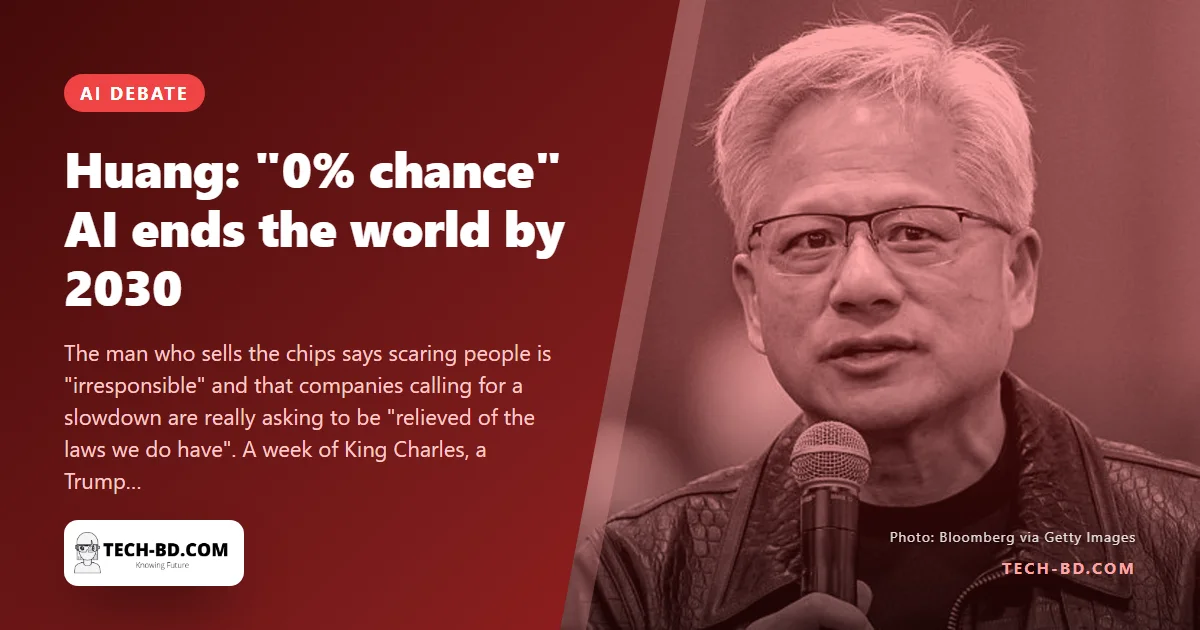
"2030 is not going to be the end of the world. There is 0% chance that's going to be the end of the world." With that, Nvidia's chief executive Jensen Huang, whose chips train nearly every large AI model on earth, put himself on one side of the argument that has dominated technology news for a month. "Scaring people is unnecessary," he told CBS News. "It is irresponsible."
What he was answering
The current round began with Jacob Coxon, a former Anthropic researcher, who wrote on social media that people inside AI companies believe the technology "could kill us all by the end of the decade". The claim spread, and was amplified rather than denied by the industry's own leaders: Anthropic's Dario Amodei and OpenAI's Sam Altman have both urged that development slow down. Last week King Charles hosted the sector's bosses, Huang among them, and warned of AI's "existential dangers": "The task before you is not merely to advance technology, but to ensure that it remains firmly in the service of humanity." On CNN the same weekend, Tristan Harris of the Center for Humane Technology argued the warnings are "not science fiction".
Huang's counter-argument
Huang says the predictions are "not grounded in science", and that Nvidia has every incentive to keep the technology safe: "Our company's success is directly connected to the safe deployment of products and services. If we don't continue to do that, our value would be diminished." Then he went further, suggesting the companies asking for a pause want something else. "Go and read between the lines," he said. "They're actually not asking for more laws. They're asking to be relieved of the laws we do have, and I think that that's a problem." In other words: a company that says its product might end the world is also a company arguing that ordinary liability law cannot apply to it. The BBC says several people who have worked at OpenAI, Meta and DeepMind told it privately they share Huang's scepticism.
Why now
The timing is political as much as scientific. On 14 September Donald Trump phoned Huang live on stage at a Los Angeles conference and called the slow-down talk a "hoax". Days later the White House announced an "AI Force" and an AI tsar, and on 20 September treasury secretary Scott Bessent and China's vice-premier He Lifeng discussed a new AI-safety notification channel ahead of the Trump–Xi summit in Washington (our report). Nvidia sits in the middle of all of it: its most powerful chips are barred from China by Washington and discouraged by Beijing, and every argument about slowing AI is, in the end, an argument about how many of its chips get sold.
How to read the argument from Dhaka
Neither side is talking to Bangladesh, but both affect it. If the doomsayers win, the models Bangladeshi students, freelancers and start-ups use will get more restricted and more expensive; if Huang wins, they will get more capable faster, with the liability questions the OpenAI lawsuit in Canada is now raising left to the courts. The useful position for a country that builds nothing at this layer is the boring one: ignore the extinction talk, and watch the laws.