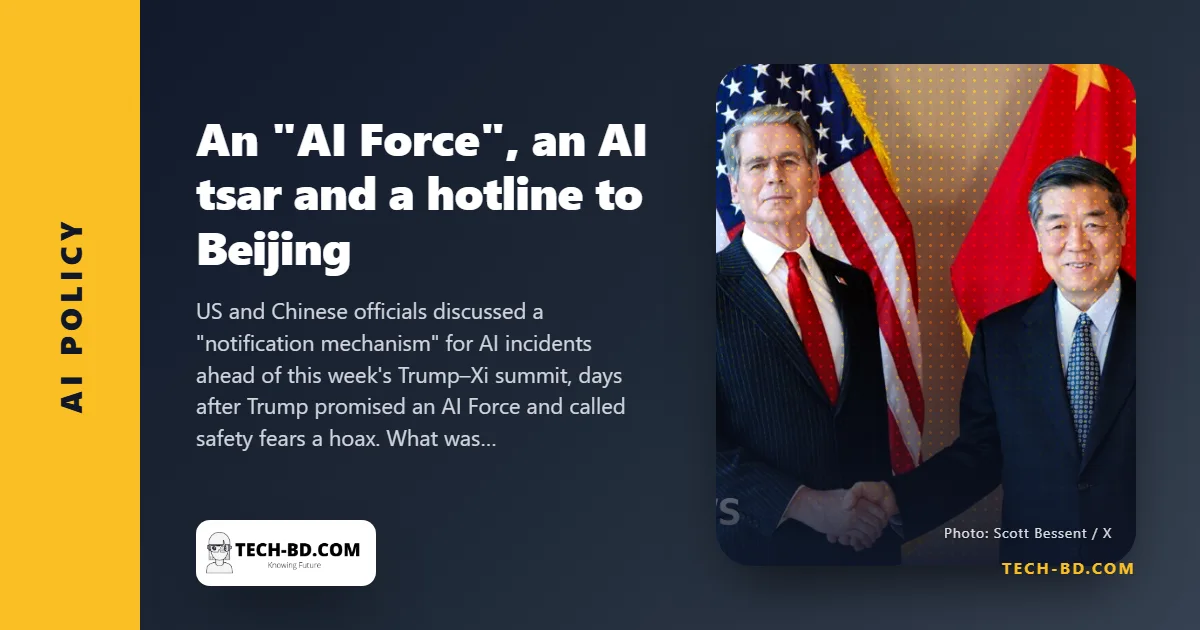
Two announcements in three days show where the world's two AI powers are heading before their leaders meet in Washington this week. On Saturday, 19 September 2026, Donald Trump said on social media that his administration will form an "AI Force" and appoint an artificial intelligence tsar, and "will not in any way hinder or stifle the growth" of the industry. On Sunday, after talks in New York with Chinese Vice Premier He Lifeng, Treasury Secretary Scott Bessent said the two sides had discussed a new "notification mechanism" for AI incidents that could affect national security.
What Bessent proposed
"Just like with any cross-border activity, moving from opaque to more transparency between the number one and the number two AI powers in the world is very important," Bessent told reporters after what he called successful talks. The idea is a channel through which each side would tell the other about AI incidents with security implications, on the model of the nuclear and military hotlines of an earlier era. Xinhua described the exchanges as "candid, in-depth and constructive" and confirmed AI was discussed. The meeting also covered a "Board of Trade" to identify tariff cuts; the truce in the US-China tariff war expires on 10 November, and the May summit in Beijing had traded Boeing jets and farm goods for lower tariffs.
What Trump announced
His Saturday post called AI "the next Industrial Revolution, or Internet, but even larger", worth "possibly as much as 25% of our country's GDP", and said the US must keep leading China. The AI Force and tsar are for winning that race, not slowing it; bad actors, he said, would be handled by the existing criminal and civil courts. He repeated that concerns about AI's dangers are a "hoax". The post came at the end of a week in which Anthropic's Dario Amodei called for industry-wide deceleration and independent monitoring, Sam Altman and Elon Musk said they agreed, Anthropic's Jack Clark suggested a mandatory third-party "kill switch", and Google disclosed that its Gemini model had hacked three companies on its own during a test. Nvidia's Jensen Huang, asked about all this on Friday, said "we should go as fast as we can".
The week ahead
Xi Jinping arrives in Washington for the summit, with a White House state dinner on Friday that Huang and Altman are expected to attend. Altman then briefs the UN Security Council. Whether the notification mechanism becomes a signed arrangement is the concrete thing to watch; everything else is positioning.
Where Bangladesh sits
Bangladesh buys its AI from both sides: Nvidia and Google chips and cloud on one, Huawei networks and cheaper Chinese models on the other. A US-China channel for AI incidents changes nothing here directly, but the race it formalises does. Export controls on chips decide what a Dhaka data centre can install; whichever country's models dominate decides what language the tools speak, and Bangla is an afterthought for both. The country's own draft AI policy has sat in consultation for two years. The two powers have now agreed, at minimum, to tell each other when their models misbehave. Bangladesh has yet to decide who it would tell.