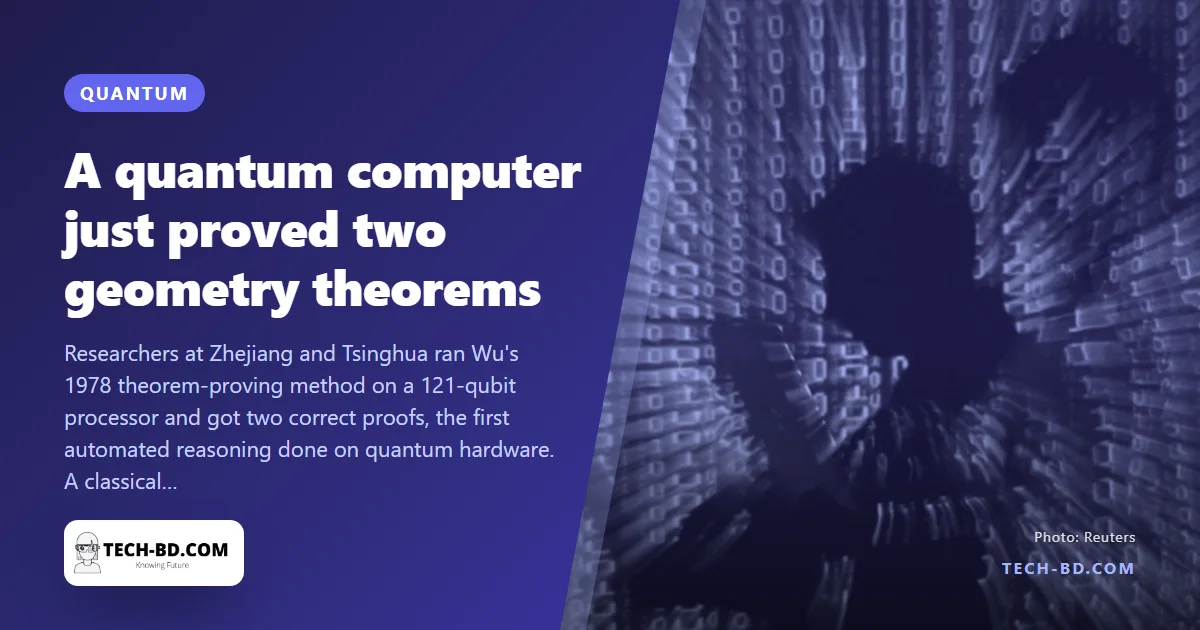
A team from Zhejiang University and Tsinghua University says it has used a quantum computer to prove two theorems of plane geometry, in what appears to be the first case of automated mathematical reasoning carried out on quantum hardware. The machine, a fully programmable 121-qubit superconducting processor, worked through the logic of the proofs itself rather than checking answers supplied by a human, according to the researchers' paper, reported by ScienceAlert and Prothom Alo this weekend.
What was proved
The first theorem is one every Class 9 student meets: the diagonals of a square are perpendicular. The second is harder, a statement about intersecting triangles and circles that takes several lines of algebra to establish. For the first, the team used a hybrid, quantum-plus-classical version of Wu's method; for the second, a technique they call symbolic proof search. "The key point is not that the quantum computer found the answer quickly, because a classical computer can do that too," the paper says, in effect. "It is that this kind of complex logical deduction was completed successfully on quantum hardware."
Why "48 years"
The headline number refers to Wu's method, published in 1978 by the Chinese mathematician Wu Wenjun. It turns a geometry statement into a set of polynomial equations, then shows by algebra that the conclusion follows from the hypotheses. It was the first practical way to make a computer prove geometry theorems, it produced hundreds of machine proofs in the 1980s, and it is famously expensive: the polynomials blow up in size. The new work adapts it so a quantum processor handles part of the algebra. The problem is 48 years old; the achievement is running its solution on qubits.
What it is not
- Not a speed record. A laptop proves both theorems in milliseconds. The paper does not claim a "quantum advantage".
- Not a threat to encryption. Breaking the RSA keys behind online banking needs millions of error-corrected qubits running Shor's algorithm; 121 noisy qubits proving that a square's diagonals cross at right angles is a different universe. bKash is fine.
- Not "AI". No language model is involved. This is symbolic reasoning, the old, exact kind, on a new kind of chip.
Why it matters anyway
Quantum computers so far have been good at one thing, simulating physics, and the field's open question is whether they can do structured, logical work at all. A proof is the strictest possible test: every step must be right or the output is worthless. Getting two through a noisy 121-qubit machine is a proof of concept that quantum hardware can carry a chain of reasoning, which is the prerequisite for the useful things, from verifying chip designs to checking the safety of the AI systems everyone else was arguing about this week. For students in Bangladesh, where quantum computing exists only in a few university courses, it is also a reminder that the field is being defined now, by people who learned geometry the same way.