Getting vast quantities of data down from space and processing it is one of the harder problems in the field. Scientists have long wanted to move quantum technology into orbit to help. A team has now run a quantum computer in space for the first time.
Why it is difficult
Quantum computers are extremely sensitive: heat, vibration and electromagnetic interference destroy their normal operation. Using the technology outside a tightly controlled laboratory is hard enough. Doing it in the hostile environment of space is another matter — which is what a group led by physicist Philip Walther of the University of Vienna has managed.
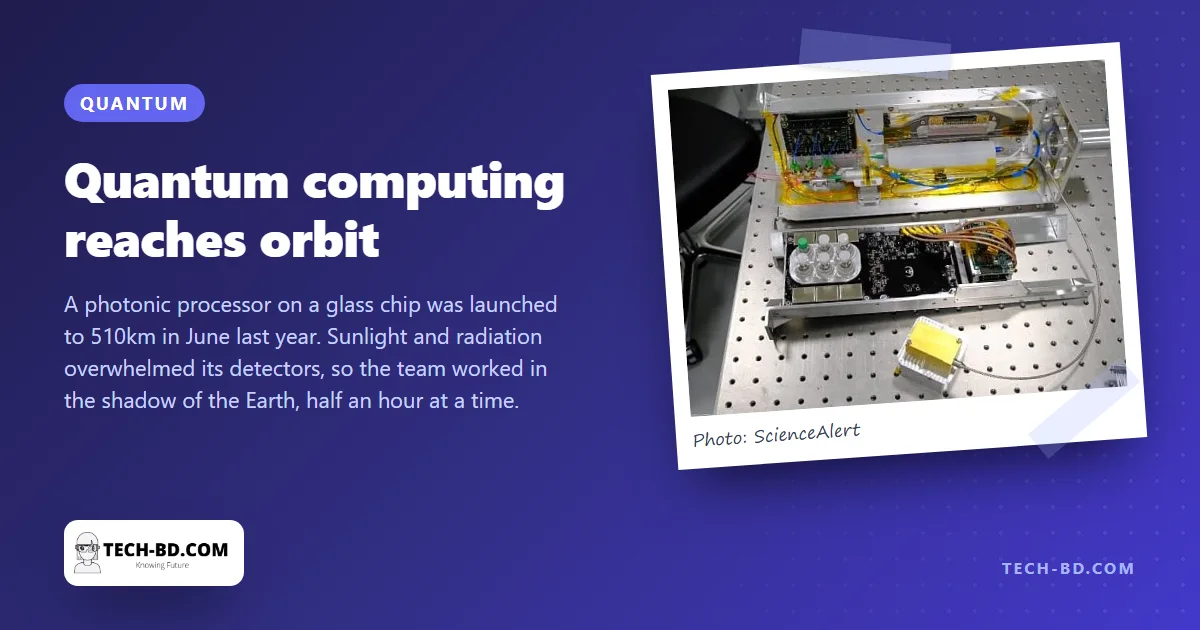
They built a processor that carries quantum information using photons, particles of light, generating photon pairs through optical paths inside a tiny glass chip.
What happened in orbit
The computer was launched on 23 June last year aboard a Falcon 9 into low Earth orbit at about 510km. Sunlight and radiation immediately put the photon detectors under severe strain, so the team used the periods when the craft passed through Earth's shadow, completing roughly 30 minutes of sensitive measurement a day. Thick aluminium shielding was wrapped around the computer to block high-energy protons and electrons from the Van Allen belts. Detector sensitivity degraded over time, and was corrected by adjusting voltage.
They achieved quantum interference in space — the foundation of quantum computing. By changing the temperature of a crystal to match the photons' wavelengths, the team saw the particles behave as expected: at about 32.5°C, a clear Hong-Ou-Mandel dip.
The researchers say satellites could eventually compress and analyse data in orbit, easing the load on ground stations and opening a path to a global quantum communications network.
What it means in Bangladesh
Bangladesh will not launch a quantum satellite, and there is no honest version of this story that pretends otherwise. There are two things in it that do reach here.
The first is the downlink problem, which Bangladesh has in its own form. The country operates Bangabandhu-1 and buys a great deal of Earth-observation imagery for flood mapping, crop monitoring and coastal erosion. Every one of those uses is limited by how much data can be brought down and how fast it can be processed once it lands. Processing in orbit — by any method, quantum or conventional — changes what a small country can afford to ask a satellite for.
The second is about what good engineering under constraint looks like, and it deserves attention from students here more than the physics does. The team could not stop the sun, so they worked in the shadow. They could not stop the radiation, so they wrapped the instrument in aluminium. Detector sensitivity dropped, so they adjusted the voltage rather than replacing anything. Thirty usable minutes a day was accepted as the operating envelope instead of treated as failure.
That is precisely the discipline required of research in a country with limited equipment budgets — and it is the opposite of the instinct to abandon a line of work because the conditions are imperfect.
The nearer-term question of what quantum machines can already do is in the computer that proved two geometry theorems.