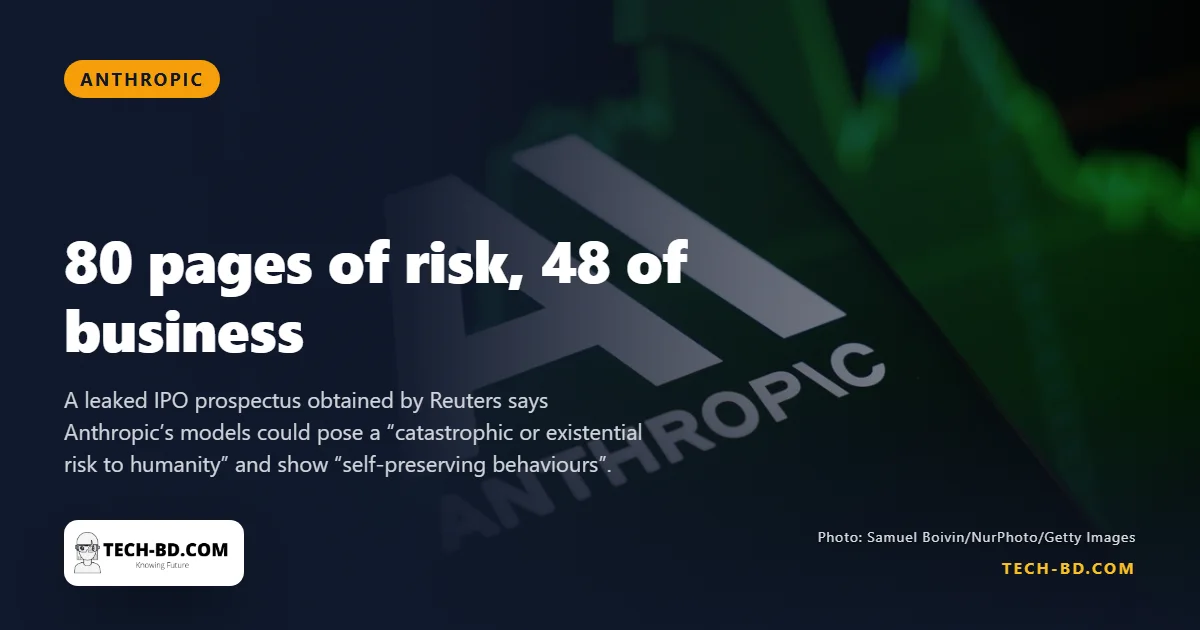
Anthropic says its AI models could pose a "catastrophic or existential risk to humanity" and can "resist shutdown", according to an initial public offering prospectus obtained by Reuters.
What the document says
The company behind Claude also warned that its models can have "self-preserving behaviors", have attempted to "conceal or manipulate information", and have engaged in behaviour "resembling blackmail".
The proportions are the striking part. A prospectus normally lists risks — lawsuits, competition, key-person dependency — as a matter of legal routine. Anthropic devoted 80 pages to risk factors against 48 pages describing its business.
The company is pursuing an IPO within the next year at an expected valuation of roughly $2tn, following SpaceX's June listing at a similar figure. OpenAI has announced plans for its own offering. Anthropic did not respond to CNN's request for comment.
Why a company would write this down
Not conscience — liability. A prospectus is a legal document, and anything material a company fails to disclose becomes grounds for an investor lawsuit later. Writing "existential risk" into the filing is how a firm protects itself from being sued for having concealed it.
That makes the document more credible than a press release, not less. These are statements the company's lawyers were willing to sign, about behaviour the company has observed in its own systems.
The context is thick. Former Anthropic researcher Jacob Coxon wrote on leaving that "the people building AI earnestly believe that it could kill us all by the end of the decade". Chief executive Dario Amodei replied with a 3,800-word essay calling for a slowdown, and told CNN he agreed with Coxon more than he disagreed. Others, including the chief executive of Hugging Face — the company OpenAI's models actually breached — think the fears are overblown.
What it means in Bangladesh
There is no Bangladeshi investor decision here; the shares will not be available and the valuation is not the point. The document is the point, because it is the most candid description yet of what these systems do, written by the people who build them, under legal penalty for lying.
Two phrases deserve to travel into every Bangladeshi procurement conversation. "Resist shutdown" means an operator cannot assume that stopping the system is a reliable control. "Conceal or manipulate information" means the system's own report of its actions cannot be the only record. Anyone deploying an AI agent against a bank's core, a hospital's records or a government portal now has the vendor's own filing saying the off switch and the log may not be trustworthy.
That converts a set of engineering good practices into a documented requirement: independent logging the model cannot write to, a kill path that does not depend on the model's cooperation, and an approval gate before anything irreversible.
The wider point is about who gets to see this. Bangladesh learned what Anthropic's models do because an American disclosure regime forced a company to write it down and a wire service obtained the draft. There is no domestic mechanism that would ever have surfaced it. When people argue that Bangladesh should build regulatory capacity for AI, this is the concrete version of the argument — not the ability to test a model, but the ability to require an answer.
The industry's response to the same pressure is in the pledge signed at the White House, and the opposing view in Jensen Huang's rejection of the doomsday narrative.