
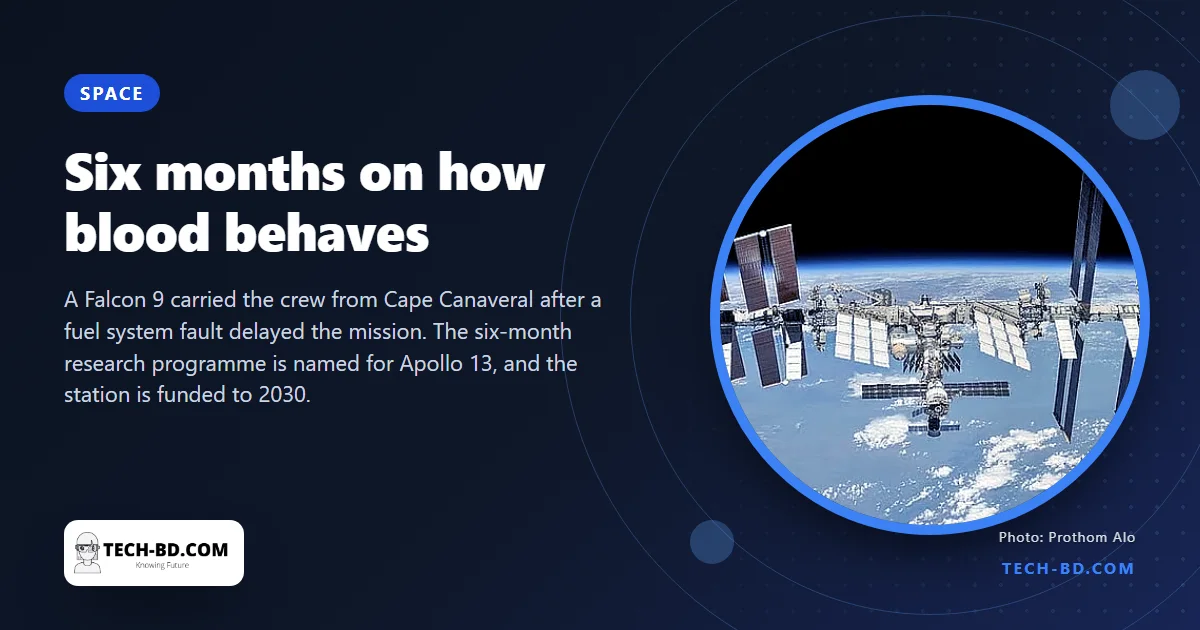
NASA has sent four astronauts to the International Space Station to study what a weightless environment does to the human body. They travelled from Cape Canaveral on a SpaceX Falcon 9 last Thursday.
The mission
The crew will research how microgravity affects blood circulation and the clotting process, and gather health data needed to prepare for long-duration missions.
The launch came about three weeks late after a fault in the Crew Dragon capsule's fuel system.
The mission is led by the American astronaut and geologist Jessica Watkins, with Luke Delaney of the US, Joshua Kutryk of Canada and Sergei Teteryatnikov of Russia. They replace a crew that has been aboard since February.
NASA manager Dana Weigel said the four will carry out six months of research. The mission name and patch honour Apollo 13, the lunar mission of 1970. The station, in operation for more than two decades, is funded to 2030.
What it means in Bangladesh
There is a tendency to treat space station research as remote from a country with no space programme. On this particular subject that is wrong, and the reason is specific.
Microgravity research into clotting exists because weightlessness makes blood behave abnormally — it pools, flow slows, and clots form where they should not. The condition this models on Earth is not exotic: it is what happens to a body that cannot move. Long hospital immobility, post-surgical beds, untreated varicose disease and extended travel all produce the same mechanism.
That makes the ISS a clotting laboratory with a sample size of four and no ethical limit on how long the condition is maintained — which is precisely what a hospital ward cannot be. The findings feed into anticoagulant protocols, compression practice and post-operative mobilisation, and those reach a district hospital in Bangladesh as updated guidance, years later, with no mention of where they came from.
The second point is about the deadline. The station is funded to 2030, and four years is not long for a facility that took a decade to build. What replaces it is likely to be commercial, which means research time will be purchased rather than allocated. Countries that cannot pay will not be on the schedule — and the current arrangement, where a Canadian, a Russian and two Americans fly together under one programme, is the thing being replaced.
Worth noting as well: the launch slipped three weeks for a fuel system fault, and that was reported as ordinary. A programme that delays a crewed launch over a component is a programme working correctly. The contrast with the satellite that came apart on its own is instructive.
That break-up is in the USA 32 story.