
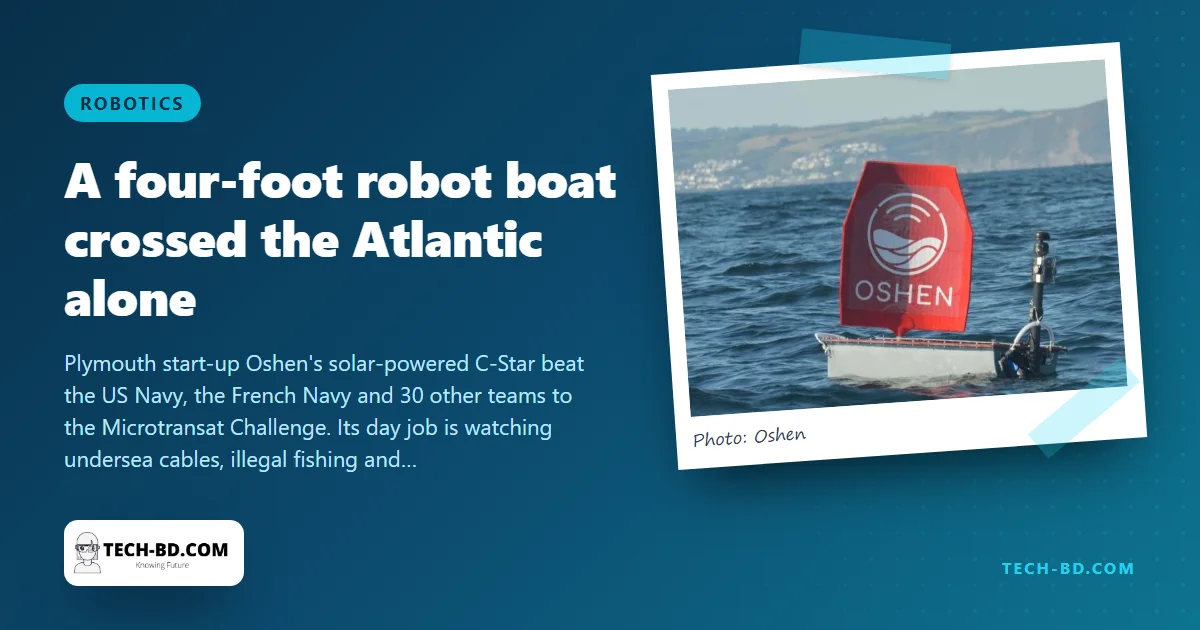
On 13 September a sailing boat just 1.2 metres long crossed a finish line east of Barbados. It had left Gran Canaria on 7 May, covered 2,926 nautical miles, about 5,400 km, and at no point in the 129 days had a human touched it. The C-Star PC13, built by Oshen, a start-up of about 30 people in Plymouth, England, is the first vessel to complete the Microtransat Challenge, a contest set in 2010 by two academics, Dr Mark Neal and Dr Yves Briere, to sail a small boat across the Atlantic with no human intervention. More than 30 teams had tried, among them Shanghai University, the United States Navy, the French Navy and a Polish entrepreneur who came very close.
How it works
The C-Star has a fixed rigid sail rather than cloth; solar panels power the sensors and the small motors that trim the sail to the wind. There is no engine to run out of fuel and, at four feet, not much for a wave to break. "The reason people get sucked in is they think, come on, why can't you get a robot to do what Christopher Columbus did 500 years ago," said Anahita Laverack, Oshen's 26-year-old chief executive and co-founder. "Turns out it's a lot harder than you think."
Three attempts
The first was "a complete failure", breaking down ten days out. The lesson was mundane: "It's very hard to make something easily removable, low cost and waterproof. It sounds very simple, but it turns out it's not." The second boat left Plymouth and lasted 220 days before its mast mechanism failed. By the third, the company was routinely running missions of more than 100 days and was "relatively confident" it would cross. Laverack says she tried not to get her hopes up while tracking it: "I really didn't want it to crash or break a few days out and for us all to be heartbroken." The boat's data will be downloaded and the vessel itself retired to a turtle sanctuary in Barbados.
What the boats are actually for
The Atlantic crossing is the advertisement. Oshen sells C-Stars as sensor platforms: navies use them to watch undersea data cables and pipelines, fisheries agencies to spot illegal fishing and "dark fleet" tankers that switch off their transponders, and scientists to collect ocean, climate and wildlife data. One sailed straight into Hurricane Humberto, a category five storm, and kept reporting. A boat that costs a fraction of a crewed vessel, needs no fuel and can stay at sea for months changes what a poor coastal state can afford to know about its own waters.
The Bay of Bengal problem
Bangladesh has 118,813 square kilometres of maritime area after the 2012 and 2014 tribunal rulings, a submarine cable that carries most of its internet, a hilsa fishery that the state tries to protect with a 22-day ban policed from a handful of coast-guard boats, and cyclones that form in the same waters every year. It has almost no instruments at sea: the Meteorological Department's cyclone track relies on satellites and foreign models, and nobody watches the cable landing at Cox's Bazar from the water. A fleet of robot sailboats at Oshen's price would not replace a navy. It would, for the first time, tell Bangladesh what is happening in the Bay before it arrives on the coast.