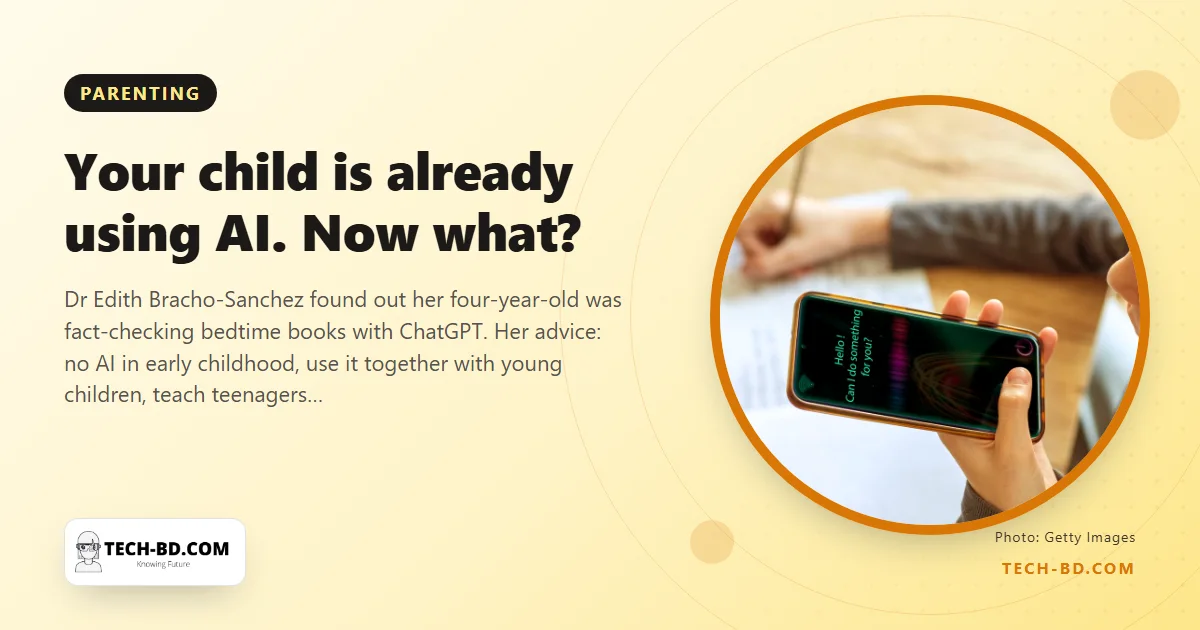
Dr Edith Bracho-Sanchez, a paediatrician who writes for CNN, was reading a bug book to her four-year-old when he corrected it: cockroaches lay hundreds of eggs, not millions. He had checked, a week earlier, on his father's phone. "Siri is really only good for the weather, Mama," he explained. "If you want to know real things, you have to ask ChatGPT." Her point, in the essay that followed, is that the question for parents is no longer whether children should use AI. Many already do. The question is how.
Why AI is not screen time
Parents have a framework for screens: hours, and content. AI needs a different one, she argues, because it talks back. It remembers what a child asked yesterday, answers them specifically and in real time, and produces "something that looks an awful lot like human attention". The risk is not hours spent but reliance: homework answers arriving before the child has worked the problem, or a bot quietly taking the place of a confidant "without anyone ever deciding that should happen".
What changes with age
Small children are built to trust confident adults; that is how they learn language and rules. A six-year-old cannot consistently question a source, so a chatbot that sounds like a knowledgeable grown-up is believed. They also attach easily to anything that responds predictably, without understanding that the thing responding is not thinking or feeling. Her position is blunt: children should not use AI in early education at all. Childhood learning is supposed to be inefficient, guessing, getting it wrong, arguing about why, and AI is "extraordinarily good at collapsing that space". Sometimes the right answer to "I don't know" is still "What do you think?"
Older children can be taught scepticism: that an answer can sound certain and still be wrong, how to check a claim elsewhere, and what should stay private, because these programs collect and keep data. The transition to watch for, she says, is "when does your child stop asking AI things and start talking to it?"
Teenagers know a chatbot is not a person, but knowing it and feeling it differ, "especially at 11 p.m., when they may be alone, anxious or sad". Something that never judges, never gossips and is always available is compelling to an adolescent working out friendship and identity. The question becomes whether AI is supplementing their social world or substituting for it: the text to a friend, the talk with a parent, the appointment with a counsellor. They should also understand that some AI products are built to keep them engaged, with incentives unlike those of anyone who actually cares about them.
Her rules, and ours
- With young children, use AI beside them, never hand it over. Name it plainly: "a computer program that generates answers; not a person; sometimes wrong."
- Keep its job narrow: a factual question you look up together, not the reflex for every "I don't know".
- From about ten, teach checking: ask the same question twice, or in two apps, and compare.
- Agree what never goes into a chatbot: full name, school, address, photos, family problems.
- Model it. Children copy what you do with your phone, not what you say about theirs.
In Bangladesh the pattern is already the same, with one difference: here the AI is usually on a shared family phone, and the "homework help" is often a coaching centre's WhatsApp group where the answers come from ChatGPT anyway. A report published in England this week said schools are "crying out" for guidance. Until someone provides it, the guidance is going to have to come from the sofa.