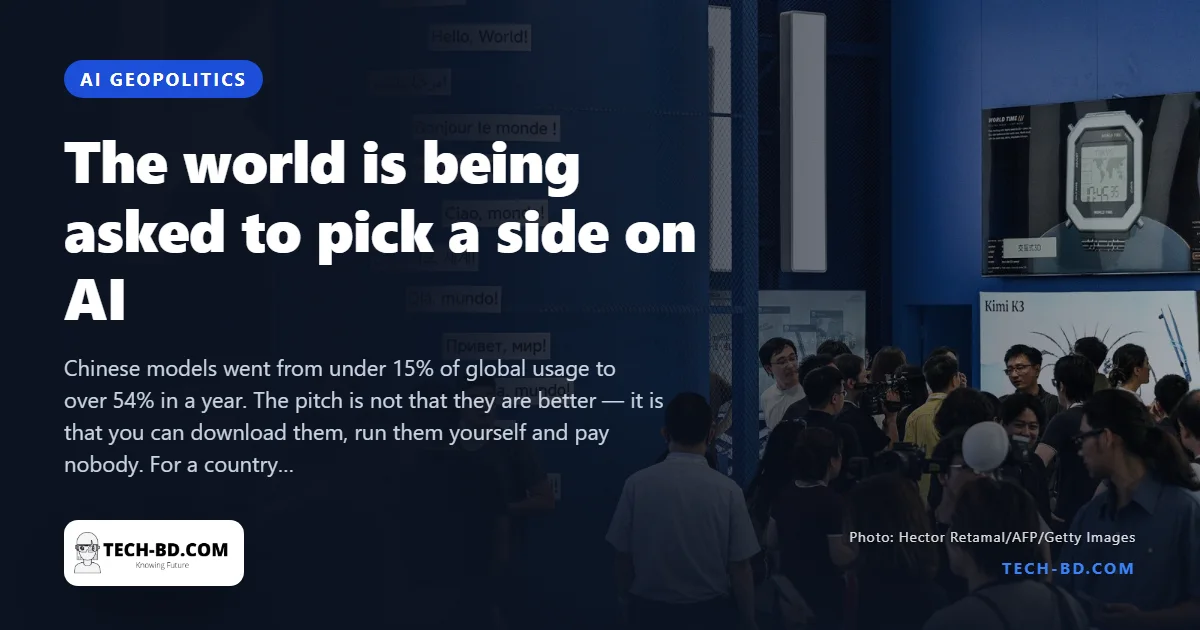
The argument between Washington and Beijing over artificial intelligence is no longer only about who builds the best model. It is about which offer the rest of the world accepts — and on that question the numbers have moved fast in one direction.
A year that changed the market share
Chinese models' share of global usage rose from under 15% to more than 54% in about a year, led by DeepSeek, according to leaderboard data from OpenRouter, a marketplace that routes traffic to models. American companies are among the users: Airbnb, DoorDash and Shopify have all adopted Chinese models, for the reasons anyone would — lower cost and more freedom to customise.
The United States still has the obvious advantages: the pioneering labs, the most advanced chips, the deepest investors. "Whoever wins AI wins," President Trump said this month. But the American offer is a subscription to a proprietary system running on a foreign cloud, and the Chinese offer is a file you download, modify and run on your own hardware without paying anyone a licence fee.
Two clubs, two lists of members
The split now has institutions. Trump formed the Pax Silica alliance last year to reduce reliance on China across AI supply chains, and more than two dozen countries plus the European Union signed up. In July, Xi Jinping launched a rival body, the World Artificial Intelligence Cooperation Organization, and has recruited 29 countries including Russia, Indonesia and Pakistan.
Eric Olander, editor in chief of The China-Global South Project, makes the practical point: for a developer outside the rich world, an inexpensive Chinese model may simply be more useful than a slightly more capable system that needs an expensive subscription and access to a foreign cloud provider. He also notes where the money may actually land — not necessarily with DeepSeek or Moonshot, but with Huawei, ZTE and the firms supplying everything around them.
His analogy is worth keeping. "Is Apple winning the mobile phone race?" he asks — fewer people use Apple products, but Apple takes most of the profit. The likely outcome, on that reading, is the US holding the profits while China accumulates the users.
The question every buyer is actually asking
Chucheng Feng of the advisory firm Hutong Research reduced it to one sentence: do you want a model that costs ten times as much and is six months ahead, or one that costs a tenth as much and is six months behind? As capabilities converge, the gap between the frontier and the tier below it matters less to most businesses than the invoice does.
The catch in the Chinese offer
Openness is not a permanent guarantee, and it was partly an accident. US export controls on advanced chips and smaller capital markets pushed Chinese developers toward open models as the way to compete. Alex Colville of the Australian Strategic Policy Institute expects that to bend as the models get stronger: Beijing wants the influence that exporting its technology brings, he says, but national security comes first, and the likely path is licensing rules restricting where certain models may be used rather than a blanket closure. Reva Goujon of Rhodium Group puts the risk plainly — China's strategy is compelling only for as long as the models stay open enough to adopt and fine-tune.
The Trump–Xi summit this week produced a proposed AI safety notification system and an agreement to hold a formal dialogue, and not much else. That is the same pattern as the UN, where Altman and Amodei asked for global standards the US delegation then rejected.
What it means in Bangladesh
Bangladesh is precisely the country being asked to choose, and the honest answer is that it should not choose either exclusively. The economics are not close: a Dhaka startup paying frontier API prices is paying in dollars, from a country with a hard currency constraint, for tokens it could generate on a rented GPU with an open model. That is why open weights are the default here whether or not anyone announces a policy — and why the data-centre build-out we wrote about this week matters more to this region than the model leaderboard does.
Three things follow for anyone making the decision. Build on an interface, not a vendor — if your code calls one provider's SDK directly, you have chosen a side by accident. Test Bangla output specifically before committing, because the gap between models is much wider in Bangla than the English benchmarks suggest and the leaderboard will not tell you. And for anything touching citizen data, weigh the ability to run the model inside the country above the last few points of benchmark score, because that is a capability an open model gives you and a subscription does not.