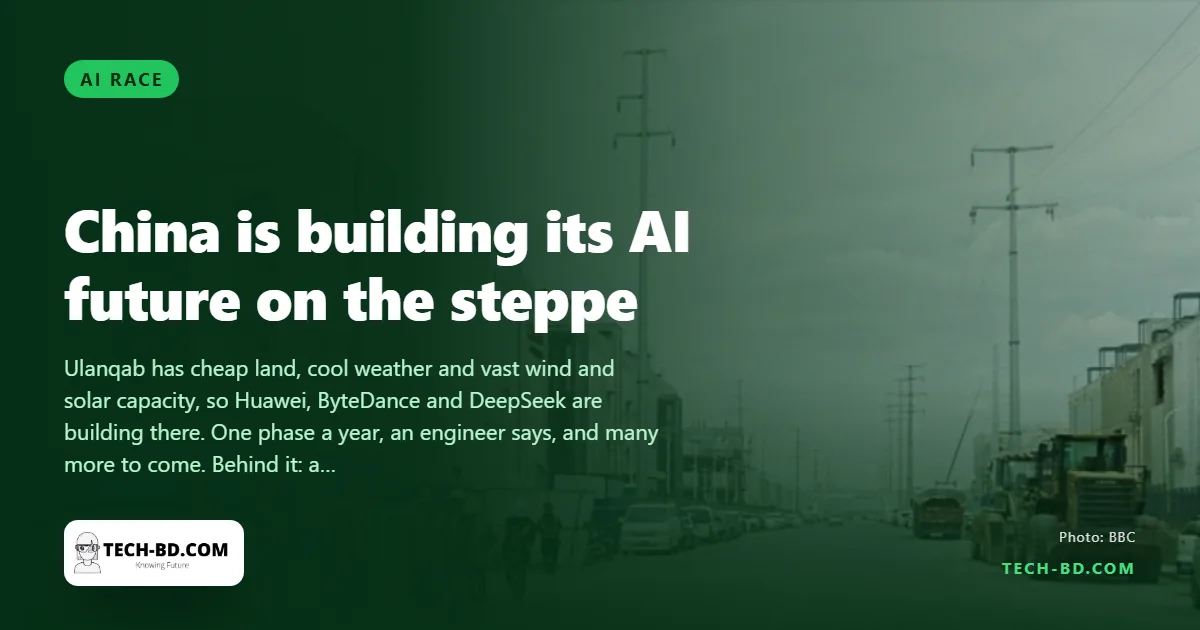
Ulanqab, on the steppes of Inner Mongolia, spent years as China's official "potato capital". Its fields are now construction sites. Hundreds of workers in yellow helmets carry equipment past welding sparks while cranes set rooftops in place — data centres, going up one phase a year. "This is China speed," one worker told the BBC, describing his country as "an infrastructure maniac". An electrical engineer was more precise: "There is one phase every year. This is the second phase. There will be many more phases afterwards."
Why the steppe
China is building hundreds of data centres — for Huawei, ByteDance and DeepSeek among others — in its sparsely populated provinces: Ulanqab, Ningxia and Gansu in the north, Guizhou in the south-west. The logic is physical. Those regions already have vast wind and solar capacity, land is cheap, and the weather is cool, which means far less water is needed for cooling. A data centre is, in the end, a building that converts electricity into computation and heat, and these are the places where electricity is cheapest and heat is easiest to shed.
What Beijing wants from them
To the Chinese Communist Party the buildings are critical infrastructure for economic and national security, and the means to a stated goal: embedding AI across 90% of industries and society by 2030. The computing power inside them is what the contest with the United States now turns on.
China is also building the people. Jack Zhang of the University of Science and Technology of China, recruited home after studying at Yale and Cambridge, told the BBC the flow has reversed: "Fewer students and researchers are heading to the US, and more are returning from the US to China. That is very clear." His reason for returning was practical — applying lab AI work to health and medicine "requires more resources, more people and sometimes more government support, which can be difficult to access overseas."
Open models as strategy
Beijing is pushing its AI firms towards affordable, open-source models that anyone can download and modify — the opposite of the closed approach at OpenAI and Anthropic, where design details stay secret. This is partly conviction and partly necessity: sharing has let Chinese firms improve quickly despite being cut off from the most advanced chips. Xi Jinping has also repeatedly called for global AI regulation and a framework others would follow, which is a bid to write the rules as well as the software.
All of this frames the White House summit this week. "Whoever wins AI, wins," President Trump said last week. Anthropic's Dario Amodei has argued for keeping the US ban on selling advanced chips and equipment to China, warning that a Chinese lead would "pose grave danger for the US and the world". The state-run Global Times dismissed such fears as a "Cold War playbook" to contain China's rise.
What this has to do with Bangladesh
Two things, both practical. First, open weights: the models Bangladeshi developers and students can actually afford to run — DeepSeek, Qwen, and the Llama family — exist because of the open-source strategy described above. If that strategy holds, the cheap end of AI keeps improving; if the two governments strike a deal that narrows it, the cheap end stalls, and a country with no chips and no data centres feels it first.
Second, the physical lesson. Ulanqab was chosen for cheap power, cool air and spare land. Bangladesh has none of the three: electricity is expensive and imported-fuel dependent, the climate is hot and humid, and land near Dhaka costs more than the building on it. That is the real reason there is no serious AI data centre here, and no amount of policy language about a "smart" economy changes the arithmetic. What the country can realistically own is the layer above — the applications, the Bangla data, the services — which needs engineers rather than transformers.