
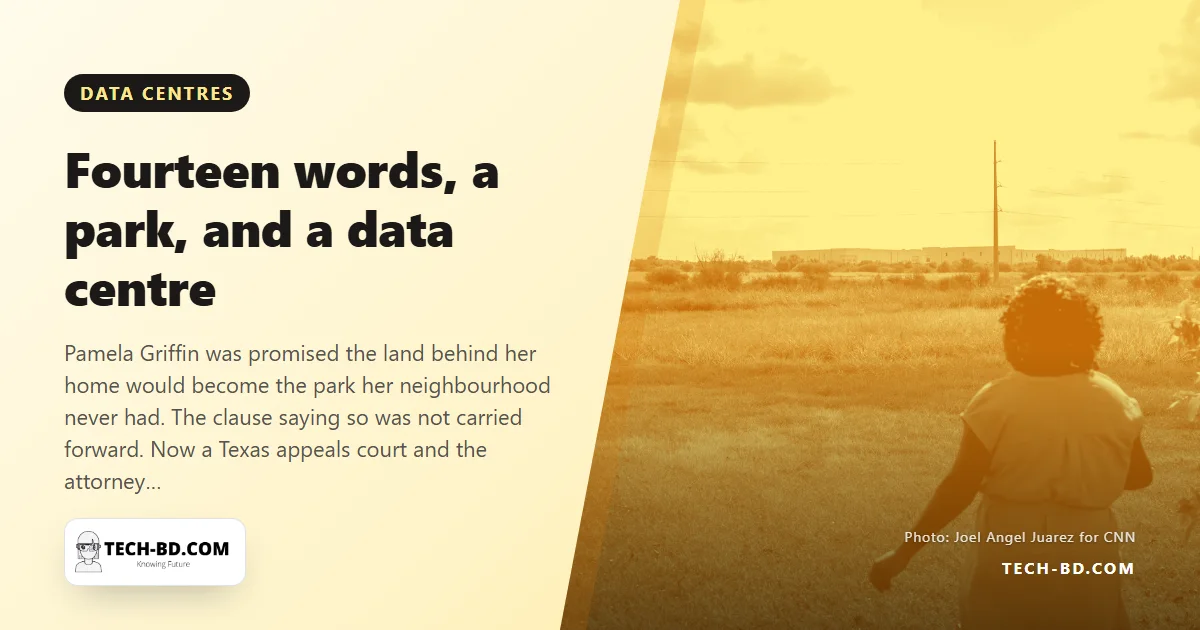
In Taylor, Texas — a town of about 18,000 people some 25 miles from Austin — a retired learning centre director is fighting to stop a data centre being built on land her neighbourhood was promised would become a park.
The missing sentence
The dispute turns on 14 words in a 1999 deed, intended to secure the land's future as a park, which were not carried forward as the property changed hands. Without them, the plot is on track to become something else entirely. Pamela Griffin, 58, learned about the plan from a flyer on her door: three 45,000 square foot data centres, coming to her backyard.
A Texas appeals court is now considering her complaint, and state Attorney General Ken Paxton has opened an investigation into whether the original language on the property's use was legally changed or removed — and whether it still carries weight today.
Why the land matters to her
The history is inseparable from the legal question. Griffin's grandmother worked as a maid and picked cotton in Taylor, and after the Fair Housing Act made housing discrimination illegal she bought parcels on the south side of town for each of her eight children. Griffin now lives in the house her father built.
As a girl in the 1970s, she and other children were kept away from the nearby Fannie Robinson Park — a former city dump that became the town's first park for Black residents in 1955 — after some of them developed rashes or fell ill. An empty lot her father bought became their informal playground instead. It bordered 87 acres owned by descendants of Howard Bland Sr, a 19th-century community leader, businessman and state lawmaker, whose family had told her father they hoped one day to turn the property into a real park.
"My daddy passed this land down to us and he told us to guard this land," Griffin said. She returned to Taylor in 2019 after her parents died.
The pattern behind it
Like other towns meeting a data centre for the first time, residents are worried about noise, water use and power shortages. Those three complaints now follow the AI build-out everywhere, and they tend to surface after the land is already committed.
What it means in Bangladesh
Bangladesh is at the start of this. Data centre projects are being planned around Dhaka and in the economic zones, and the same three pressures apply harder here — grid capacity is already the binding constraint on industry, and cooling in this climate means water.
The transferable lesson is not about protest, it is about paperwork. In Bangladesh the equivalent of Griffin's 14 words is a land record: mutation entries, khatian corrections, conditions attached to a transfer that quietly do not survive the next deed. Anyone whose land sits near a proposed project should pull the current record now rather than after a notice arrives, and check that any condition they believe protects it is actually written in the live document.
The other half is disclosure. Before a project is approved, the megawatts it will draw and the water it will use should be public numbers, because those are the costs the neighbourhood pays and they are decided long before anyone is consulted. We looked at the scale of this build-out in the Inner Mongolian plains where the AI race is being built; Taylor is the same story at street level.