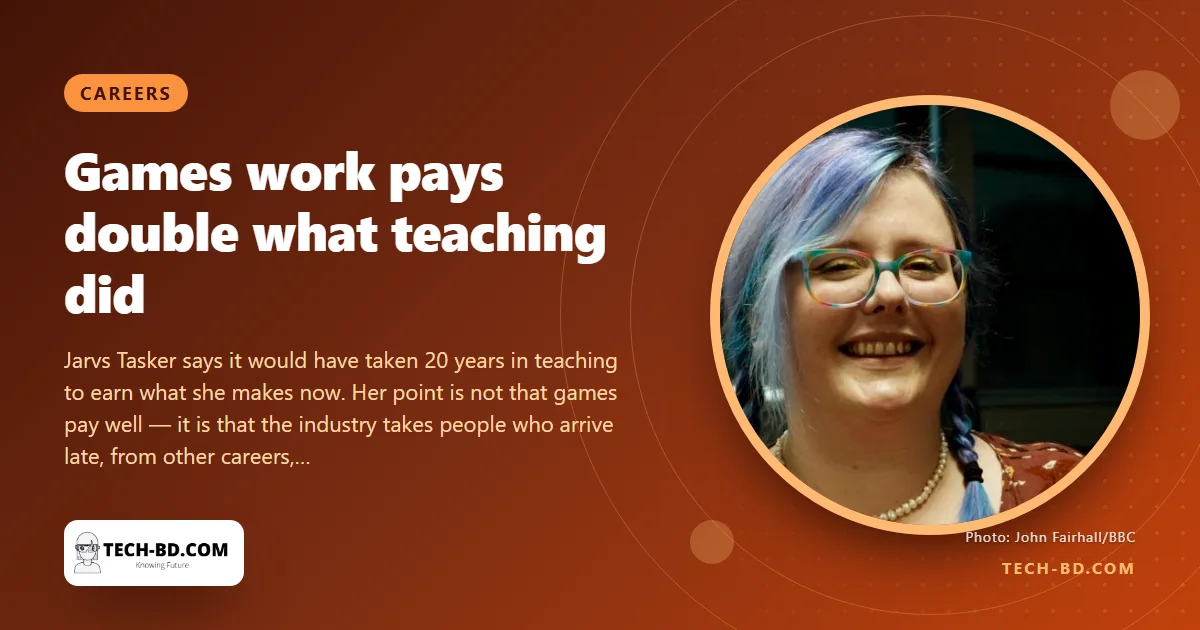
In 2019, Jarvs Tasker gave up teaching at 28 because of chronic illness. Seven years later she runs Jarvs Indie Insights, doing communication and marketing for the games industry, and earns double her old salary. "I can comfortably say it probably would have taken me about 20 years in teaching to earn what I make now," she told the BBC.
The route in was sideways
She did not retrain as a developer. She started by volunteering for PlayStation's YouTube channel, and found the skills carried over more than she expected — managing a community, she said, is very similar to managing a class of children.
Her wider point is about who the industry takes. Video games, she said, is one of those industries a lot of people come into later in life, and young people often do not know how many pathways there are. The community champions people who love the work, she added, but it also notices when someone is in it only for the money.
Tasker was speaking at the University of Suffolk's e-sports building in Ipswich, at an event run by Game Anglia celebrating independent developers in the East of England.
A sector that is bigger than it looks
Mark Backler of Game Anglia said games is now one of the biggest industries in the UK and, while competitive, it is more possible than ever to develop and release your own game — like being a content creator, he said: hard to be a standout, but doable.
Developer Sam Read-Graves said the industry had grown massively in ten years, with clusters of students and developers across Suffolk, Essex, Cambridgeshire and Norfolk. The big titles will not come out of the East of England, he said, because the big studios are not there — but there is no reason an independent game cannot be as big financially.
Abbygale Dunn, 22, founder of Astral Forge in Essex, said there is now plenty of space for women in the industry.
On AI, Tasker's view was striking given the week's news: she thinks the industry is doing a really good job of rejecting it, because players hate it, and said the sector should be proud of still championing human creativity with the audience on board.
What it means in Bangladesh
Bangladesh has the raw material — a young population, a large freelancing base, art and animation talent that already sells abroad — and almost none of the structure. There is no Game Anglia here: no regional cluster, no showcase event where a student meets a studio, no route from a university lab to a released title.
What is realistically available is the side door Tasker used. The games industry does not only hire programmers; it hires community managers, QA testers, localisation staff, 2D and 3D artists, sound designers, and marketing people who understand players. Those are jobs a Bangladeshi freelancer can do remotely today, and several of them reward exactly the skills teachers, customer-support staff and moderators already have.
Two practical notes. Build a public portfolio on itch.io or a small released project rather than a CV, because that is what studios actually read. And look at localisation seriously — Bangla is a large market that almost no studio serves properly, and being the person who can test and localise a title is a narrow door with very little competition behind it. The caution is the one running through our freelancing coverage: whoever you work through, make sure the account and the earnings are in your own name, as the allegations BASIS is now investigating show what happens when they are not.