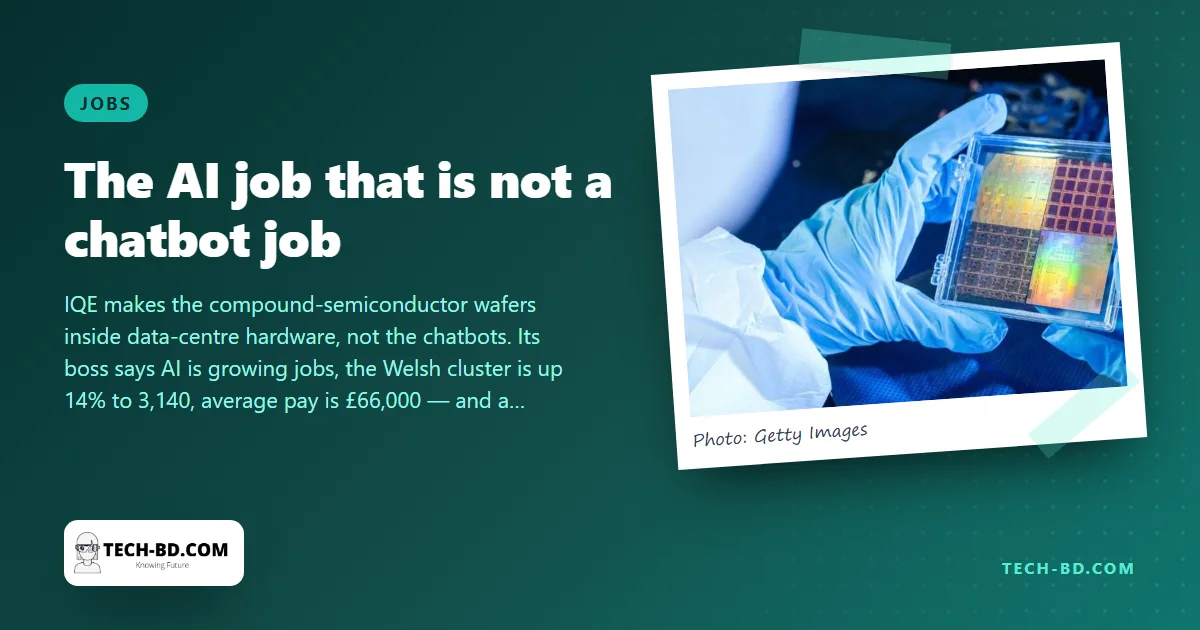
In a metal building beside the M4 in Newport, south Wales, engineers in coveralls grow the wafers that end up inside AI hardware. The company is IQE, in production since 1988, and its chief executive has a line worth testing: "We are growing great jobs based on AI and supporting AI, quite the opposite from destroying jobs by AI."
That claim lands in a week when the other kind of AI headline is everywhere. Oracle has cut 21,000 roles worldwide while reshaping itself around the technology; Amazon and Meta have cut thousands more while spending heavily on it.
What IQE actually makes
The distinction is the whole story. IQE's chips are not the algorithms you talk to. They are compound semiconductors — part of the physical architecture of data centres, sitting in the hardware that carries and switches the signals underneath everything else. When the AI boom turned into a construction boom, demand for that hardware went up.
The company had a rough ride first. "The last 18 months were quite bumpy," the chief executive admits; IQE struggled to hold investors' attention. Earlier this year its role in data-centre computing was recognised, the share price rose quickly, the firm cleared its debts and started hiring again. "We're really lucky to have a very dedicated workforce that stuck with us throughout this bumpy road," he said. "Talent, for IQE, is one of the biggest assets that we have."
The numbers behind the cluster
Newport has built a semiconductor cluster around firms like IQE. An independent report for CSconnected by Cardiff University's Welsh Economy Research Unit found the south Wales compound semiconductor sector supported 3,140 jobs across Wales in 2025, up from 2,748 the year before — a 14% increase. Of those, 1,914 were direct industry jobs, concentrated around Newport and the M4 corridor. Average salaries in the sector were about £66,000. For comparison, the Office for National Statistics put median UK pay in August at £2,657 a month, about £31,884 a year.
The UK's AI minister, Kanishka Narayan, said Wales had to "reindustrialise itself" for an AI future while "supporting everyone who is affected" by the change.
They start at 15
Two miles from the plant, Bassaleg School is among the first in the UK to offer a semiconductor qualification. Head teacher Victoria Lamb said it lets students learn about an industry "right on their doorstep", and that it matters to "work with our community to offer pupils these kinds of opportunities". Grace, 15, was blunter: "It is really good fun. We are doing practical work, and before the course I used to think semiconductors were all on a computer."
The lesson for Bangladesh
Bangladesh's AI conversation is almost entirely about the top layer — prompts, chatbots, content, and the freelancing that sits on top of them. That is the layer with the lowest barrier to entry, which is also why it is the layer most exposed when a model gets better. Newport is a reminder that the AI economy also has a physical floor, and the jobs there are the ones paying twice the national median.
Bangladesh will not be growing gallium arsenide wafers soon. But the transferable part is not the fab; it is the sequence: a cluster of firms doing one specific thing, a university unit measuring it honestly, and a secondary school two miles away teaching the subject to fifteen-year-olds. The country has the pieces — Bangladesh Hi-Tech Park Authority's parks, a chip-design industry at Ulkasemi and a handful of others, and more than a hundred universities teaching EEE. What it does not have is the link from the classroom to a named local employer, which is exactly what Bassaleg School built.