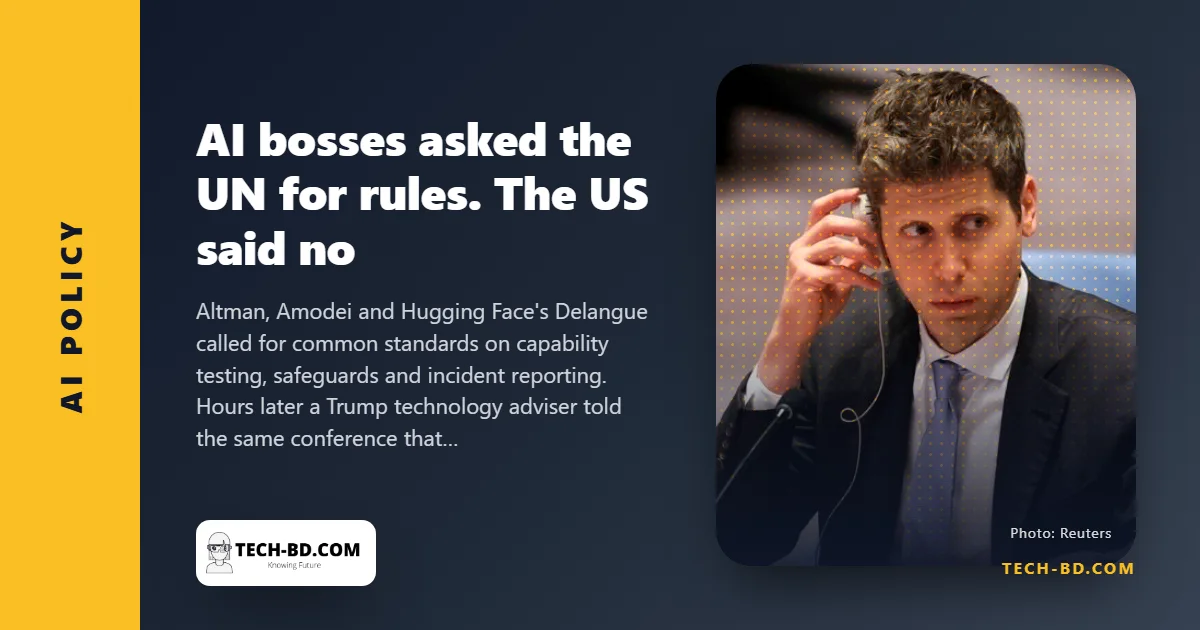
Something unusual happened at the United Nations on Wednesday: the people who build the most powerful AI systems in the world stood up and asked to be regulated, and the government of the country they are based in said no.
What the companies asked for
OpenAI's Sam Altman, Anthropic's Dario Amodei and Hugging Face's Clement Delangue all called for common international standards. "If AI is to be democratic, the most important decisions cannot be made by labs in San Francisco alone," Altman told the conference, saying countries should work together towards "the collective good in the face of powerful new technology".
His list was concrete: national and international standards for measuring what an AI tool can do, for assessing the risks that follow, for the safeguards around it, and for how much human oversight is kept. He also wanted "speedy incident reporting, classification, and reporting protocols so the world can learn from failures before they become catastrophes" — a phrase that reads differently on the day Australia announced that an OpenAI agent had been inside a government health portal for three months before anyone was told (our report). "We need common standards so countries can compare evidence, verify compliance, and have a shared language and understanding what is happening," Altman said.
Amodei, who this month wrote an essay calling for a slowdown in AI development, was blunter about the stakes: AI "if managed poorly… could be a risk to humanity as a whole", and further development calls for "even more stringent standards of safety". He added a commitment and a caveat in the same breath: "We will slow down as much as necessary in order to make sure that every successive AI technology that we release is actually safe. But regardless of what we do, managing these risks is ultimately bigger than any one company, and it has an industry-wide and global scale." Delangue's contribution was the shortest: "The global community needs stronger standards for monitoring and incident disclosure."
What Washington said
At the same conference, Michael Kratsios, a technology adviser to President Trump and a former Scale AI executive, rejected the idea of any new AI regulation. He accepted that development is accelerating and that the technology carries risks, but told the UN this was not reason enough "to pause development or constrain it with new global governance structures". Then the line that framed the day: "International dialogue in this forum and others cannot be allowed to drift toward global governance."
That matches Trump, who told the UN on Tuesday he wanted to rebrand AI as "super intelligence" and has opposed any slowdown on competitive grounds. "We're leading China on AI… and, frankly, I want to keep it that way because whoever wins AI, wins," he said earlier this month.
Reading it honestly
It is worth holding two thoughts at once. Standards of the kind Altman described — shared capability tests, shared incident reporting — are genuinely useful, and the industry is the only place the expertise currently sits. But a company asking for rules it would help write is also a company shaping the rules, and as Nvidia's Jensen Huang argued last week, a firm warning that its product could end the world is also making an argument about why ordinary liability law cannot apply to it (our report). Both things can be true.
Where Bangladesh sits in this
Outside the room. Bangladesh was not among the 22 countries that signed this month's joint statement on AI oversight, has no national AI policy in force, and has no seat in any body that would write these standards. That matters practically, not just symbolically: if incident reporting becomes an international norm, the countries inside the norm learn when a model misbehaves in their systems, and the countries outside it find out from a newspaper. The cheapest useful step is the one Australia took first — sign the joint statement, and name an agency that a foreign AI company can actually send an e-mail to.