On Thursday afternoon a fire broke out in Khaja Tower in Mohakhali, a fourteen-storey building that, unknown to most of the people who depend on it, houses several of Dhaka’s internet service providers, an international gateway and the data centres of at least two large hosting firms. Three people died. Across the country, roughly a fifth of broadband users lost their connection, some for days. On Saturday, with the building still cordoned off, the country’s system administrators gathered a kilometre away at BRAC Inn for a symposium planned months earlier on a different subject.
The programme
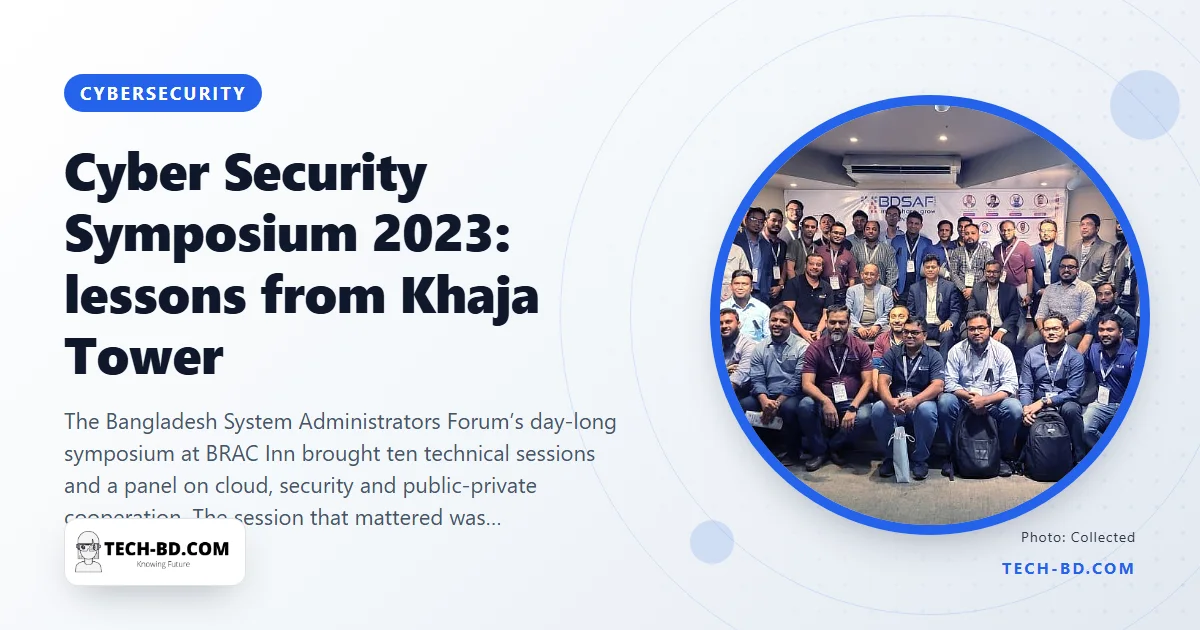
The Bangladesh System Administrators Forum (BDSAF), an association of about 5,000 IT professionals, ran Cyber Security Symposium 2023 as a full day: ten technical sessions, a panel and a quiz. The ICT Division’s secretary, Md Shamsul Arefin, opened it by video, calling IT the foundation of Smart Bangladesh and asking the room to build a safe cyberspace. BDSAF president Md Jobaer Al Mahmud Hossain said that with adequate support the forum could bring foreign dependence in cloud computing and other emerging technologies down to zero. Adviser Shayerul Haque Joarder gave the keynote: cybersecurity is no longer an IT function but needs an integrated strategy across the organisation. Saif Rahman, chief operating officer of the government-backed Meghna Cloud, argued for public-private cooperation in cloud and security.
Who taught what
The technical sessions were led by practitioners: Grameenphone’s head of cloud network and security Ruskin Paul, principal security architect Mohammad Shahadat Hossain and head of information security Muhammad Shawkat Ali; icddr,b system administrator Shankar Nandi; BGIT’s head of DevOps and cloud engineering Amir Hossain; Brain Station 23’s chief technology officer Md Mizanur Rahman; Dhaka University network engineer Md Mehedi Hasan; Contessa Solutions’ SM Rubayet Islam; Alpha Connection’s Ahmed Saif; Akij Venture Group’s head of information security Shahanaz Begum, among others. The panel — Contessa’s Lutfor Rahman, Community Bank’s deputy managing director MA Qaium Khan, Deloitte Bangladesh director Muiz Tasnim and Robi vice-president Sanjay Chakraborty, moderated by BDSAF general secretary Mohibbul Muktadir — was scheduled to discuss governance.
What everyone actually discussed
Khaja Tower. Session after session returned to it: a single commercial building, with a single power feed and no fire-suppression designed for server rooms, holding infrastructure that a national network depended on, in a city where fire codes are theoretical. The experts’ demands were concrete. Mandatory assessment — structural, electrical, fire — before a data centre may be established in a building. IT asset registers, so that an organisation can say what it lost and what it needs to restore. Disaster-recovery plans with regular drills, coordinated across operators, so that the next fire moves traffic to a second site in minutes rather than days. None of it is new; all of it was ignored until Thursday. A symposium on cybersecurity had found, on its own doorstep, that the biggest threat to Bangladesh’s internet in 2023 was a short circuit.