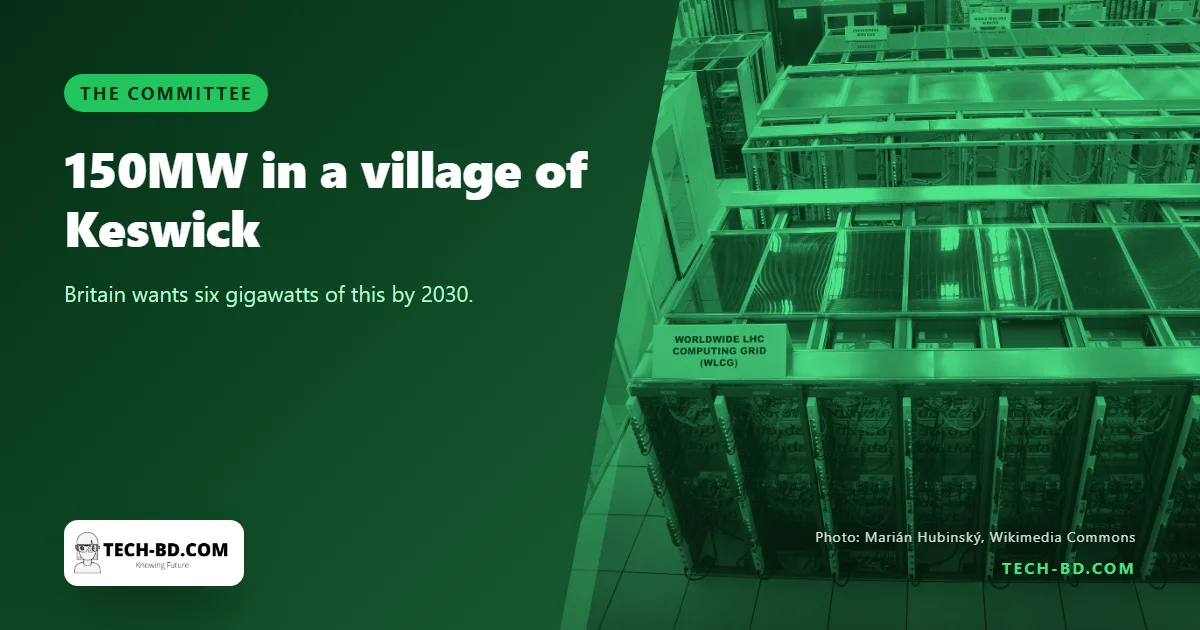
Ben Goldsborough, the Labour MP for South Norfolk, has been one of the louder voices against a 150 megawatt data centre proposed for the village of Keswick, near Norwich.
He has now been appointed to a new data centre committee that will scrutinise the government's national policies on exactly that kind of development.
He does not think this is a contradiction, and his explanation is worth reading carefully, because it is the argument every country with a grid is about to have.
What he accepts
Goldsborough admits data centres are needed, and says they "support business, innovation and the technologies of the future". He insists he is not at odds with his own government's position, which wants them built to "power the age of AI".
Britain classed data centres as critical national infrastructure last year. The target is six gigawatts of continuous capacity by 2030.
What he objects to
His objection is not to data centres. It is to a particular one, in a particular place, built for a particular customer.
"What we're seeing with the Keswick one is a mass mega data centre, which is only going to benefit the likes of Elon Musk, Google and others," he said. "We need data centres which are built in the local interest for local people."
He worries about the environmental impact on nearby nature sites, and wants heat generated by the site used to warm homes rather than vented. He likens the growth of these facilities to a "gold-rush" by private companies, and says legislation "hasn't caught up with the times".
He points to a data centre at Norwich Research Park as the version he would accept, calling it built in a "mindful way". The distinction he draws is ownership of what is inside: "Most importantly it is sovereign data for our research institutions, not a mega data centre which just holds data for whoever pays the highest price."
The developer disagrees on the site. It argues the location is good — next to a dual carriageway, on land already earmarked for a business park, and close to a substation for a new wind farm off the Norfolk coast — and that the scheme would boost Norwich's economy.
What the committee is actually for
This is the part with consequences beyond one village. Goldsborough will contribute to a National Policy Statement, currently in draft and out for consultation, which sets the terms planning decisions are made against.
The draft's foreword states the tension plainly: "Britain must build the infrastructure that will power the age of AI, but this government believes how it is built matters just as much as how much we build."
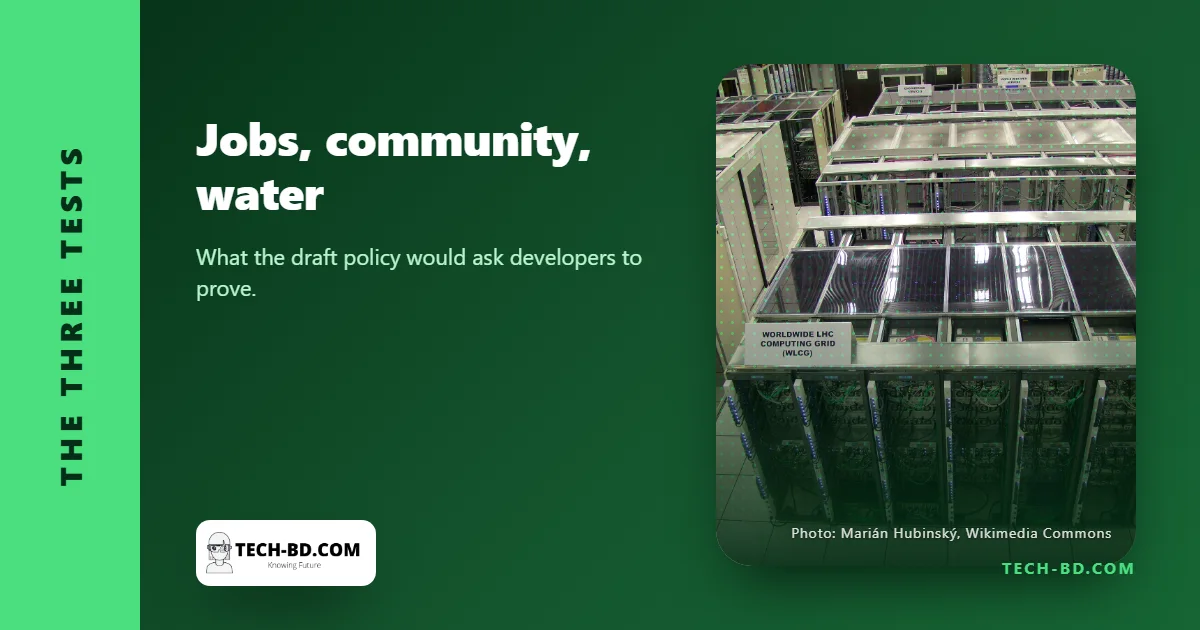
The conditions themselves are not new. The chancellor set them out in the October Budget — local investment, local jobs and local water, traded for a grid connection. What the policy statement does is turn that bargain from a speech into the document planning inspectors have to apply, which is the step where the exact wording starts to decide cases.
Norfolk will feel the result either way. Plans have also been lodged for what would be one of the largest data centres in the country near King's Lynn.
What this means here
Bangladesh is not fielding 150MW hyperscale proposals, and the constraint here is different: the grid, not the planning objection. But the three conditions in that British draft travel well, and they are worth writing down before the first serious proposal arrives rather than after.
Local jobs is the weakest of the three, and the honest reading of the sector is that a large data centre employs very few people once it is running. Local water is the one that gets underestimated — cooling at this scale is a water question before it is an electricity question. And investment in the community is the only one that converts a national asset into something the people next to it can point at.
Goldsborough's formulation is the useful one, whichever country is asking. Not "should we build these", but "whose data is in it, and who gets the heat".