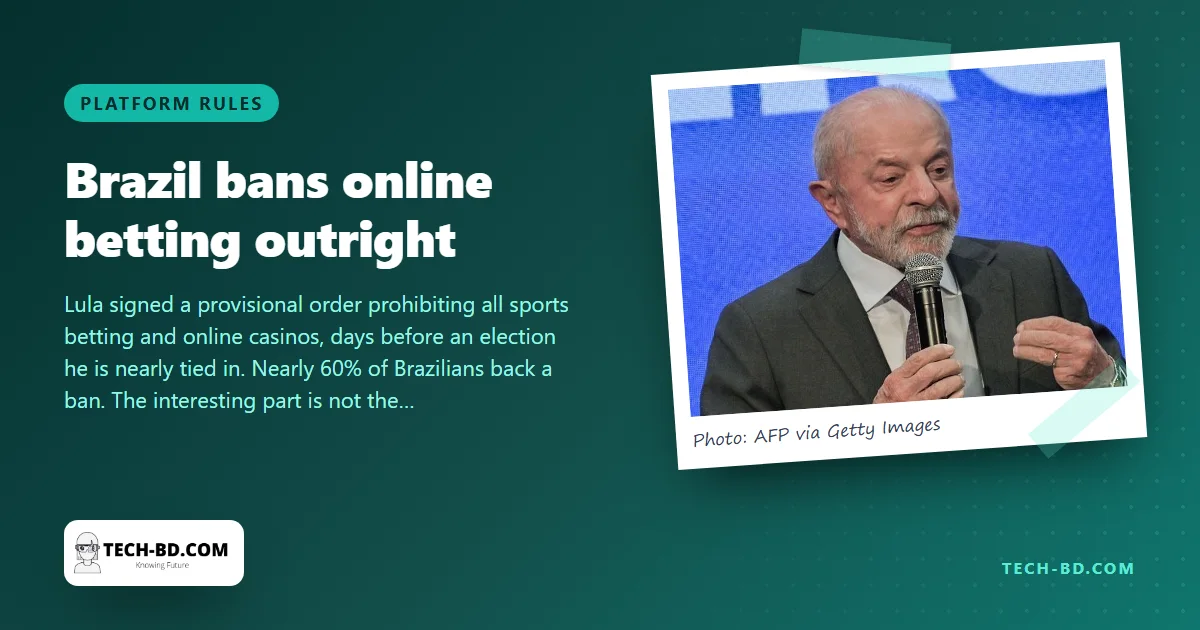
Brazil legalised online betting in 2018. On Friday, President Luiz Inácio Lula da Silva signed a provisional order prohibiting all sports betting and online casinos — a reversal of national policy, announced just over a week before the first round of a presidential election in which he is seeking a fourth term.
What was signed, and what still has to happen
The order takes effect now but is not permanent: it must be approved by congress within 120 days to remain in force. Lula separately signed a bill penalising criminal offences related to fixed-odds betting. He has described the industry as a cancer, saying either the tumour is removed or it kills us, and told of families who had sold everything in their houses because of gambling addiction. At the UN General Assembly this week he accused the industry of turning addiction into profit.
His account of how it grew is pointed: online betting was created under Michel Temer's administration, he said, but expanded without regulation under Bolsonaro's — with no restrictions worth the name on children and adolescents reaching it.
The politics, stated plainly
The timing is not incidental. Lula, 80, is running against Flávio Bolsonaro, son of the incarcerated former president, and recent polls put them almost neck and neck. Flávio Bolsonaro called the crackdown populist, hypocritical and politically motivated.
The polling complicates that dismissal. A survey by Atlas and Bloomberg published this week found 59.9% of Brazilian adults support banning internet betting. A measure can be both electorally timed and genuinely popular, and this one appears to be both.
The part that travels
Strip out Brazil and what is left is a live test of a question every government now faces: can you switch an online industry off? Most gambling — casinos, slot machines — has always been illegal in Brazil, and that did not stop online betting exploding after 2018, because online is where the prohibition was weakest.
Banning it puts pressure on three chokepoints, and only one of them really works. Blocking domains is the visible measure and the least effective, because a new domain costs a few dollars. Removing apps from the Google and Apple stores helps, until the sites become web apps. The one that bites is payments: an operator that cannot take a deposit or pay a win has no business, regardless of whether its site loads. Whether Brazil's ban means anything in a year will be decided by its banks and payment providers, not its censors.
What it means in Bangladesh
Online betting has never been legal in Bangladesh — the Public Gambling Act of 1867 predates the internet by more than a century — and it is nonetheless everywhere. BTRC blocks betting domains in batches and they return within days under new names. The advertising has moved into the places enforcement does not reach: Telegram groups, cricket-season Facebook pages, and the sponsorship slots on football streaming sites. Recruitment runs through local agents who take deposits in cash or by mobile financial services and settle in a ledger, which is why the domain block rarely touches the actual business.
Brazil's move is worth watching precisely because the Bangladeshi debate usually stops at whether to ban, when the question was never that — it has been banned since 1867. The question is enforcement, and the answer sits with Bangladesh Bank and the mobile financial service operators, not with BTRC. A ban enforced at the URL is theatre; a ban enforced at the payment rail is policy. The domestic harm is also the same as the Brazilian one: household income disappearing, and adolescents reaching the product with nothing in the way. Whether heavy app use counts as addiction or habit, and what time limits a platform builds for younger users, are the same argument underneath: who is responsible for a product engineered not to be put down.