Today, buying a SIM card in Bangladesh means hearing "brother, give me your fingerprint". Soon it may mean: turn your face to the camera, move your head a little, now smile.
The BTRC has approved a proposal from mobile operators to trial live face verification — a "liveness check" — for SIM registration.
What a liveness check actually is
It is not face recognition on its own. Recognition asks is this the right face? A liveness check asks a narrower and harder question: is there a living person in front of the camera right now?
That is why the instructions involve movement. The technique exists to defeat someone holding up a photograph, a screen, a video, a mask — or a deepfake.
The practical gain is real. Registration currently requires a trip to a customer care centre. Under the new arrangement it could be done from home on a smartphone.
This is not only about SIMs
Electronic customer verification — e-KYC — is spreading across banking and finance at the same time.
In March the BFIU updated its guidance, setting a deadline of 31 December this year for insurance and capital market institutions.
So the direction of travel is not one regulator trying something. It is the telecoms regulator and the financial intelligence unit moving the same way in the same year, which means a large share of adults will have their face enrolled somewhere within months.
The objection worth taking seriously
An opinion piece in The Financial Express warned that AI-driven deepfakes can defeat static verification systems.
That warning lands differently when you read it alongside today's other story about voice cloning, where three seconds of audio is enough to generate a convincing fake. Face and voice are both being adopted as proof of identity at precisely the moment both became cheap to synthesise.
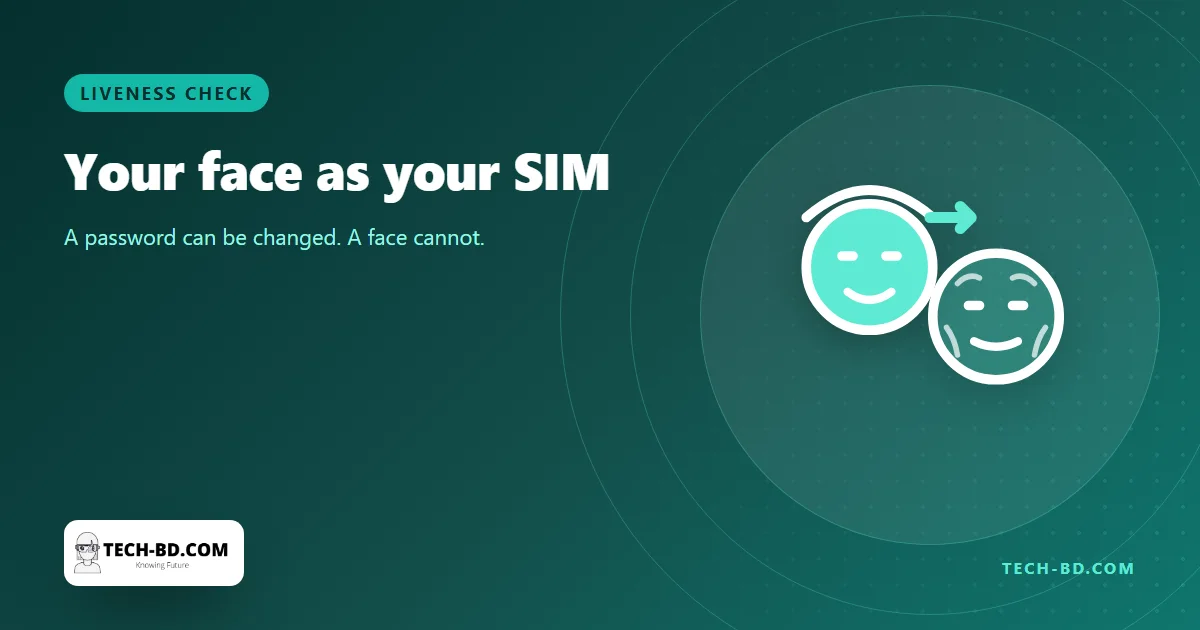
And then there is the line that should govern the whole debate, which the report puts plainly: a password can be changed. A face cannot.
If a password database leaks, everyone resets and life continues. If a face template leaks, there is no reset. The person carries that compromise for life, and it is the same face they will use at the bank, at the SIM counter, and at whatever else adopts this next.
What to actually do
Two rules cover most of the risk, and they are the ones the report itself gives.
Use only official apps or official branches for identity verification. If a process asks you to verify your identity somewhere other than the operator's or bank's own app or office, that is the warning sign, not an inconvenience.
Never send a photo of your face or a copy of your NID to an unfamiliar link. The registration itself may be legitimate; the message pointing you to it may not be. This is exactly the shape of the SMS phishing case we covered earlier today, aimed at a different kind of credential.
The question underneath
Is a face a password, or just one layer among several?
Treated as a password — a single thing that proves you are you — it is a bad one, because it is public, permanent and increasingly easy to fake. Treated as one layer among several, alongside a device you hold and a secret you know, it is genuinely useful.
Security here is not machines against people. It is layers of caution, and the layer that matters most is still the human decision about what to hand over and to whom.