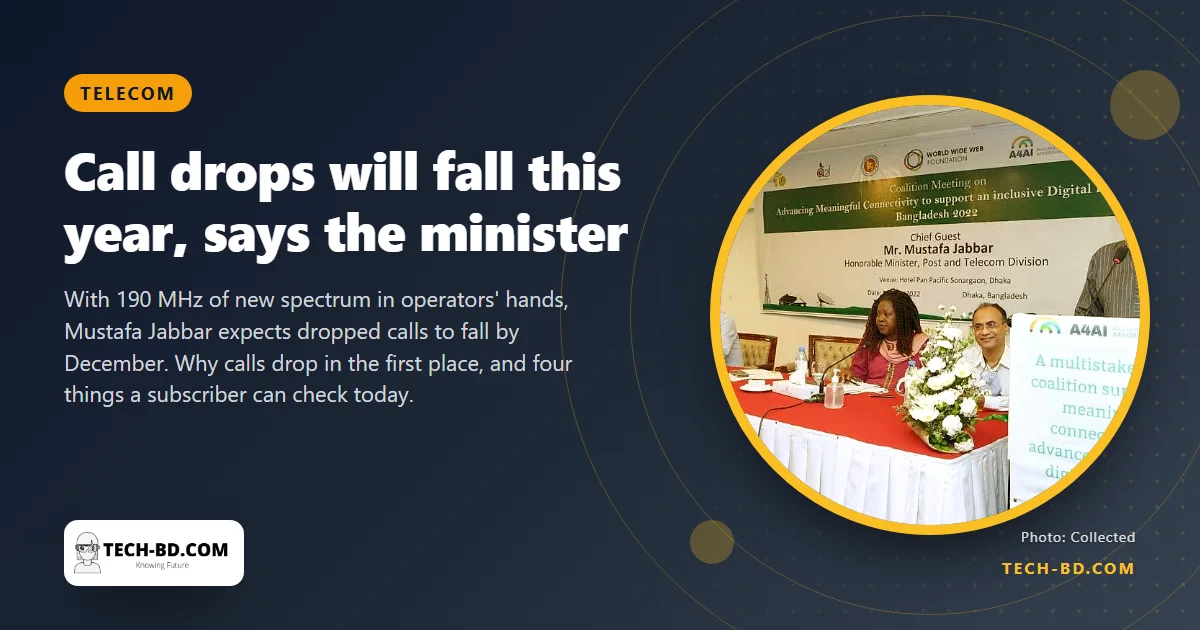
Dropped calls will decline before the end of 2022, telecommunications minister Mustafa Jabbar said on Thursday, 12 May, because the operators now have 190 MHz of additional spectrum to work with. He was speaking at a Dhaka hotel at a discussion organised by the Alliance for Affordable Internet on the ministry's role in an inclusive digital economy, alongside BASIS president Russell T Ahmed and A4AI's Asia-Pacific coordinator Anju Mangal.
The minister's case
Jabbar's argument is that call drops are mostly a capacity problem: too many users per tower and too little spectrum to serve them. The March auction put 100 MHz in the 2.3 GHz band and 120 MHz in the 2.6 GHz band into the operators' hands, and once that is deployed, he said, service quality will rise. He listed the ministry's other claims: high-speed broadband in almost every union, 4G reaching 98 per cent of the country's area, and 14 brands assembling phones locally to meet 70 per cent of demand.
Why calls actually drop
- Congestion. A cell can carry only so many simultaneous calls. In Motijheel at noon or a village during Eid, it runs out. New spectrum helps here, but only where operators add it to towers.
- Handover failure. A moving phone is passed from one tower to the next; if the next one is full or the overlap is poor, the call dies. This is why calls drop on the Dhaka-Chattogram highway and in the Metro Rail tunnel sections.
- Indoor coverage. The new 2.3 and 2.6 GHz bands penetrate walls badly. Inside a concrete building the phone may fall back to a weaker band or to 2G, and voice over 4G (VoLTE) may switch to a 2G call mid-sentence.
- Power. Towers on generator during load-shedding are a known cause of drops in rural upazilas.
What a subscriber can do today
- Turn on VoLTE in your phone's SIM settings if your operator supports it; calls stay on 4G and connect faster.
- If drops happen only at home or the office, ask the operator for a coverage check; they can retune a nearby sector.
- Keep the phone's software updated; modem firmware fixes handover bugs.
- Know the rule: BTRC directives require operators to compensate subscribers for repeated drops with talk time. Few people claim it, and the regulator was, in the same month, promising to tighten the rule.
Update: in September 2022 BTRC ordered operators to refund talk time from the first dropped call of the day, and Grameenphone began doing so on 29 September.