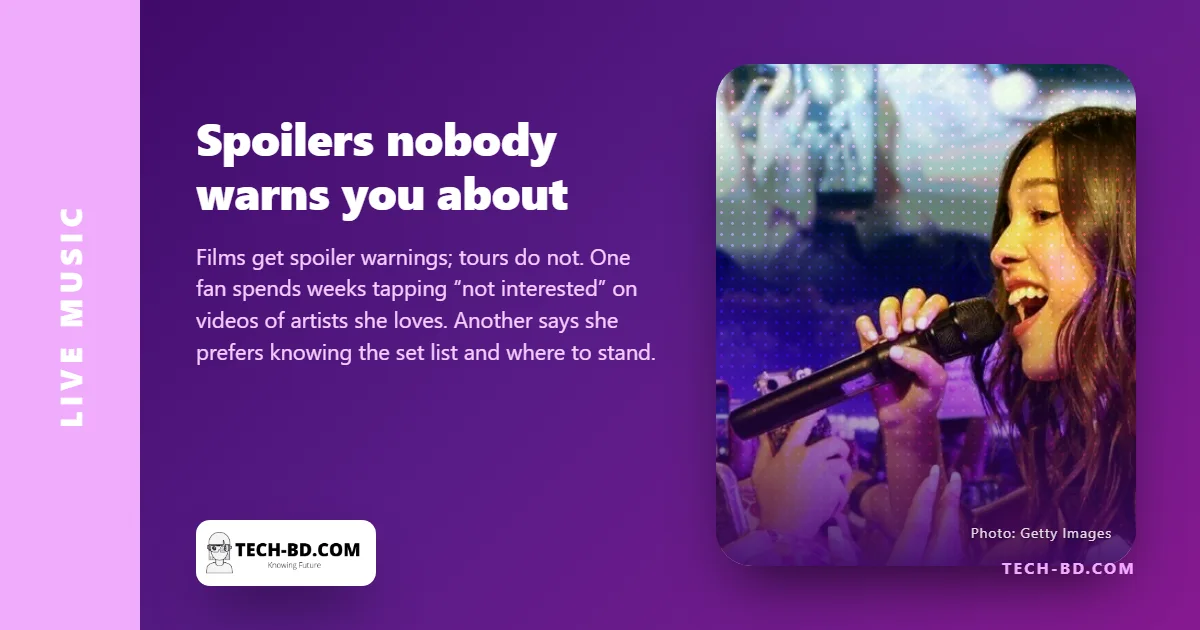
Months before you see your favourite artist, you probably already know some of the big moments they have planned — the set list, the stage design and, if you have been paying attention, where to stand for the best view.
A spoiler with no warning attached
Films and TV series are guarded with spoiler warnings. For major concerts there is no such convention: fan videos from the shows flood online, whether you want them or not.
Last week Olivia Rodrigo opened her Unraveled tour, and the surprises were dissected online within days. Tours by Harry Styles, Charli XCX and Ariana Grande have been filmed from every angle and shared.
Aurélia Collins, a 20-year-old criminology student, spends weeks trying to trick her algorithm — tapping "not interested" on videos of artists she loves, even though "it hurts my soul". Her feed goes bland, but she told BBC Newsbeat "it's worth it for the surprise".
She managed to avoid spoilers for Styles' tour over the summer. When one slipped through about Niall Horan before she saw him in London — her first time, after 16 years as a fan — she was "gutted". "When I was younger, we couldn't afford to go to events like this... I want the full experience, and that includes the element of surprise," she said.
Not everyone agrees. Georgia McAdam, 22, says she loves spoilers: "I'm the type of person that loves to be prepared. I love to know what the stage is looking like, what the set list consists of and where to stand."
What it means in Bangladesh
The detail worth sitting with is the method rather than the complaint. A young woman is spending weeks actively teaching a recommendation system to withhold things she likes. That is a form of literacy, and it is more sophisticated than most corporate social media policies.
It also exposes something about how these systems are built. There is no setting for "show me this artist but not clips from the current tour", because the feed is optimised for engagement and a fan video of an artist you love is the most engaging thing it has. Collins is not using a feature; she is working around its absence by deliberately feeding it false signals. The cost — a blander feed — is the price of a preference the platform does not offer.
For Bangladeshi readers the surface version of this is remote: the stadium tour economy barely reaches here, and a Dhaka concert by an international act is a rare event. But the underlying situation is extremely familiar. Cricket is the national equivalent, and anyone in this country who has tried to watch a delayed broadcast knows the exact problem — the result arrives through a notification, a group chat or an uncle, long before the innings does.
The same technique works, and is worth knowing: muting keywords rather than people, turning off match notifications at the source rather than in the app, and accepting a duller feed for a few hours. It is the same bargain Collins is making.
And McAdam's position deserves respect rather than correction. Knowing the set list and where to stand is not a failure to appreciate the show; for a lot of people, including anyone managing anxiety in a crowd of fifty thousand, preparation is what makes the evening possible.
The other story today about what a video does not show is the mountain rescue report.