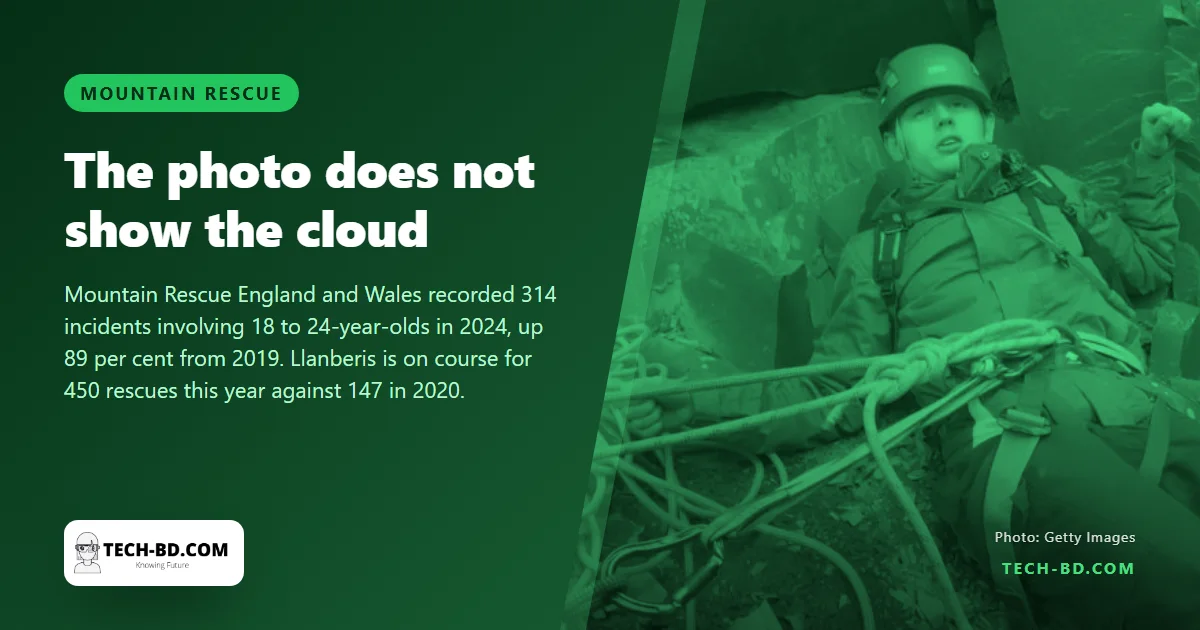
Posts on TikTok and Instagram show the beauty of wild places without warning about the danger walkers can face, mountain rescuers have said.
The numbers
"Too many people influenced by these posts are ending up in the mountains unprepared," said Nick Phillips of Mountain Rescue England and Wales (MREW).
Emergencies involving 18 to 24-year-olds almost doubled from 2019 to 2024. That group became the largest needing rescue in 2024, involved in 314 incidents — up 89% from 166 in 2019.
Llanberis Mountain Rescue Team in Eryri, Wales' busiest, had its highest-ever month in August with 59 call-outs — two a day. It had 147 in all of 2020; it has already attended 359 this year and expects 450. Ogwen has gone from 107 in 2020 to a projected 200-plus; Brecon from 70 to 80 already; Central and Brecon from 89 to possibly 200.
Volunteer Tom Carrick said that despite 30 new volunteers joining, "already we're seeing a lot of burnout among volunteers". Huw Jones, 45 years with Central and Brecon, said: "Volunteers' time and energy are finite. We cannot assume that more and more can be absorbed indefinitely."
MREW was careful: "We are not criticising people who want to go into the mountain based on what they have seen in a post... but we need to be balanced with the reality." As LMRT put it, a photo of Crib Goch can make an exposed scramble look like an ordinary route — "What it doesn't show is how intimidating that ridge can be in cloud, rain or strong winds."
What it means in Bangladesh
Bangladesh is living the same mechanism at a different altitude, and with considerably less rescue capacity behind it.
The destinations are familiar: Sajek, Nafakhum, Amiakhum, Keokradong, Boga Lake, the Sangu river. Each has been through the same cycle — a photograph circulates, visitor numbers multiply within a season, and the infrastructure arrives years later if at all. The risks are not ridge exposure in cloud; they are flash flooding in hill streams, dehydration on long unshaded treks, and injuries many hours from a road.
The critical difference is the last line of the British story. Wales has volunteer mountain rescue teams — trained, equipped, on call, and now exhausted. Bangladesh's hill districts have nothing equivalent. A serious injury on the Nafakhum trail is handled by the people present, local guides, and eventually Fire Service or army assets that were not positioned for it. The thing being described as unsustainable in Wales does not exist here to be strained.
There is a second difference worth naming plainly, because it cuts the other way. Much of the Chittagong Hill Tracts requires permissions and is subject to movement restrictions, and travel there is often channelled through registered guides. That bureaucracy is resented by travellers and has real costs for the people who live there — but it does function, incidentally, as the gatekeeping that Welsh mountains lack.
The practical advice is the same everywhere and bears repeating because it is boring: go with someone local, tell a third person your route and expected return, carry more water than seems necessary, and treat a stream crossing after upstream rain as the most dangerous thing on the trip. The photograph that brought you there was taken on a good day.
Another trend measured in before-and-after videos is in the lymphatic massage story.