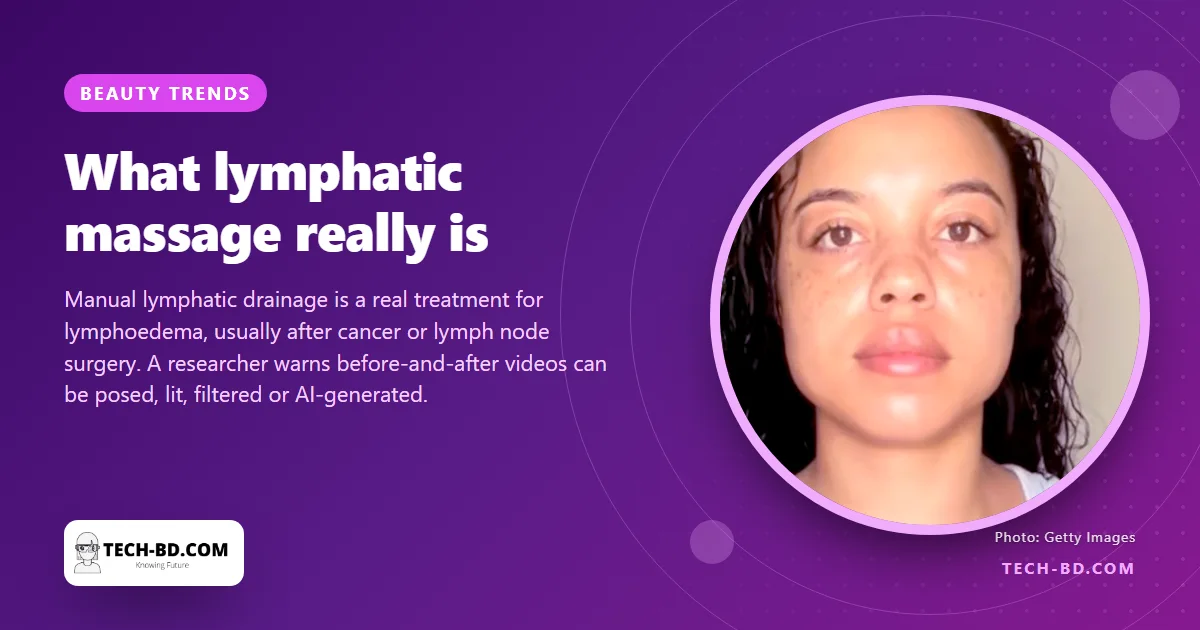
If she is feeling bloated, Abbey Alexandra has a routine: body oil and a wooden roller, used to massage her stomach. The 31-year-old from Birmingham posts before-and-after videos on TikTok and says the process leaves her feeling "a lot better after, they are relaxing".
Where the technique comes from
What she is doing is a form of lymphatic drainage massage, adapted from a medical treatment and shared as a beauty trend. Fans claim it helps "flatten" and "debloat", and the celebrity endorsements include Maya Jama and Hailey Bieber, who told Time magazine "I swear by them".
The lymphatic system is a network of channels and glands that helps fight infection and remove excess fluid, according to the NHS. Dr Xand van Tulleken told Morning Live that it "helps keep your body's fluid levels balanced, cleans up waste, and supports your defences against illness", and that when it is not working properly it can contribute to swelling — a condition called lymphoedema.
That commonly affects people with cancers involving the lymph system, or who have had treatment involving the lymph nodes, and usually develops in the arms or legs. Manual lymphatic drainage is one of the treatments medical professionals use in those cases.
What the videos do not show
Social media body trends should always be viewed with scepticism, said Dr Ella Guest, health psychologist at the Centre for Appearance Research. "These images might be altered using photo-editing tools or filters, people standing in particular poses, use of lighting, lots could even be AI-generated," she said. "If something looks too good to be true, it probably is."
What it means in Bangladesh
The reframing worth noticing is that a treatment for a serious complication of cancer care has become a cosmetic routine — and the serious version is the part this country should be paying attention to.
Lymphoedema is not rare in Bangladesh and it is not primarily about cancer here. The country has one of the world's larger historical burdens of lymphatic filariasis, the mosquito-borne infection whose late stage is the severe limb swelling long known as elephantiasis. Bangladesh was validated as having eliminated it as a public health problem — a genuine achievement — but elimination of transmission does not reverse the damage in people who already have it. Tens of thousands live with the swelling, and for them manual lymphatic drainage, limb hygiene and compression are the actual standard of care.
That creates an odd and useful opportunity. The technique being popularised on TikTok for a flat stomach is, in a trained form, the treatment those patients need and mostly cannot access. The skill exists in the country largely in beauty clinics in Dhaka and Chattogram rather than in upazila health complexes.
On the cosmetic claim itself, the honest answer is short. Moving fluid temporarily out of the abdominal tissue can make a measurable difference for a few hours. It is not fat loss, nothing is detoxified, and the lymphatic system was already doing its job. If it feels good and relaxing, that is a real benefit and a sufficient reason.
Dr Guest's warning deserves repeating for a specific local reason: the before-and-after format is the standard sales device of Bangladesh's entirely unregulated skin-and-slimming clinic sector, where the same posing, lighting and editing sell treatments that are considerably less harmless than a wooden roller.
The opposite trend — removing the product entirely — is in the bare nails story.