“Do you have ferritin face?” a young woman asks on TikTok, pointing at dark circles, washed-out skin and brittle hair, with before-and-after photographs alongside.
It is one of a growing number of posts on TikTok and Instagram claiming that low ferritin — the protein that stores iron in the body — leaves visible clues on your face. Users list pale or grey skin, dark under-eye circles, dry or cracked lips, hair shedding and weak nails. The phrase has attracted millions of views.
Doctors say appearance alone cannot diagnose iron deficiency.
What the doctors actually said
“Ferritin face is not a medical diagnosis,” said GP Dr Aziza Sesay, based in the West Midlands. “However, it may be a clue to tell us that something is going on.”
That is a more careful sentence than either side of this argument usually manages. Pale skin, hair shedding and brittle nails can accompany low iron. They can also accompany a long list of other conditions.
Consultant haematologist Dr Drew Provan was blunter about the specific claim: it is “impossible” to determine someone’s ferritin level from how their face looks. People who are significantly anaemic may look pale, and fatigue can contribute to dark circles, but these signs are “subjective and unreliable”.
Sesay adds a point the trend misses entirely. In people with darker skin, changes in skin colour may be less obvious — so someone looking specifically for the signs described online could miss iron deficiency altogether. A visual test calibrated on one group of faces fails on others, and fails silently.
The biology the trend gets half right
Ferritin levels show how good your body’s iron stores are. Haemoglobin is the protein in red blood cells that carries oxygen. When haemoglobin is low, blood cannot carry as much oxygen — that is anaemia.
But iron stores can run down before that happens. Someone can be iron-deficient, and have symptoms, without being anaemic.
“You’ve got no stored iron but you’re maintaining your haemoglobin. That’s the big disconnect,” said Provan.
This is why people get told their blood tests are “normal” and still feel unwell — and it is the real grievance underneath the trend. Consultant haematologist Dr Sue Pavord says iron deficiency is common and often under-diagnosed in women.
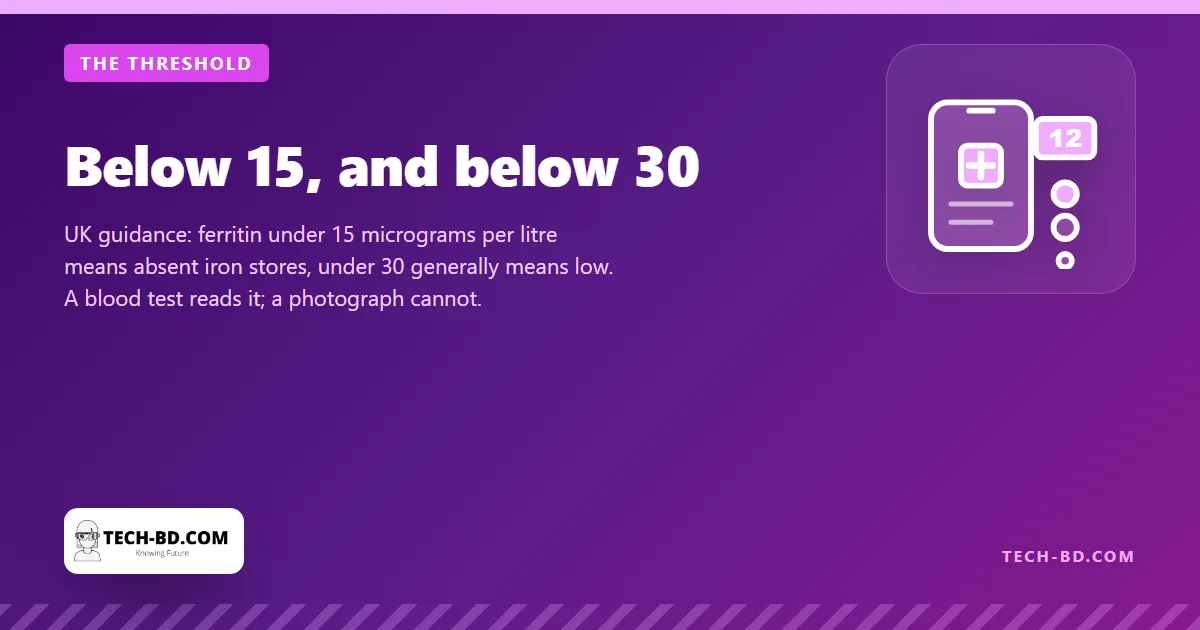
UK guidelines from the British Society of Gastroenterology put ferritin below 15 micrograms per litre as absent iron stores, and below 30 as generally indicating low stores.
One case, with the numbers attached
Lucy M, 32, who posts about hair loss as @marvluceskin, developed heart palpitations, fatigue and hair loss in 2021. She was told her blood tests were normal and was diagnosed with generalised anxiety disorder. A later test showed her ferritin at 12 micrograms per litre.
She said she looked “grey”, with dull, brittle hair, and that the difference between how she felt and looked before and after recovery was “night and day”.
Her case is worth reading precisely. The visible change was real. What found the problem was not a photograph — it was a number.
Why the method matters, not just the conclusion
Blood tests matter not only to confirm iron deficiency, Provan and Sesay said, but to establish the cause and guide treatment. Heavy periods, low dietary iron, gastrointestinal blood loss and problems absorbing iron through the gut can all be behind it.
This is where the trend becomes actively risky. Taking iron supplements without a diagnosis can be harmful, and self-treating can delay the investigation of an underlying problem. Iron deficiency caused by gastrointestinal bleeding does not stop being caused by gastrointestinal bleeding because the tablets made you feel better.
Where iron deficiency is confirmed, it is commonly treated with oral iron. Pavord advises taking tablets on an empty stomach, ideally first thing in the morning, and avoiding tea or coffee around that time because they inhibit absorption — a detail worth knowing in a country that runs on tea. Iron also comes from meat, beans, lentils, leafy greens and fortified cereals.
Awareness or misinformation
Lucy argues social media has helped women take symptoms seriously and given some the confidence to ask questions. That is not nothing, and dismissing the whole trend would miss it.
But the two halves have to be kept apart. “I feel exhausted and my hair is falling out, should I ask for a ferritin test?” is a good question that the internet has helped people ask. “Your face says your ferritin is low” is a diagnosis delivered by a stranger who cannot see your blood, to an audience whose skin tones the method was never calibrated for.
The first costs a conversation with a doctor. The second can cost months.