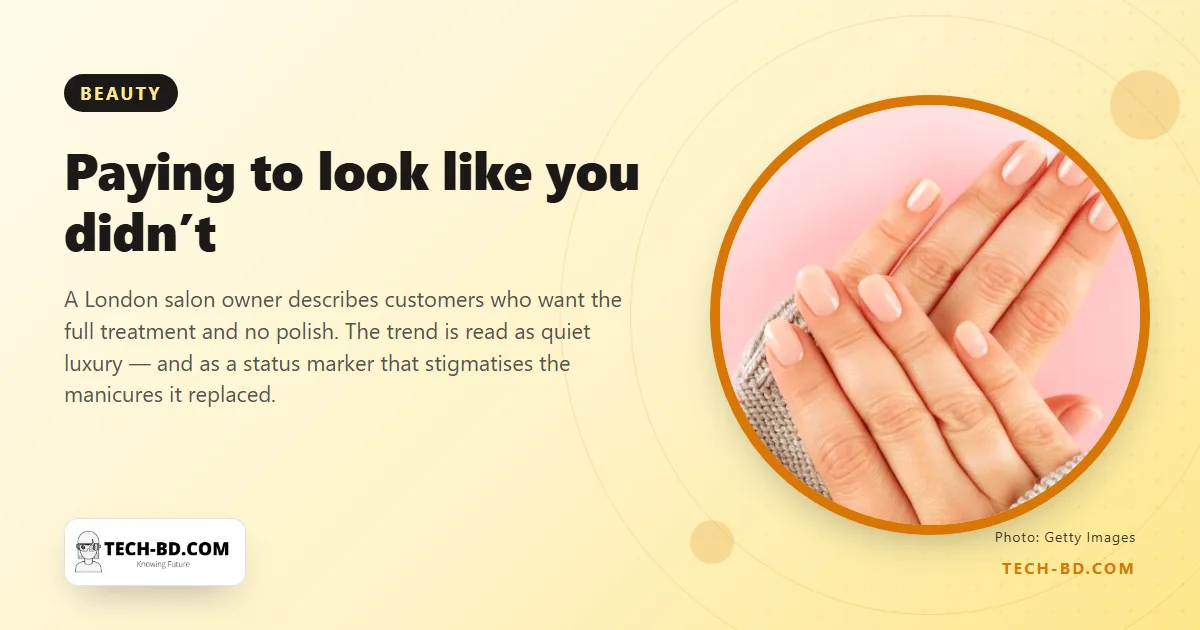
In recent months Paloma Buddemeier has watched a stream of people walk into her nail salon with the goal of looking as though they had never been there at all.
"It's crazy," says the owner of Wumman Spa in London. These customers still get their nails filed, buffed and trimmed. "You still do the cuticle, you do the soaking and hydrate everything," she says, "but you just put no polish on."
What is being sold
Driving it, she says, is a viral craze for bare-looking nails. Artsy shots of glossy naked nails have been flooding social media and appearing on fashion runways and red carpets — read by some as the latest symbol of "quiet luxury".
But critics argue the trend says something about class, about the treadmill of beauty standards, and about who gets to define what counts as tasteful. Nail art's historical and creative roots are linked to black, Latino and Asian communities, and the suggestion that bare nails signal high status could stigmatise bold manicures.
"That trend really promotes blankness and this kind of sameness and erasure of culture and identity that is so important to black and brown communities," beauty journalist Kristina Rodulfo tells the BBC.
What it means in Bangladesh
The mechanism here is worth naming, because it is not about nails. A look that requires money and time is coded as tasteful precisely because it reads as effortless — and the looks it displaces are the ones associated with people who have less of both. "Quiet luxury" is expensive invisibility.
That pattern is thoroughly familiar in Bangladesh, where it operates on a much harsher axis. The dominant beauty standard here is not understatement but fairness, and the skin-lightening market built on it is large, aggressively marketed and medically dangerous. Creams sold openly in Bangladeshi shops have repeatedly been found to contain mercury and clobetasol — the first causing kidney damage and neurological harm, the second thinning skin and producing steroid dependence with rebound acne and permanent discolouration. This is the version of the beauty treadmill that reaches hospitals.
The class logic is identical to the one the BBC's critics describe. Fairness reads as status because it reads as not having worked outdoors. The standard punishes exactly the people it describes.
Two practical things follow. If a cream produces visible lightening within weeks, that is a reason for suspicion rather than satisfaction — rapid results indicate a steroid or a metal, not skincare, and dermatologists in Dhaka see the consequences constantly. And unbranded or repackaged creams without an ingredient list should be treated as unsafe by default, because there is no way to know what is in them.
The narrower point about nails still applies, and it is a hygiene one: the least safe part of any salon visit is the instrument, not the polish. Cuticle work breaks the skin, and inadequately sterilised tools transmit fungal infections, bacterial infections and, in principle, blood-borne viruses. Whatever look you are paying for, that is the question worth asking.