Warning: this report describes surgical complications.
Nikita Morgan decided to have a blepharoplasty — a "bleph", removing skin from just above the eyes — after seeing videos about it on social media. She was given a local anaesthetic, and still felt extreme pain.
"Everyone made it out to be so easy, but my face felt like it was on fire and there was a horrible smell of burning skin," she said.
What surgeons are seeing
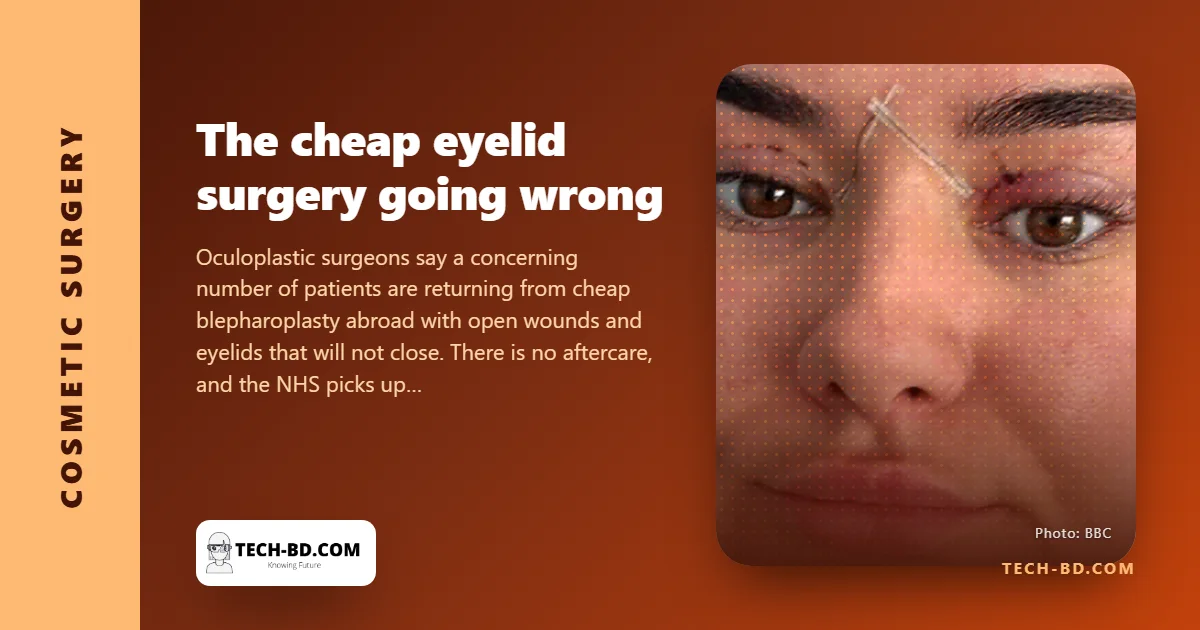
Oculoplastic surgeons — doctors who specialise in surgery around the eyes — have told the BBC that a concerning number of patients are reporting problems after cheap bleph surgery, typically carried out abroad.
The complications they describe are serious: open wounds, and eyelids that cannot close. An eyelid that does not close is not a cosmetic problem. The eye's surface depends on being covered and lubricated; left exposed it dries, ulcerates and can scar, and vision is what is at stake.
Demand has risen as part of a wider aesthetic trend to tighten, smooth and lift the face. In the UK the procedure normally costs thousands of pounds — which is precisely what drives people abroad. Surgeons say complications have been linked to clinics across mainland Europe, Africa and Asia, and that when things go wrong the lack of aftercare puts the burden on the NHS.
The structural problem
The thing that makes cosmetic surgery abroad different from other surgery is not the skill of the surgeon, which may be excellent. It is that the model sells the operation and not the follow-up. Complications from eyelid surgery typically appear over days and weeks — after the patient has flown home, and beyond the reach of the person who operated.
What it means in Bangladesh
Bangladesh sits on both sides of this. Bangladeshis travel for cosmetic procedures — to India, Thailand and Turkey — and Dhaka itself has a fast-growing aesthetic clinic sector advertising heavily on Facebook and Instagram, where the same procedures are sold with the same before-and-after reels.
Three questions are worth asking before any facial procedure, here or abroad, and they are the ones that separate a clinic from a shopfront. Who exactly is operating, and what is their registration? In Bangladesh that means a BMDC registration you can check, and specialist training in oculoplastic or plastic surgery rather than a weekend course. What happens at day three, day ten and week six? A price that does not include reviews is not a price for surgery. Who treats a complication, and where? If the answer involves a flight, there is no answer.
The wider point is that eyelid surgery is minor in scale and not minor in consequence. The margin for error is a few millimetres of skin, and taking too much cannot be undone. A procedure being quick and cheap says nothing at all about how reversible it is.