
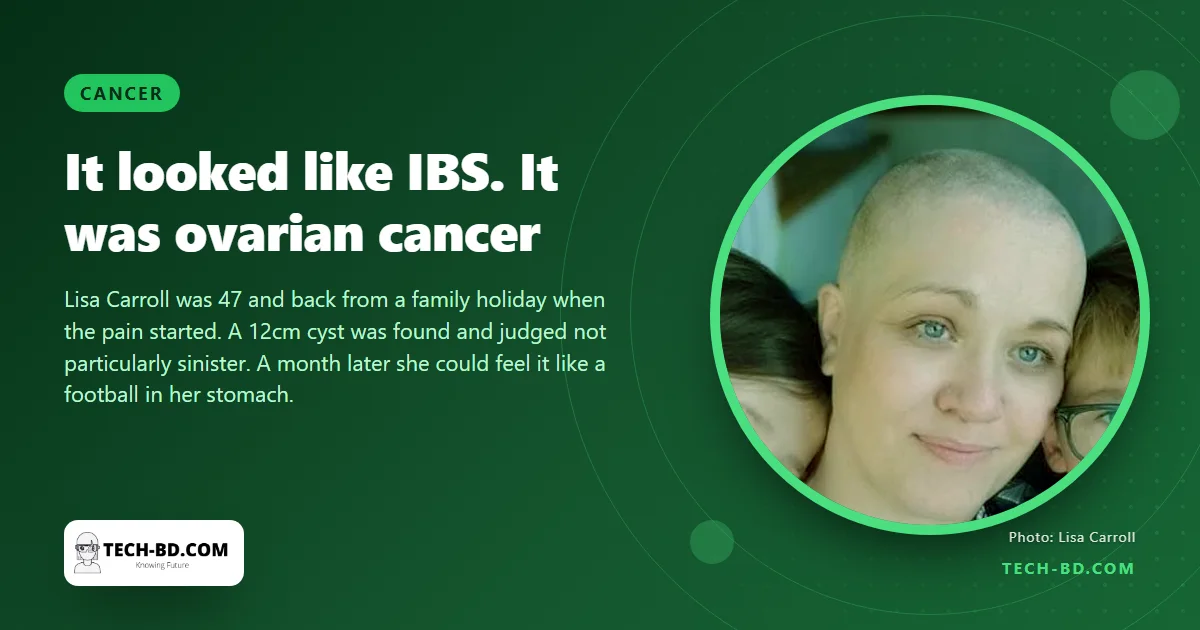
When Lisa Carroll, 47, a mother of three from Coventry, came back from a family holiday in August 2021 in pain, she assumed it was something ordinary — irritable bowel syndrome, perhaps, or a kidney infection.
"I thought I had possibly a bit of IBS or a kidney problem or something like that. I was in quite a lot of pain," she said.
It was mucinous ovarian cancer (MOC), one of the rarest forms of ovarian cancer in the UK.
What happened next
After calling NHS 111 she was sent to hospital in Coventry, where medics found a 12cm cyst on her right ovary. She was told it did not appear particularly sinister, and was put on a waiting list for surgery.
"Within a month, a cyst the size of a fist had grown to the point that I could feel it like a football in my stomach," she said. "Pain and discomfort got worse and I felt shattered emotionally and physically."
She is now urging other women not to dismiss their symptoms.
Why ovarian cancer is so often missed
There is a reason this pattern recurs, and it is not carelessness. Ovarian symptoms are genuinely indistinguishable from common complaints: bloating, abdominal or pelvic pain, feeling full quickly, needing to urinate more often, changes in bowel habit. Every one of those is far more often IBS than cancer, and a doctor who sent every such patient for imaging would be wrong the overwhelming majority of the time.
What separates the two is persistence and change. IBS fluctuates and has usually been present for years. Ovarian symptoms tend to be new, to occur most days, and to keep going. The rule clinicians use is roughly: new, frequent — more than 12 times a month — and persistent for three weeks or more warrants investigation.
What it means in Bangladesh
Bangladesh has no ovarian cancer screening programme, and there is no screening test good enough to justify one anywhere — which makes symptom awareness the entire front line.
The obstacle here is specific and worth naming. Abdominal swelling and bloating in a middle-aged woman is, in a great many Bangladeshi households, not treated as a medical event at all. It is attributed to weight, to age, to having had children, to gas. Women are also more likely to present late for anything gynaecological, and rural women more likely again.
The practical version is a rule any family can apply without a doctor: bloating that does not come and go is not gas. If a woman's abdomen is persistently distended, if she is full after a few mouthfuls, if this has been going on most days for three weeks, that is a reason for an ultrasound and a CA-125 blood test — both of which are available and affordable in every district town in Bangladesh, and neither of which requires a referral.
Lisa Carroll's point is the one to end on, because it applies regardless of health system: she was told it did not look particularly sinister, and a month later it was the size of a football. If symptoms are getting worse while you wait, that is new information, and it is worth going back.