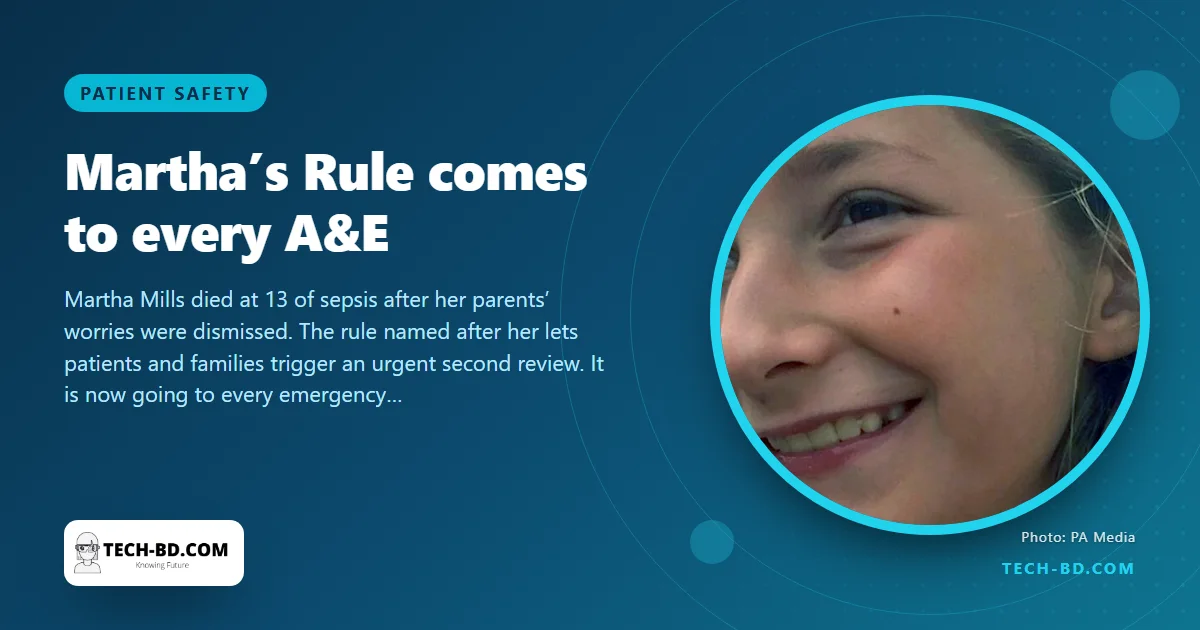
The NHS is expanding Martha's Rule to every hospital emergency department in England — giving patients, families and staff a way to demand a rapid second review when they believe someone's deterioration is not being taken seriously.
Where the rule comes from
It is named after Martha Mills, who died aged 13 in 2021 after developing sepsis. Her family raised concerns that were not listened to. A coroner ruled in 2022 that Martha would probably have survived had she been transferred earlier to intensive care and given appropriate treatment. Her parents, Merope and Paul, set out to change the culture that failed her, and the rule is the result.
How it works
Patients, relatives and staff in A&E will be able to call a dedicated phone number to trigger an urgent review by a separate clinical team if a patient is deteriorating and they feel that is not being acted on.
The rollout follows a trial at seven trusts and is already in place across inpatient wards. Nationwide expansion to emergency departments should be complete by March 2028. Nursing Times, reporting the same announcement, noted that the pilot produced 69 calls that led to urgent surgery or intensive care transfers, and that July 2026 saw a record 1,678 calls.
Scotland is beginning to use Martha's Rule, Northern Ireland is considering it, and Wales runs a similar scheme called Call4Concern.
Why it works, when it works
The mechanism is subtle and worth naming. It does not require staff to be better at noticing deterioration. It routes around the one failure that kills people in hospitals: a junior clinician's assessment going unchallenged because the person who disagrees is a frightened relative with no standing.
The family is usually the one party who has watched the patient continuously, and they are the ones who notice "he is not himself" hours before a chart does.
What it means in Bangladesh
Bangladeshi hospitals have no equivalent, and the cultural distance is larger than the operational one. Questioning a doctor here is socially costly in a way it is not in England, and in a crowded public hospital a relative who insists is likely to be managed rather than heard.
But the intervention is genuinely cheap: a phone number, a duty clinician obliged to answer it, and a written rule that nobody is penalised for calling. That is within reach of any private hospital chain in Dhaka today, and it is exactly the sort of thing a hospital could adopt as a competitive standard rather than waiting for a regulation.
There is a smaller step available to families in the meantime, and it is worth knowing. The thing that gets escalation is specificity. "He is worse" invites reassurance; "his breathing has gone from 20 to 32 in an hour, he has not passed urine since morning, and he does not know where he is" is a clinical handover, and it is much harder to wave away. Write the numbers down, note the times, and ask directly for a senior review — the request that Martha's Rule formalises is one you are entitled to make anyway.