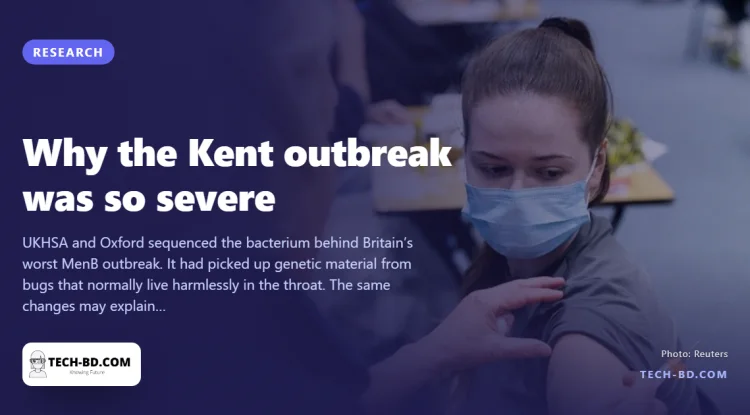
A vaccination programme aimed at one million teenagers and young adults is under way in England, launched after concern about meningitis B infections and the outbreak in Kent earlier this year. Officials say it will protect those at "highest immediate risk".
The scale so far
Nearly 90,000 doses had already been given when the programme was described, with a further 135,000 booked in over the following weeks. The vaccine protects against the MenB strain that caused the Kent outbreak — the UK's largest and fastest-growing.
The UK Health Security Agency has since confirmed the outbreak's scale in its own published material: 21 people diagnosed with invasive meningococcal disease in a single week in March, all needing hospital treatment, nine in intensive care and two deaths.
Why this age group
It looks odd to vaccinate teenagers against a disease most associated with babies, and the reasoning is worth following. Meningococcal bacteria live harmlessly in the throats of a share of the population, and carriage peaks in late adolescence and the early twenties — exactly the years people move into halls, share drinks and socialise in crowds.
So this age group is both the group most likely to be carrying the bacteria and, in outbreak conditions, among the groups most likely to fall seriously ill. Vaccinating them protects them and reduces how much of the bacterium is circulating.
The Kent outbreak made the case concrete rather than theoretical: it was traced to a single Canterbury nightclub over one weekend.
What it means in Bangladesh
Bangladesh has no equivalent programme, and there is no realistic prospect of a million-dose meningococcal campaign here. But the logic transfers directly, and it is the more useful thing to take away.
The principle is that you vaccinate where transmission concentrates, not only where the illness is worst. Bangladesh already applies this thinking well in some places and poorly in others. The country's measles-rubella and HPV campaigns have reached enormous numbers of children through schools. The gap is the 16-to-24 group, which leaves the school system and effectively drops out of public health contact until adulthood — the same group that lives in the halls and hostels where respiratory infections spread fastest.
The practical version for a family here: meningococcal vaccine is available privately in Bangladesh, and it is the same jab pilgrims are required to have. If someone in your household is about to move into a university hostel, a shared mess or garment-worker accommodation, it is worth a conversation with a doctor about whether it is warranted — particularly if there has been any cluster of serious illness in that institution. Knowing what the early signs actually look like remains the part that saves time when it matters.