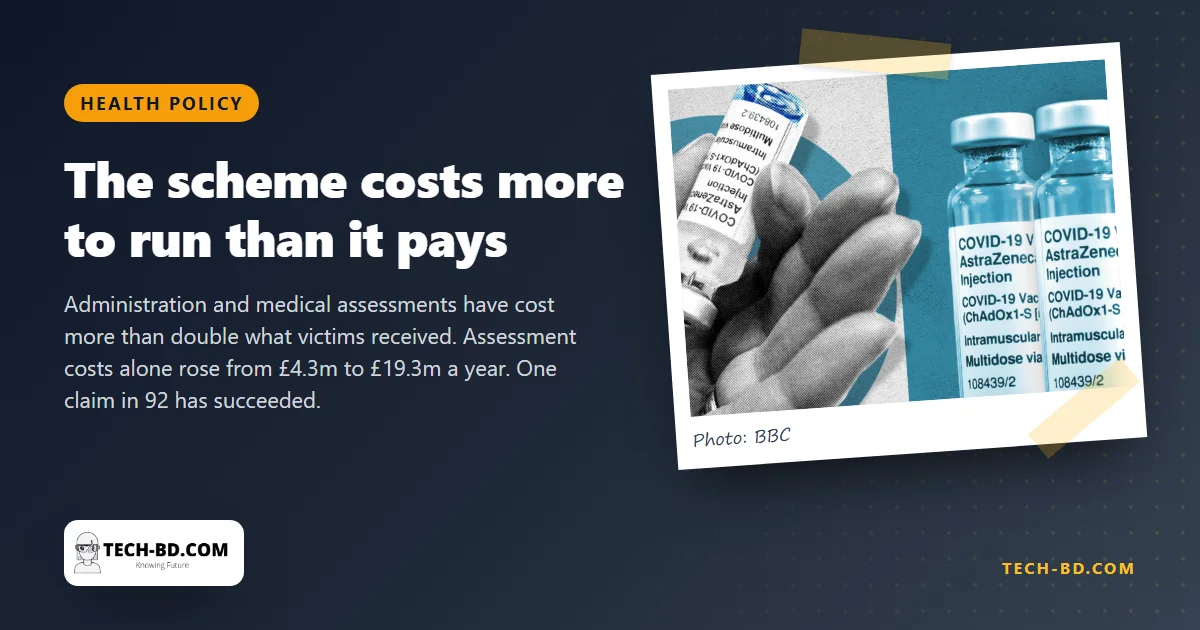
The British government scheme that compensates people injured by Covid vaccines and other jabs has cost £83m to run since April 2022. Over the same period it has paid £32m to the people it exists to support.
In other words, administration and medical assessment have cost more than double the support delivered.
The numbers
There have been 24,260 claims since November 2021. 264 have succeeded — roughly one in 92.
The £83m covers staffing, administration and medical reviews. Figures given by health minister Dame Diana Johnson, reported alongside the BBC's account, show the cost of medical assessments alone rising from £4.3m in 2022/23 to £19.3m in 2025/26 — a more than fourfold increase. On data up to June 2026, total damages paid stood at about £31.6m.
The NHS Business Services Authority, which runs the scheme, attributes the rising administrative and assessor costs to the rising number of claims. The TaxPayers' Alliance said the public would be "stunned" and called for an urgent review.
What the numbers do and do not show
It is worth being careful here, because this is a statistic that can be pushed in two directions.
A low approval rate is not by itself evidence that the scheme is failing claimants, nor is it evidence that vaccines are more harmful than understood. The scheme has a high statutory bar — it requires severe disablement and a causal link — so most claims will fail on the threshold rather than on the medicine. Every one of those claims still has to be assessed by a clinician, which is precisely why assessing 24,260 claims costs more than paying 264.
What the numbers do show is a scheme whose design has not kept pace with its caseload: built for a handful of claims a year, now handling tens of thousands.
What it means in Bangladesh
Bangladesh has no vaccine injury compensation scheme at all. The country ran one of the largest Covid vaccination campaigns in the world — well over 300 million doses — and a person who believes they were harmed by one has no route to assessment, acknowledgement or redress beyond ordinary litigation most families cannot afford.
That absence is worth naming precisely because vaccination is overwhelmingly beneficial. No-fault compensation schemes exist in more than 25 countries for a hard-headed reason: they are the mechanism that lets a state say both things at once — that a vaccine is safe and recommended, and that the rare person harmed will be looked after. Where no such mechanism exists, every claim of harm becomes a fight, and fights are what anti-vaccine narratives feed on.
The British experience also carries a design warning worth having before building anything. If a scheme's threshold is set so high that one claim in 92 succeeds, and each of the other 91 still needs a full medical assessment, the cost lands almost entirely on process. A system that spends £19m a year assessing and £8m paying is not obviously serving anyone.