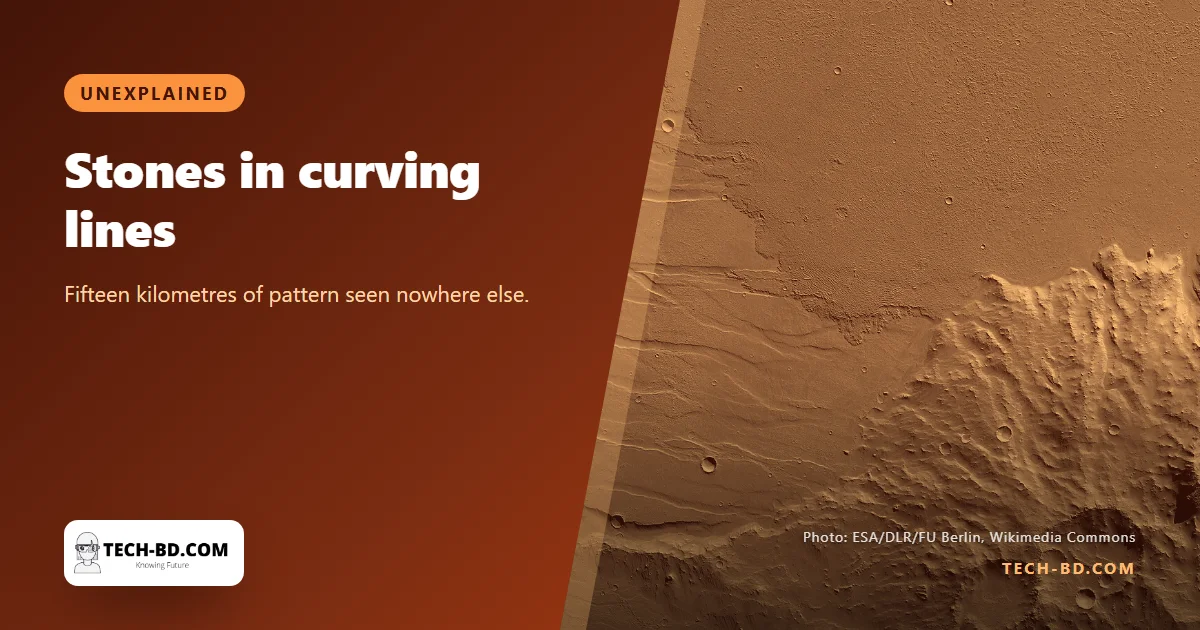
Mars is covered in rocks. Large and small, yellow ones, fibrous ones, stones striped and spotted like a zebra or a leopard, scattered everywhere.
Then in 2024, in one corner of the planet, a set of them turned up in orderly rows. At a glance they look arranged, as though someone had laid them out for a garden. Scientists still cannot say why they are like that.
Where this is
The place is called Daedalia Planum, in the highlands of the Tharsis volcanic region near the Martian equator, about 5,455 metres above the planet's datum.
Orbital images taken in 2002 suggested it was a monotonous area, topographically featureless. In August 2024 new pictures from the HiRISE camera on NASA's Mars Reconnaissance Orbiter showed how wrong it is to call anything on Mars monotonous. Zoom into the roughly 15-kilometre stretch of Daedalia Planum and a complex arrangement of beautifully curving lines appears.
What the pattern looks like
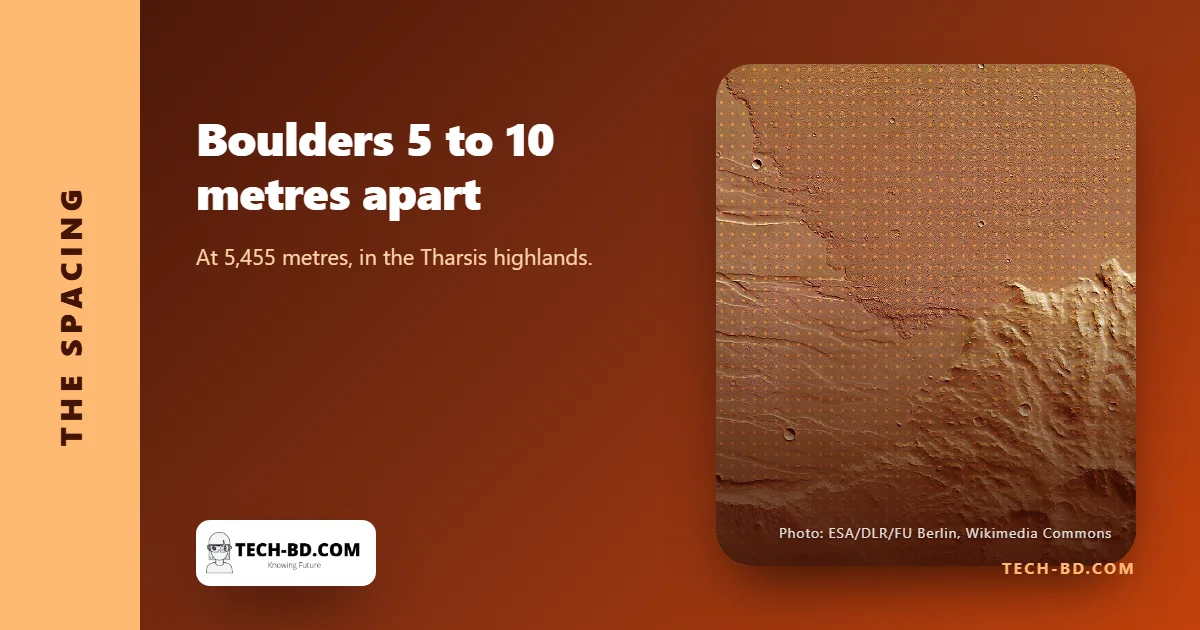
Paul Geissler, a former planetary scientist with the United States Geological Survey, describes boulders arranged in long curving rows 5 to 10 metres apart, forming a design like a fingerprint.
No such pattern has been seen anywhere else on Mars, and scientists are not sure how the terrain formed.
The spacing is what makes it strange. Rocks strewn by an impact or carried by wind do not space themselves evenly; they cluster, or they trail off in the direction they were pushed. Something here repeated at a regular interval across kilometres of ground, and whatever it was did it in curves rather than straight lines.
The two explanations on the table
Odd as they look, scientists say a natural arrangement of this kind is not impossible.
The first candidate is freeze-thaw. At 5,455 metres, the highlands of Daedalia Planum could have their own cycle of freezing and thawing, which on Earth sorts stones into patterns. Whether it has actually happened there is not established.
The second is shaking. Mars has a great deal of seismic activity, and that can produce what is known as the Brazil nut effect: throw nuts of different sizes into a container and shake it hard, and the biggest Brazil nuts rise to the top while the small ones sink. If the ground below trembles, a similar sorting process can happen to stones.
Why a plain answer is hard
Both explanations are mechanisms that are known to sort particles by size. Neither obviously produces long, parallel, curving lines fifteen kilometres across, and that is the part that is missing. Patterned ground on Earth tends towards polygons, circles and stripes on slopes, and those forms are well understood; this is not one of them.
There is also a reason to be cautious about how striking it looks. Human vision is tuned to find alignment, and a pattern that reads as "arranged" to the eye is not evidence of arrangement. The honest position is the one the scientists have taken: it is almost certainly natural, the candidate processes are plausible, and the mechanism that produced this exact geometry, in this one place and nowhere else, has not been identified.