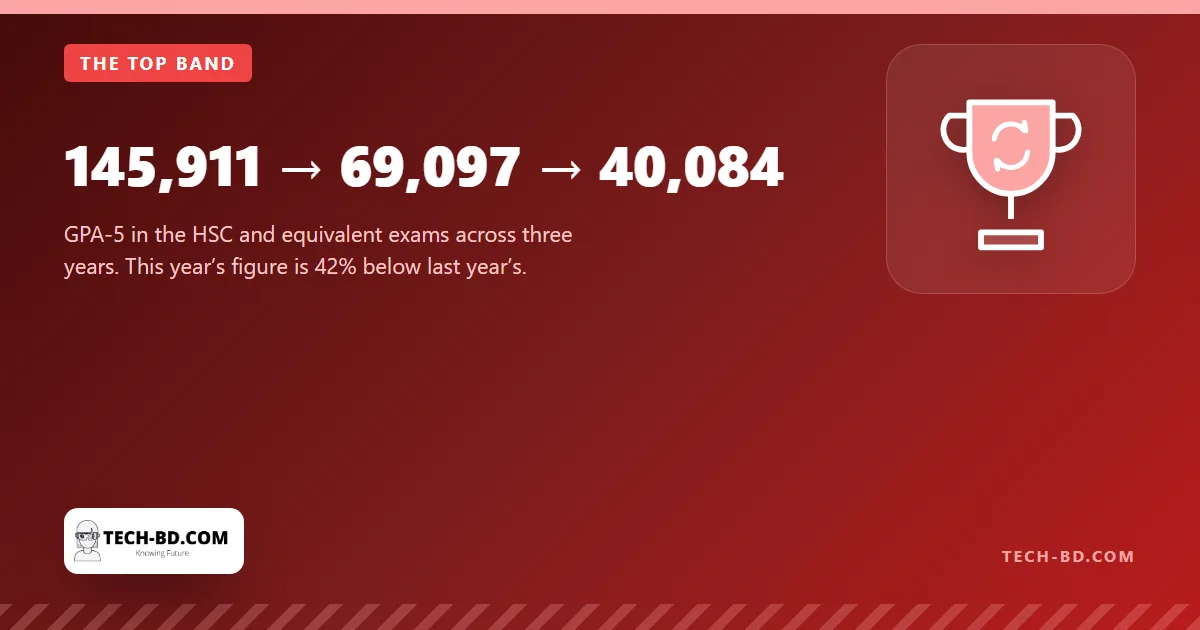
The number of students achieving GPA-5, the highest grade, in the HSC and equivalent examinations has fallen to 40,084.
Two years ago the figure was 145,911. Last year it was 69,097 at publication, rising by a further 3,079 after re-examination of scripts. So the top grade has fallen by roughly 42% in one year and 72% in two.
In the HSC examination alone, 35,948 students secured GPA-5, down 27,271 from 63,219 last year.
What a number like this actually describes
It is tempting to read a falling top grade as a falling standard among students. The arithmetic does not support that reading, and the reason deserves stating exactly.
GPA-5 is not an absolute measure of attainment like a height or a weight. It is the output of a grading scheme applied to marks produced by a particular paper and a particular marking policy. Change how generously scripts are marked, or how the grade boundaries sit, and the count at the top moves sharply without any student behaving differently.
A 72% fall over two years, across more than a million candidates, is far too large and far too fast to be explained by a change in what teenagers know. Cohorts do not change that quickly. Marking policies do.
Why that still matters enormously
Here is the part that is not academic. University admission in Bangladesh runs on these grades, and it runs on them competitively — a fixed number of seats allocated by rank.
When the top band shrinks by 72% in two years, two things follow. The students who do hold a GPA-5 this year are in a far stronger relative position than a GPA-5 holder two years ago. And a student who would have been inside the top band under the old marking is now outside it, competing for the same seats with a grade that reads worse than their counterpart’s from 2024 — through no change in their own work.
Comparing grades across these three years is therefore not meaningful, and anyone doing it — an admissions committee, an employer screening CVs, a scholarship panel — is comparing the output of three different marking regimes as though it were one scale.
The question the boards have not answered
None of this is a criticism of stricter marking, which may well be the right correction after years of grade inflation. But the boards have published the numbers without publishing the policy behind them.
What would settle it is simple and routine elsewhere: a statement of what changed in the marking scheme and the grade boundaries, and the distribution of marks, not only the count of grades. Without that, every student and every admissions office is left guessing whether this year’s result means what last year’s meant.
What a student holding a GPA-5 today should know
You are one of 40,084 in a cohort of 1,240,798 — about one in thirty-one. Two years ago the same grade went to roughly one in nine. In any process that ranks candidates, your grade is worth considerably more this year than the identical grade was in 2024.
And a student who missed it by a narrow margin should know the converse: a near miss this year is not comparable to a near miss two years ago, and it is worth checking whether the institutions you are applying to have adjusted their cut-offs. Many will not have.