
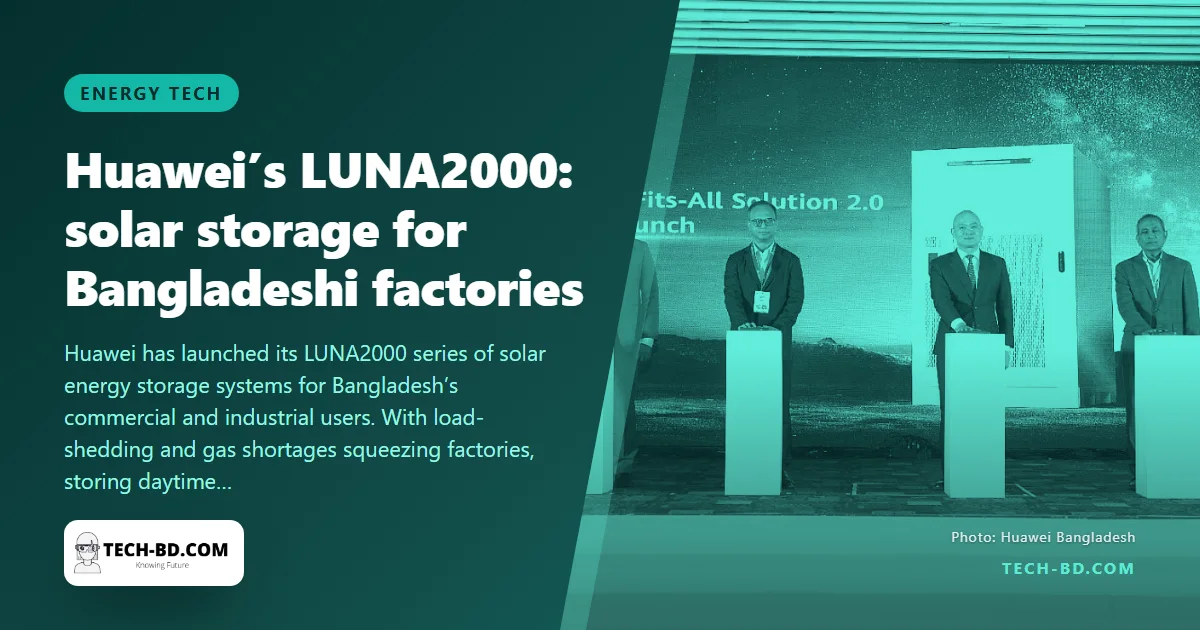
Solar panels are the easy part. A factory can cover its roof with them and cut its daytime bill — and then watch the sun set at six, exactly when the evening shift, the compressors and the lights need power most. The missing piece is storage, and that is what Huawei is now selling into Bangladesh: at an event in Dhaka the company launched its LUNA2000 series of storage systems, aimed squarely at commercial and industrial customers rather than homes.
What the product is
LUNA2000 is a family of lithium battery systems that sit between a solar array and a building's electrical load. During the day they absorb surplus solar output; when the panels stop producing, or the grid fails, or power becomes expensive, they discharge. Huawei's regional digital-power managing director highlighted a safety architecture that monitors the installation from individual cells through to the point of use — which matters for a product installed inside buildings full of fabric and chemicals. The company says its digital power equipment has already supported more than 430 million kilowatt-hours of generation in Bangladesh, mostly through inverters and plant-level gear, so storage is a second product sold to existing customers.
Why industry and not homes
The answer is not about who can afford it.
A battery earns its money by the difference between what you avoid paying and what the stored unit costs you. For a household on a subsidised residential tariff, the avoided cost is a cheap unit of grid electricity, and against that a battery takes a very long time to repay. For a factory, three things change at once.
The benchmark is diesel, not the grid. When the grid fails, a factory's alternative is a generator, and diesel is the most expensive electricity a business can buy — several times the grid tariff per unit once fuel and maintenance are counted. A battery discharging into that hour is not competing with cheap power. It is replacing the most expensive power in the building.
Commercial tariffs have a demand charge. Industrial bills are not only energy consumed; they include a charge based on the highest power drawn in the billing period. A battery that discharges during the few minutes of peak draw lowers that recorded peak, and the saving continues every month without any further energy being shifted. This is where a large share of commercial storage revenue actually comes from, and it has no residential equivalent.
Continuity has a direct cost. A dark half hour on a production line is measurable in output, in spoiled work in progress, and in overtime. A household losing power loses comfort.
Stack those and a storage system installed against gas rationing, repeated electricity price rises and unreliable supply is paid back in months of avoided fuel rather than in carbon credits.
The four specifications that decide whether it pays
1. Cell chemistry. Stationary commercial storage is overwhelmingly LFP — lithium iron phosphate. It holds less energy per kilogram than the chemistries used in phones and cars, which does not matter when the battery sits on a factory floor, and in exchange it is far more thermally stable, lasts for thousands more cycles, and contains no cobalt. If a vendor will not state the chemistry plainly, that is the answer.
2. Cycle life and the warranty's end-of-life figure. An industrial battery is charged and discharged every day, so the number that matters is guaranteed cycles — and, critically, the capacity still guaranteed at the end of them. A warranty promising 6,000 cycles at 70 per cent retained capacity is a different product from one promising 6,000 cycles with no retention figure. Divide the system price by (usable capacity × guaranteed cycles) and you have the real cost per kilowatt-hour stored, which is the only number that compares two quotations.
3. Round-trip efficiency and depth of discharge. Some energy is lost going in and coming out; 90 per cent round-trip is good. And a battery rated at 100 kWh does not give you 100 — the usable fraction, the depth of discharge, is typically 80 to 95 per cent, and running deeper shortens life. Both figures quietly change the sums above, and both are routinely omitted from a sales sheet.
4. Who replaces a failed module, and how fast. A battery system is a serviceable installation, not an appliance. The question is not whether the vendor has a local office but what the spare-parts position is: how long a replacement module takes to arrive, whether service is by the manufacturer or a local integrator, and what happens to the warranty if the integrator leaves the business.
Two things to settle before signing
Grid rules. Net-metering guidelines govern what may be exported to the grid and on what terms. A system sized for self-consumption — storing your own solar for your own evening — avoids most of that complexity, and is usually the right first installation regardless of what the export rules permit.
Connectivity. Modern inverters and storage systems are internet-connected and remotely updatable by the manufacturer, which is how monitoring, diagnostics and firmware fixes work. It also means a third party can reach equipment attached to your electrical supply. Several governments have raised this as a security question about grid equipment generally, and it applies to every connected brand rather than to one. The practical responses are the ordinary ones: ask what the device sends and to where, put it on a segregated network rather than the office LAN, and establish whether the system continues to operate normally if you cut its internet connection — a system that degrades without a cloud service is a dependency you should know about before it is bolted to the wall.
The larger signal stands. Battery storage has crossed from pilot project to product here, and the first customers at scale will be the factories with the most to lose from a dark evening shift.