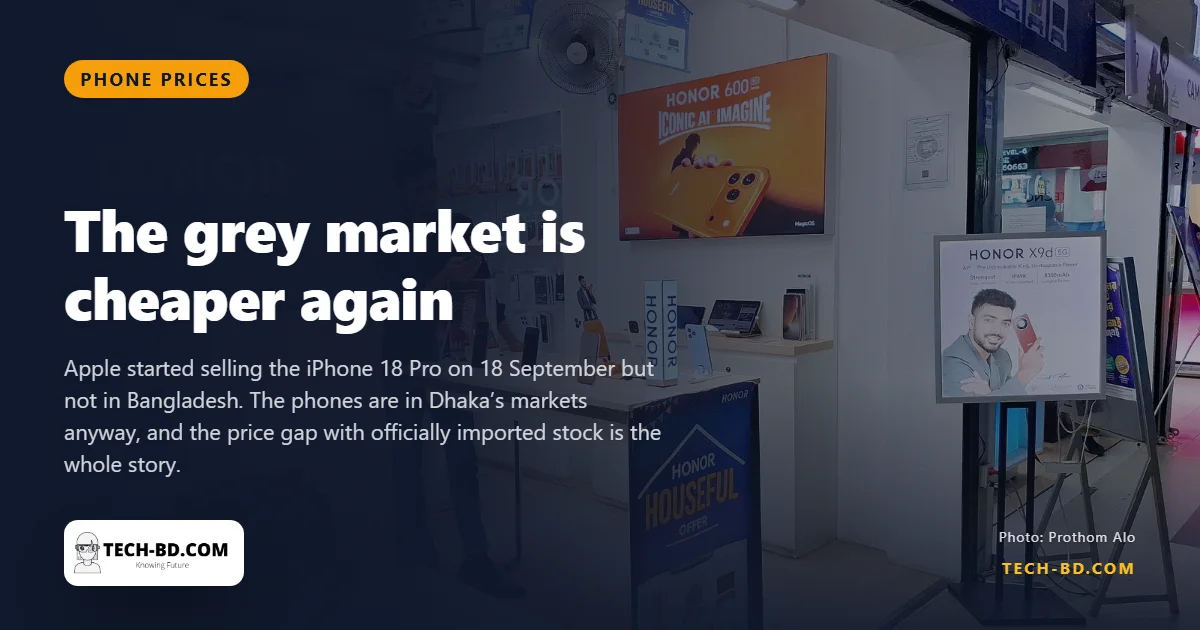
Apple began selling the iPhone 18 Pro and iPhone 18 Pro Max in several countries on 18 September. Bangladesh was not one of them. The phones are on sale in Dhaka's mobile markets regardless.
What the market is asking
Prothom Alo's survey of Dhaka's shops puts the iPhone 18 Pro at an unofficial Tk1,90,000 (6.3-inch screen, 48MP camera, 12GB RAM, A20 Pro, 256GB, 4,056mAh) and the iPhone 18 Pro Max at Tk2,12,000 (6.9-inch, 5,391mAh).
Officially imported stock sits alongside it: the iPhone 17 Pro Max at Tk2,42,999, the iPhone 17 Air at Tk1,64,999 and the iPhone 17 at Tk1,47,000.
Elsewhere in the market, Google's Pixel 11 Pro is unofficially Tk1,40,000 and the Pixel 11 Tk97,000, against an official Pixel 10 at Tk1,09,999. At the other end, Tecno's Spark 50C is officially Tk23,999 with a 6.78-inch screen, 50MP camera, Helio G81 and a 5,200mAh battery; the Camon Air is Tk44,999 with 6,000mAh.
What the Tk30,999 is actually paying for
Put the two iPhone columns side by side and the number that matters appears. A newer, unreleased phone bought outside the official channel costs Tk30,999 less than last year's top model bought inside it. That is not a smuggling anecdote; it is a measurement of what the official channel costs the buyer.
Most of that gap is tax and duty, and some of it is the structural cost of being a small market an importer must stock in advance. A grey importer carries a suitcase. An official distributor carries inventory, warranty liability, VAT and a retail network.
Which is exactly why the comparison is not as simple as it looks, and the recommendation runs against the arithmetic. What the Tk30,999 buys is a device with no Bangladeshi warranty, no service centre obligation, and no recourse if the handset fails in month three. Apple's own repair network does not recognise a phone that was never sold here, and the shop that sold it may not exist next year.
The IMEI question, and how to settle it before you pay
There is a second, less visible cost. A grey handset's IMEI may not be registered with the BTRC's device database, and the regulator has moved repeatedly — if inconsistently — towards blocking unregistered devices from the network. A phone that works today is not a phone guaranteed to connect next year.
This one is checkable, and it takes two minutes in the shop:
- Get the IMEI off the handset itself, not off the box. Dial
*#06#and the number appears on screen. A box label that does not match the dialled number is the end of the conversation. - Send it to 16002 as an SMS — type
KYD, a space, then the 15-digit IMEI — from any operator's SIM. The reply says whether the handset is in the national database. - Read the reply literally. A confirmation means the device is known to the system. Anything else, including silence, means you are buying a handset whose network access depends on a policy decision nobody has made yet.
- Get it in writing. If the shop assures you it is registered, have that written on the receipt with the IMEI. It will not help against the regulator, but it changes the conversation if you go back.
The consequence most buyers do not price in is resale. A top-end iPhone is normally sold on after two or three years, and that resale value is a real part of the purchase. An unregistered handset is harder to sell, sells for less, and gets harder to sell over time as checking becomes routine — so part of the Tk30,999 saved today is paid back at the other end, by you.
The row to read instead
The useful way to read this table is not iPhone-versus-iPhone at all. It is the bottom of it: a Tk23,999 handset with a 5,200mAh battery and a 6.78-inch screen is what the overwhelming majority of Bangladeshi buyers are actually choosing, and the official-versus-unofficial question barely touches that end of the market.
The reason is instructive. At Tk24,000 the official price and any grey price are close enough that the warranty wins outright — the duty on a budget handset is a small absolute number, so there is almost nothing for a grey importer to undercut. The gap only becomes tempting at the top of the market, where a percentage of a very large number turns into Tk30,999. The official channel is least competitive precisely where the stakes of being outside it are highest.
What Apple does with the device after you own it is in the ads-in-Settings story.