Dictionary.com has chosen maxxing as its 2026 Word of the Year. Short for maximising, the site says the term “can be used on its own or added to the end of any word to convey you’re doing something to the fullest or optimizing it as much as possible”.
The selection is made by analysing US social media trends, news stories and search data. Two years ago the choice was demure; last year it was 67.
The measurement
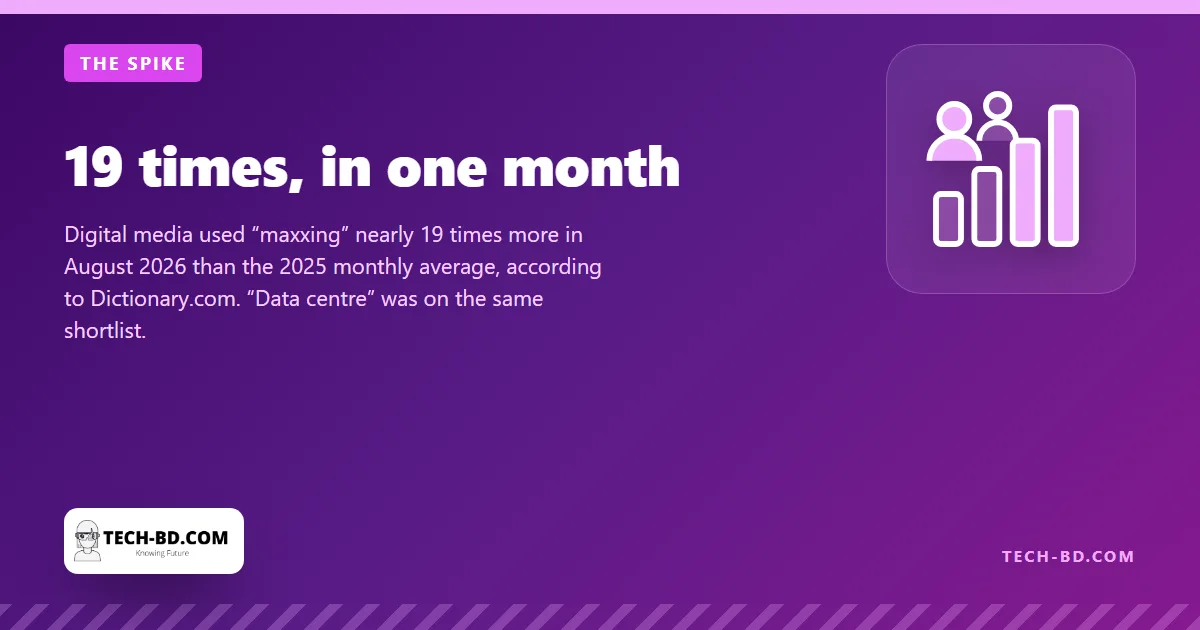
Digital media used “maxxing” nearly 19 times more in August 2026 than the 2025 monthly average. Steve Johnson, director of lexicography for the Dictionary Media Group, said: “Maxxing is the linguistic manifestation of a culture increasingly preoccupied with getting the most out of everything.”
In use it is mostly a suffix. Fitness and wellness influencers post about proteinmaxxing and fibermaxxing; people working on their sleep habits call it sleepmaxxing. The influencer Clavicular has gained thousands of followers chronicling extreme looksmaxxing — working towards a prescribed set of criteria for attractiveness, with particular weight given to jawlines, eyes and physique.
Johnson also noted the term has turned on itself: “Whatever we’re doing, we want to push it further. But its expanding uses also reveal how people are responding to that impulse. Some embrace it. Some exaggerate it for laughs. Others subvert it entirely to describe stepping back from the relentless pursuit of more.”
The shortlist is the real story
Dictionary.com also considered affordability, data centre, odyssey, and unc, the shortened form of uncle.
That list is a better summary of 2026 than the winner. A cost-of-living word, an infrastructure word, and two internet-register words — and the infrastructure one is a term that until recently nobody outside the industry used in a sentence.
“Data centre” reaching a word-of-the-year shortlist is a measurable sign that AI infrastructure has become a local political subject rather than a technical one. People use the phrase now because a building is being proposed near them. We have covered that shift repeatedly: Scotland’s 23 proposed data centres against a grid that cannot carry them, and Microsoft walking away from Britain’s largest AI data centre.
Already past its peak
The most interesting voices in the BBC’s report are the ones saying the word is finished.
“Unfortunately, by the time the dictionary gets a hold of it, that probably means that it’s reached critical mass,” said teacher Lauren Cella, a content creator known for Gen Z history lessons. She and her students have used “maxxing” as a suffix for some time. It gives them permission to “optimise to meet a goal” or do something others might find “cringe”, and own it. “They’re actually, in their own way, reinventing grammar, which I think is super cool.”
Linguist Vanessa Croft, who teaches English, said the internet and digital media make language move at “warp speed”, faster than radio, film or television ever did — and that terms fall out of favour as quickly as they arrive. “By the time millennials and Gen X or Gen Y start using the terms, Gen Z and Gen Alpha aren’t using those terms anymore.” Her secondary-school students still say it, but now “almost ironically”.
People were also playing with the word long before any of this. In the opening song of The Fresh Prince of Bel-Air in the 1990s, Will Smith raps: “Chillin’ out, maxin’, relaxin’ all cool.”
Why a dictionary does this
Worth being clear about what the award is. A word of the year chosen from social media and search data is a measurement of attention, not a judgement about language. Dictionary.com is a commercial reference publisher, and the announcement is partly a marketing exercise that works precisely because people argue about the result.
What it does usefully record is velocity: a 19-fold jump in one month is a real number about how fast a suffix can travel now. Whether anyone is still saying it in 2027 is, on the evidence of the two linguists quoted, doubtful.